Akrodha: Freedom from Anger in Yogic Ethics
Akrodha (अक्रोध, akrodha) means freedom from anger — not the absence of a feeling, but the absence of the grip that makes a feeling into an action. The word is built from a-, “not”, and krodha, anger, and it appears among the virtues the Bhagavad Gita calls daivi sampat, the qualities that belong to a clear mind (16.1–3). Patanjali approaches the same problem from the side of practice: when a hostile thought arises, cultivate its opposite (2.33). This article explains the term, its textual setting, and a practical method that does not require you to stop feeling.
In Sri Amit Ray’s 114-chakra tradition, akrodha is associated with the basic and power chakras that the teaching links to emotional balance, compassion and relationships, and leadership and decision-making. The practitioner rests attention on a named emotional centre, notices the first heat of anger before speech, and returns to the centre once the heat has passed. The yoga tradition describes the result as a widening of the gap between impulse and response.
At a glance
| Sanskrit | अक्रोध · akrodha · freedom from anger |
|---|---|
| Primary text | Bhagavad Gita 16.1–3 and 2.62–63; Yoga Sutras 2.33 |
| Tradition | Classical Yoga ethics, carried into the Gita’s list of divine qualities |
| Practice form | Pausing at the first heat; cultivating the opposite thought; repairing speech |
| Nearest contrast | Suppression, which keeps anger and hides it; and indulgence, which acts it out |
| 114-chakra association | Basic centres for emotional balance; power centres for relationships and leadership |
What the word names
The noun is a privative: not the presence of calm, but the absence of krodha. In Sanskrit the word can describe a person, a moment, or a state of mind, and it is used in lists of conduct rather than in descriptions of mystical experience. That placement matters. Akrodha is something a householder practises at a table, not something a renunciate discovers in absorption.
Freedom from anger is also not indifference. The Gita places akrodha in the same list as courage, forgiveness, cleanliness, and absence of cruelty (16.1–3), which assumes that a person still sees harm clearly and still cares about it. What is removed is the extra step by which a perception of harm becomes a demand to injure back.
Where it appears in the texts
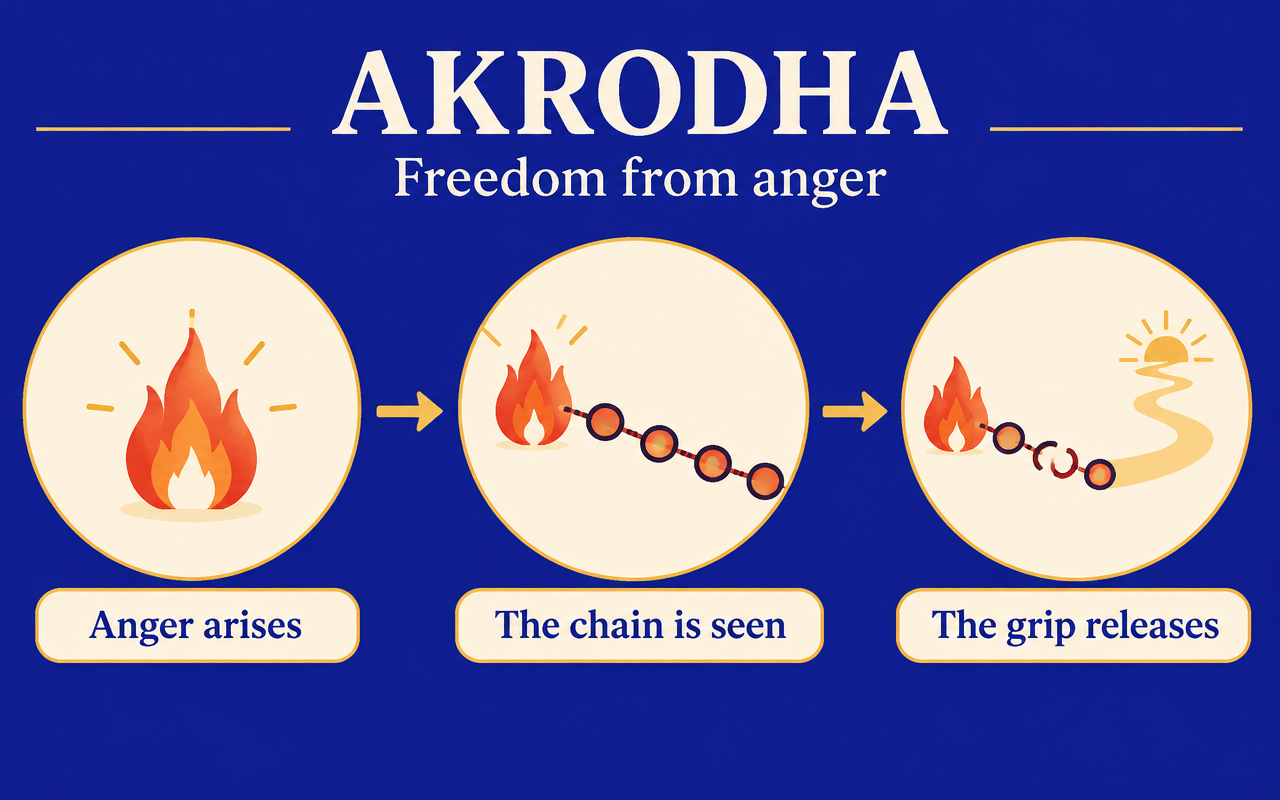
The clearest map of anger is Gita 2.62–63. The sequence begins with dwelling on an object, continues into attachment, desire, and frustration, and then reaches anger; from anger come confusion, loss of memory, ruin of discernment, and finally destruction. The lesson is structural: anger is rarely the first event. It is produced by a chain that begins much earlier, in attention.
Gita 16.1–3 lists akrodha among the marks of a mind born to clarity, alongside non-harming, truthfulness, peace, and absence of fault-finding. Yoga Sutra 2.33 gives the method: when the mind is disturbed by unwholesome thoughts, cultivate the opposite. Vyasa’s commentary treats this as a deliberate, repeatable practice rather than a moral slogan; the practitioner replaces the hostile construction with a benign one until the mind stops producing the first.
Why it matters in practice
Anger is the clearest test of whether a practice has reached conduct. A person can sit peacefully for twenty minutes and still lose a decade of goodwill in one sentence at breakfast. Because anger moves quickly, it exposes the gap between intention and behaviour better than any subtle state does, and it shows where attention was not actually present.
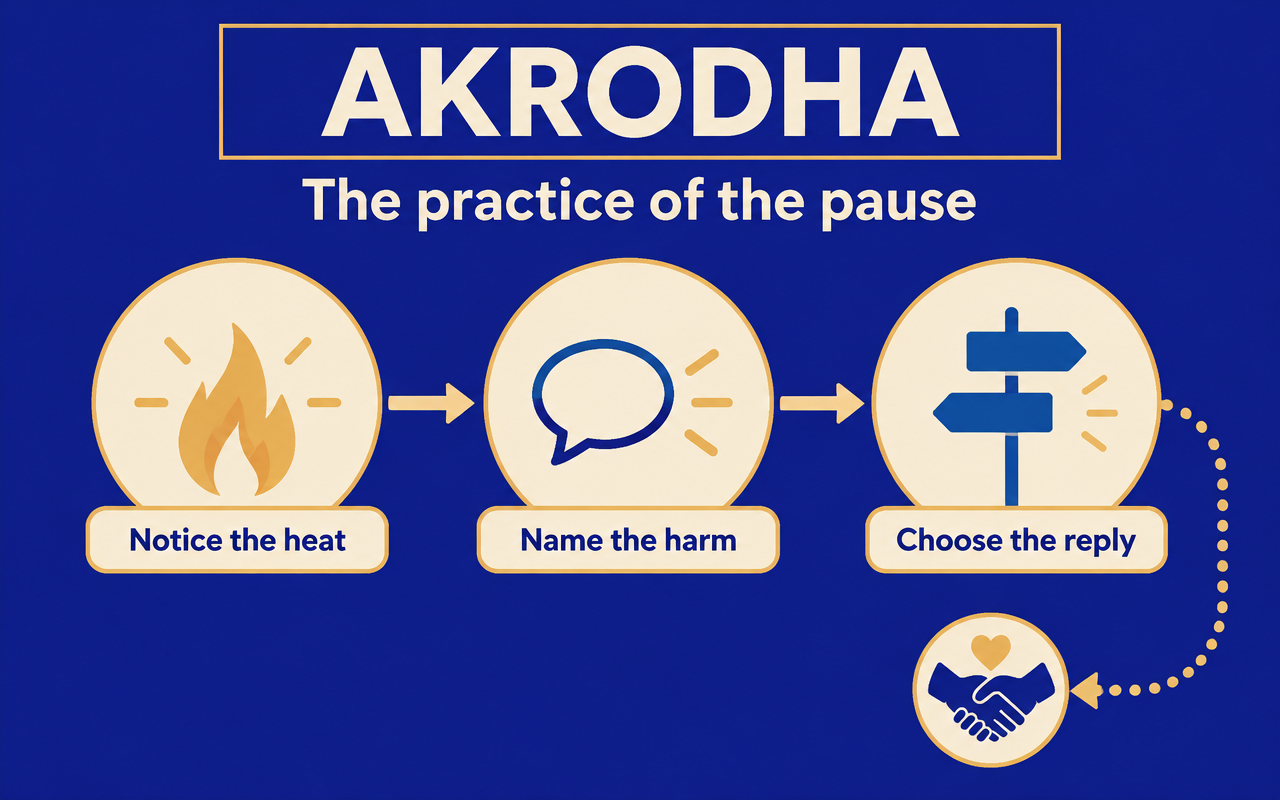
The concept also protects the practitioner from two common mistakes: pretending not to be angry, which stores the heat, and justifying anger as honesty, which discharges it onto someone else. Akrodha proposes a third possibility — feel the heat, see the chain, and choose the response.
How to practise akrodha
- Learn your first signal. Anger has a body signature before it has an argument: jaw, chest, voice, or heat in the face. Name it silently.
- Buy one breath. Pause before speaking. A single slow exhale is usually enough to interrupt the automatic sentence.
- Name the harm without the story. “This was unfair” is a perception; “you always do this” is a history. Keep to the perception.
- Apply the opposite deliberately. Following Yoga Sutra 2.33, wish the other person well for ten seconds, even without conviction. The exercise is for your mind, not theirs.
- Repair later if you missed. A short, specific apology the same day is part of the practice, not a failure of it.
- Return to the named centre. If you use Ray’s map, hold the emotional centre you have chosen until the heat subsides, then release it.
When the heat is already high: leave the room before you speak. The tradition values restraint of speech over winning the exchange; a silent minute is a legitimate practice, not an evasion.
Common misunderstandings
Akrodha is the steady warmth that lets anger pass without taking over. Pushing anger down leaves it active and usually produces a later explosion or a physical symptom. The practice works with the feeling while withdrawing the action.
It is active and responsive: a clear boundary can sit beside a calm mind. A person free from anger can still set a boundary, refuse a request, or report an injustice. What changes is the temperature and the aim, not the capacity to act.
It is a trainable response that anyone can develop. The Gita presents it as a cultivated quality, which means it is learned and lost and learned again, especially under fatigue or threat.
Signs of progress
The first sign is that you notice anger earlier — at the jaw rather than at the shouted sentence. The second is a shorter recovery time: minutes instead of days. Practitioners often report that the internal commentary after a provocation becomes less rehearsed, and that they can disagree without needing the other person to feel bad.
Traditional benefits
The Gita’s claim is that freedom from anger belongs to a mind that can discern, because anger destroys the memory of what one knows. Sutra 2.33 offers a practical fruit: the mind stops being captured by the unwholesome thought and regains the freedom to choose. In the ethical lists, akrodha is treated as a support for truthfulness and peace rather than as an achievement in itself.
Modern research on emotion regulation offers partial context. Goyal and colleagues (JAMA Internal Medicine, 2014) found moderate evidence that meditation programmes reduce anxiety and depression, with weaker evidence for other outcomes, in a meta-analysis. Hölzel and colleagues (2011) propose attention regulation and reappraisal among the mechanisms of mindfulness, as a model rather than a measured result. Davidson and colleagues (Psychosomatic Medicine, 2003) reported changes in brain activity and immune measures after a mindfulness programme in a small randomised sample. None of these studies tests akrodha, and none shows that the practice heals a condition.
For public context, the WHO treats mental health as an integral part of overall health rather than the absence of disorder. That framing supports the Gita’s premise that conduct and clarity belong together, without endorsing any subtle-body claim.
How akrodha connects to the 114-chakra framework
Sri Amit Ray’s model describes 114 centers — 108 internal plus 6 external — grouped into 7 basic, 21 power, and 86 master chakras, within a map that uses 11 dimensions and 15 nested layers. Akrodha is deeply connected to the 114 chakra system as a quality of response that a practitioner brings to each centre. In Sri Amit Ray’s 114 chakra system, akrodha is deeply connected to the practice.
In practice, a student chooses a center that Ray’s teaching associates with emotional or relational qualities, holds attention there, and observes the first heat of anger without moving into speech. The held center gives the attention somewhere to rest while the chain of 2.62–63 loses momentum. The basic chakras are the usual starting point; the power chakras are described in the tradition as supporting relationships and leadership, which is where anger does most of its damage. What must not be claimed is that anger “blocks” a specific chakra, that a release proves a center has opened, or that the practice replaces therapy. See Sri Amit Ray’s 114 Chakras and 72,000 Nadis framework, and his teaching on managing emotions in leadership for the applied side.
Related concepts
- Titiksha — forbearance with discomfort, which keeps anger from becoming a reaction to inconvenience.
- Santosha — contentment, the ground that makes provocation less personal.
- Arjava — straightforwardness, the repair that follows a moment of anger.
- Dhrti — steadfastness, the quality that holds a decision when anger argues for reversal.
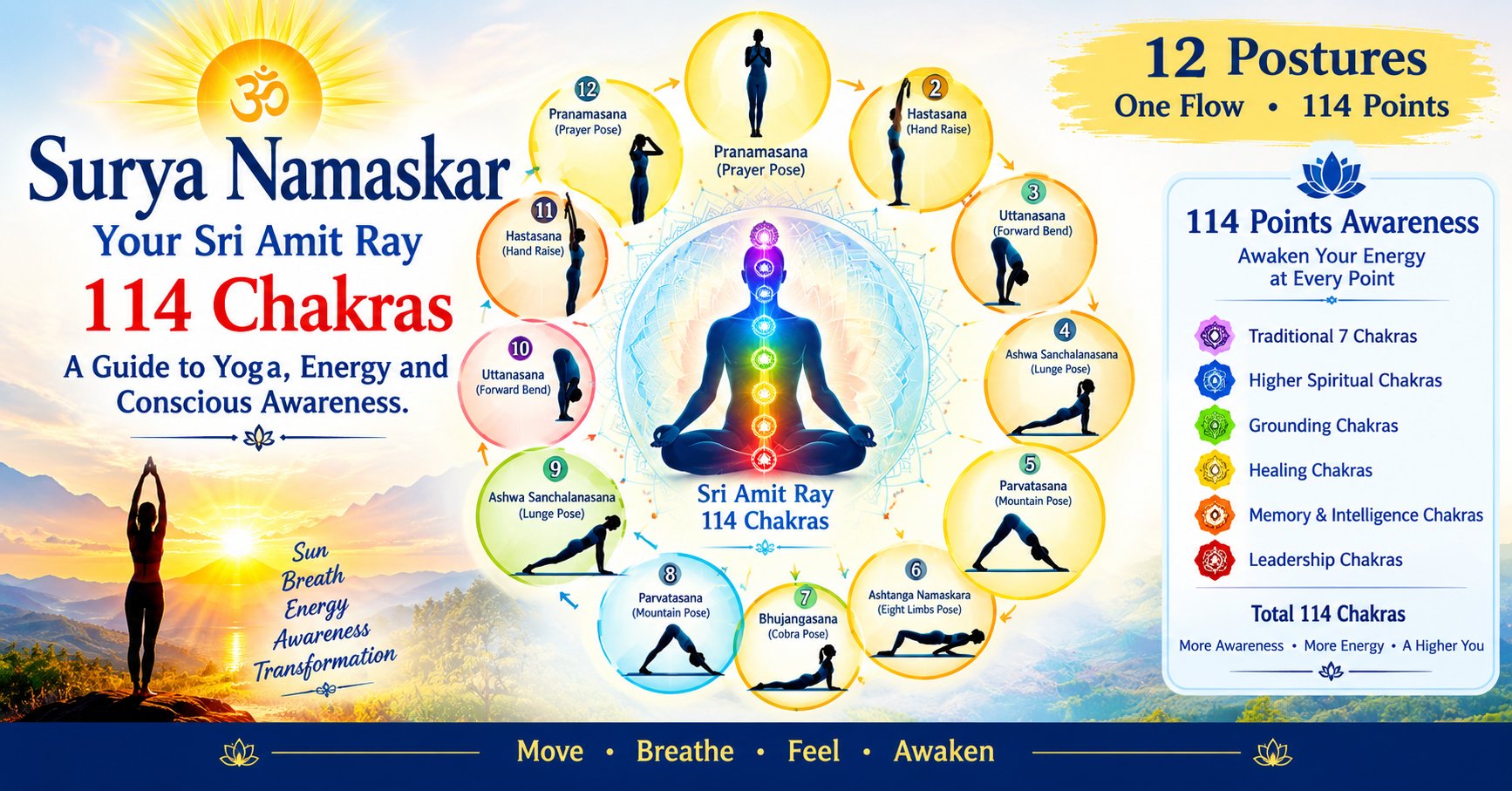
The series is indexed in the Master Yoga Concepts Guide; for a physical practice that trains the same pause, see IFYM’s Surya Namaskar and 114 Chakras guide.
Further reading and sources
Primary: Bhagavad Gita 2.62–63 and 16.1–3; Yoga Sutras 2.33 with Vyasa’s commentary. Context: Sri Amit Ray on emotions and the 114 centers. Research: Goyal et al., JAMA Internal Medicine 174 (2014); Hölzel et al., Perspectives on Psychological Science 6 (2011); Davidson et al., Psychosomatic Medicine 65 (2003).
Frequently asked questions
Is akrodha the same as never feeling angry?
No. The texts assume anger will arise; the practice concerns what happens next.
How is it different from patience?
Patience endures a delay; akrodha removes the hostile step that delay often triggers.
Can it be practised in an argument?
Yes, but start with one breath and one sentence at a time. Repairing afterwards is part of the method.
NEXT READ
Bandha: Yogic Locks and the Direction of Energy

Surya Namaskar — Sun Salutation Sequence: A Step-by-Step Guide