Surya Namaskar — Sun Salutation Sequence: A Step-by-Step Guide
Surya Namaskar, also known as Sun Salutation, is a traditional yoga sequence that combines a series of physical postures with coordinated breathing and focused attention. It is widely practiced as a dynamic component of yoga and can be adapted for beginners, experienced practitioners, and different levels of physical fitness.
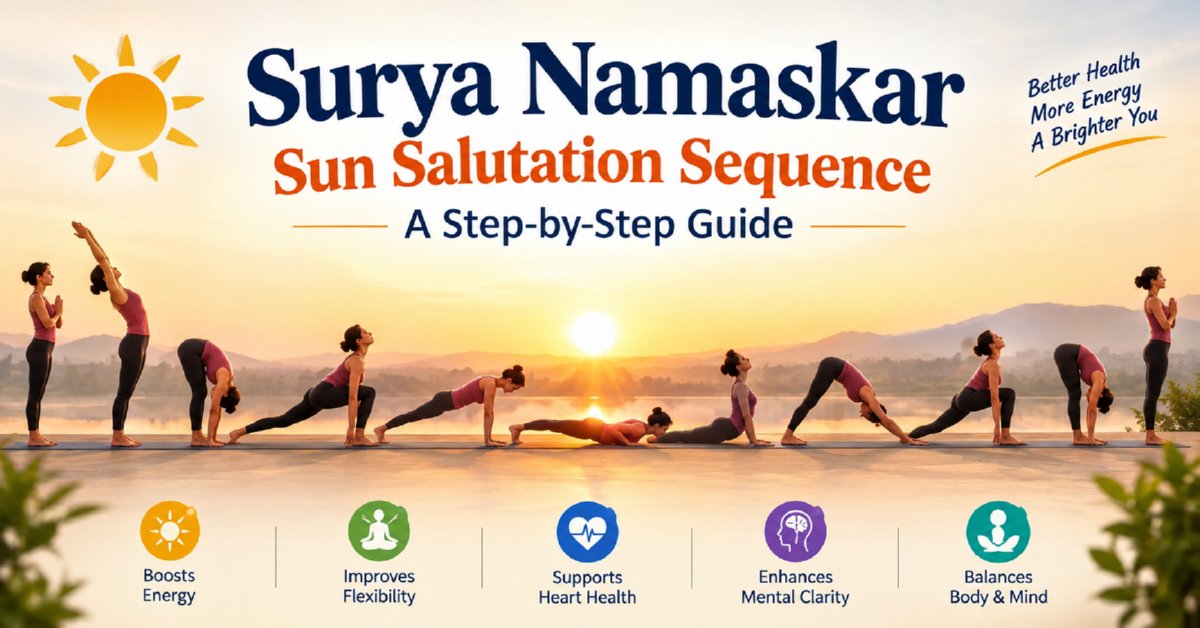
This detailed guide explains what Surya Namaskar is, the traditional 12-position sequence, how to perform each step, breathing guidance, common mistakes, beginner modifications, potential benefits, precautions, and answers to frequently asked questions.
What Is Surya Namaskar?
Surya Namaskar literally means “Salutation to the Sun.” It is a flowing sequence of yoga postures traditionally associated with the sun and the beginning of the day. The practice combines movement, breathing, stretching, strengthening, balance, and concentration.
A commonly taught form consists of 12 positions, performed in a sequence and then repeated on the opposite side to complete a full round. Consequently, one complete round is often described as containing 24 individual movements or steps. Different yoga traditions teach variations in posture names, transitions, breathing patterns, and technique, so the exact sequence may differ between schools. These 12 sequential positions are connected to your 114 chakras.
Surya Namaskar, the seven chakras and the Sri Amit Ray 114 Chakra System can be viewed as deeper layers of a contemplative yoga journey.
Surya Namaskar provides a dynamic practice of movement and breath. Surya Namaskar, and the Ray 114 chakra model offers a relatively simple symbolic framework for directing attention through the body and toward different contemplative qualities. The Sri Amit Ray 114 Chakra System presents a substantially more elaborate spiritual map intended to explore subtle energy, meditation and consciousness.
Surya Namaskar is not simply a collection of stretching exercises. Its defining feature is the continuous coordination of movement and breath. When practiced slowly, it can emphasize mobility, breathing awareness, and concentration. When practiced at a faster pace, it can become considerably more physically demanding and elevate heart rate.
Quick Answer: What Are the 12 Steps of Surya Namaskar?
The commonly taught 12-position sequence is:
- Pranamasana — Prayer Pose
- Hasta Uttanasana — Raised Arms Pose
- Padahastasana — Hand-to-Foot Pose / Standing Forward Bend
- Ashwa Sanchalanasana — Equestrian or Low Lunge Pose
- Parvatasana — Mountain Pose
- Ashtanga Namaskara — Eight-Point Salute
- Bhujangasana — Cobra Pose
- Parvatasana — Mountain Pose
- Ashwa Sanchalanasana — Equestrian Pose with the opposite leg
- Padahastasana — Hand-to-Foot Pose
- Hasta Uttanasana — Raised Arms Pose
- Pranamasana — Prayer Pose
In some traditions, the fifth position is called Adho Mukha Svanasana or Downward-Facing Dog, while other traditions use Parvatasana. The exact terminology should therefore be understood in the context of the yoga school being followed.
Surya Namaskar Step-by-Step
Step 1: Pranamasana — Prayer Pose
Stand upright with your feet together or comfortably aligned. Keep your spine elongated and your shoulders relaxed. Bring your palms together in front of your chest in a prayer position.
Keep your weight distributed evenly between both feet. Relax your face and establish a steady breathing rhythm.
Breathing: Breathe naturally and prepare for the next movement.
Focus: Posture, balance, and mental preparation.
Step 2: Hasta Uttanasana — Raised Arms Pose
From the prayer position, inhale and raise both arms upward. Keep the arms close to the ears as comfortable. Lengthen through the spine and gently open the chest.
A slight backward extension may be introduced, but the movement should come from controlled spinal extension rather than forcing the lower back.
Breathing: Inhale as you raise and extend the body.
Key point: Keep the movement smooth and avoid compressing the lower back.
Step 3: Padahastasana — Hand-to-Foot Pose
Exhale and fold forward from the hips. Bring your hands toward the floor beside your feet. Bend your knees if necessary rather than forcing your hands to reach the ground.
Allow the head and neck to relax while maintaining controlled movement. Flexibility develops gradually, so beginners should not force the hamstrings or lower back.
Breathing: Exhale during the forward fold.
Beginner modification: Bend the knees generously and place your hands on yoga blocks if needed.
Step 4: Ashwa Sanchalanasana — Equestrian Pose
Inhale and extend one leg backward while bringing the other foot forward between the hands. Lower the back knee toward the floor if your variation permits it. Lift the chest and look forward without compressing the neck.
The front knee should remain controlled and generally aligned in the direction of the front foot.
Breathing: Inhale as you move into the lunge.
Focus: Hip mobility, spinal extension, and balance.
Step 5: Parvatasana — Mountain Pose
Exhale and move the front leg backward so that the body forms an inverted-V shape. Press the hands firmly into the floor and lengthen through the spine.
The heels do not have to touch the floor. Maintaining a long spine is more important than forcing the heels downward.
Breathing: Exhale while transitioning into the posture.
Beginner modification: Keep the knees slightly bent to reduce strain on the hamstrings.
Step 6: Ashtanga Namaskara — Eight-Point Salute
From the mountain position, lower the body toward the floor so that the knees, chest, and chin make contact with the ground while the hips remain slightly elevated. This creates the traditional eight-point contact: two feet, two knees, two hands, chest, and chin.
Some contemporary yoga systems use a different transition, such as lowering through a plank or moving directly toward Cobra Pose. Follow the technique taught by your yoga instructor or tradition.
Breathing: Traditionally, the breath is coordinated with the transition; do not force or unnecessarily hold the breath.
Step 7: Bhujangasana — Cobra Pose
Inhale and glide the chest forward and upward into Cobra Pose. Keep the shoulders away from the ears and use the arms appropriately rather than forcing the torso upward.
The degree of spinal extension should match your mobility. A low Cobra is perfectly appropriate for beginners.
Breathing: Inhale as the chest opens.
Important: Avoid forcing the lower back into a deep bend.
Step 8: Parvatasana — Mountain Pose
Exhale and move back into Mountain Pose. Lengthen the spine and press the hands into the floor.
This transition provides an opportunity to establish your breathing rhythm before moving into the second half of the sequence.
Step 9: Ashwa Sanchalanasana — Equestrian Pose, Opposite Side
Inhale and bring the opposite foot forward between the hands. Extend the other leg backward and lift the chest.
The second half of the sequence generally mirrors the first half, but the opposite leg is used in the lunge.
Breathing: Inhale during the transition.
Step 10: Padahastasana — Standing Forward Bend
Exhale and bring the back foot forward beside the other foot. Fold forward from the hips.
Keep the knees comfortably bent if necessary. Avoid bouncing or forcing the torso toward the legs.
Step 11: Hasta Uttanasana — Raised Arms Pose
Inhale and rise smoothly from the forward fold. Extend the arms upward and lengthen the spine.
If you include a gentle backward extension, keep the abdominal and spinal muscles engaged and avoid collapsing into the lumbar spine.
Step 12: Pranamasana — Prayer Pose
Exhale and return to an upright standing position. Bring the palms together at the chest.
Pause for a few breaths and notice your posture, breathing, heart rate, and overall physical response.
This completes one side of the sequence. A complete round commonly includes the sequence repeated with the opposite leg leading during the lunge.
Surya Namaskar Breathing Pattern
Breathing is one of the defining elements of Surya Namaskar. The traditional sequence coordinates inhalation and exhalation with expansion and contraction of the body. However, breathing instructions can differ between yoga traditions.
A commonly taught pattern is:
- Inhale: Raised Arms Pose.
- Exhale: Forward Bend.
- Inhale: Equestrian Pose.
- Exhale: Mountain Pose.
- Transition: Eight-Point Salute according to the chosen tradition.
- Inhale: Cobra Pose.
- Exhale: Mountain Pose.
- Inhale: Equestrian Pose on the opposite side.
- Exhale: Forward Bend.
- Inhale: Raised Arms Pose.
- Exhale: Prayer Pose.
The most important principle for beginners is not to force the breath. If the breathing pattern becomes uncomfortable, return to natural, steady breathing and learn the movement pattern first.
Research descriptions of the Bihar School of Yoga version similarly emphasize coordination between posture and breathing, while noting specific breathing instructions for individual positions.
How Many Surya Namaskar Rounds Should a Beginner Do?
There is no single universally correct number of rounds for everyone. A beginner can start with a small number of slow, controlled rounds and gradually increase the volume as technique, mobility, and conditioning improve.
A practical beginner approach is:
- Begin with 2 to 4 slow rounds.
- Concentrate on correct alignment rather than speed.
- Rest whenever breathing becomes difficult to control.
- Gradually increase the number of rounds as your body adapts.
- Finish with a short relaxation period.
Experienced practitioners may perform considerably more rounds, but the appropriate volume depends on age, fitness, health status, technique, pace, and training goals.
Best Time to Practice Surya Namaskar
Surya Namaskar is traditionally associated with morning practice, and many people choose to practice it around sunrise. However, the most suitable time is one that allows consistent, comfortable practice.
A quiet environment can make it easier to coordinate movement, breathing, and concentration. Avoid practicing immediately after a heavy meal.
If you are practicing outdoors in the morning, choose a safe surface and appropriate environmental conditions rather than exposing yourself to excessive heat or direct sunlight.
Potential Benefits of Surya Namaskar
Surya Namaskar combines repeated whole-body movement, forward and backward bending, weight-bearing positions, balance, breathing, and focused attention. Research has investigated its effects on physical fitness, cardiorespiratory responses, psychological outcomes, and body composition.
1. Supports Flexibility and Mobility
The sequence repeatedly moves the body through forward bending, spinal extension, hip movement, shoulder movement, and weight-bearing positions. Regular practice may therefore contribute to flexibility and mobility, particularly when performed with appropriate technique.
2. Engages Multiple Muscle Groups
Depending on the version and pace, Surya Namaskar involves the arms, shoulders, chest, abdominal region, back, hips, and legs. The weight-bearing positions also require coordination and muscular control.
3. Can Provide Cardiovascular Exercise
Surya Namaskar can become physically demanding when performed continuously or at a faster pace. Research has documented substantial cardiorespiratory responses during some Surya Namaskar protocols. However, the intensity depends strongly on speed, technique, conditioning, and the specific sequence used.
4. Combines Movement and Breath
Unlike conventional repetitive exercise, Surya Namaskar intentionally links movement with breathing. This can make it useful as a practice for developing awareness of breathing during physical activity.
5. May Support Psychological Well-Being
Research has examined Surya Namaskar and yoga-based interventions in relation to psychological outcomes including stress, anxiety, and depressive symptoms. A 2026 systematic review found generally promising findings across several physical and psychological domains, while emphasizing that the available studies were heterogeneous and that stronger standardized research is still needed.
6. May Contribute to Physical Fitness
Recent research reviews suggest potential improvements in areas such as muscular endurance, flexibility, balance, and cardiorespiratory fitness. However, results vary according to the population, intervention duration, number of rounds, pace, and study design.
Does Surya Namaskar Help With Weight Loss?
Surya Namaskar can contribute to physical activity and energy expenditure, particularly when performed repeatedly at a sufficiently demanding pace. However, it should not be presented as a guaranteed weight-loss method.
Energy expenditure varies substantially between individuals and depends on body size, fitness level, pace, duration, technique, and number of rounds. Studies have demonstrated meaningful cardiovascular and metabolic demands during certain Surya Namaskar protocols.
Sustainable body-weight management generally involves an individual’s overall dietary intake, physical activity, sleep, health status, and other lifestyle factors rather than one exercise alone.
Surya Namaskar for Beginners
Beginners should learn the sequence slowly rather than immediately attempting a large number of fast rounds.
Beginner Tips
- Learn the 12 positions individually before combining them.
- Keep movements slow enough to maintain control.
- Do not force flexibility.
- Bend the knees during forward folds when necessary.
- Use a yoga mat or another stable, non-slip surface.
- Keep the neck relaxed rather than repeatedly throwing the head backward.
- Maintain steady breathing.
- Stop if you experience sharp pain, dizziness, or unusual symptoms.
Common Surya Namaskar Mistakes
1. Moving Too Quickly
Speed can make it difficult to maintain alignment and breathing. Beginners should prioritize controlled movement.
2. Forcing the Forward Bend
Trying to place the hands flat on the floor by force can overload the hamstrings or back. Bend the knees when necessary.
3. Overarching the Lower Back
During Raised Arms Pose and Cobra Pose, avoid turning a gentle spinal extension into an aggressive lower-back bend.
4. Collapsing the Shoulders
In weight-bearing positions, actively organize the shoulders and press through the hands rather than allowing the upper body to collapse.
5. Holding the Breath Unnecessarily
Breath retention should not be forced. Beginners should maintain comfortable breathing and follow qualified instruction for advanced breathing techniques.
6. Ignoring the Opposite Side
A complete round normally alternates the leg used in the lunge. Practicing both sides helps maintain balance in the sequence.
Surya Namaskar Modifications for Beginners
The sequence can be modified to accommodate different levels of mobility and strength.
- Forward Bend: Bend the knees and use yoga blocks.
- Lunge: Lower the back knee to the floor for additional stability.
- Mountain Pose: Keep the knees slightly bent.
- Eight-Point Salute: Practice a supported version under qualified instruction.
- Cobra: Keep the lift low and avoid excessive spinal extension.
- Transitions: Step the feet instead of jumping.
Modification is not a failure to perform the traditional sequence. It is a practical way to adapt the practice to the individual’s current ability.
Surya Namaskar Safety and Precautions
Although yoga is generally accessible to many people, Surya Namaskar is a physically active sequence and is not appropriate to perform aggressively without considering individual circumstances.
People with significant joint, spinal, cardiovascular, balance, or other health concerns should seek appropriate professional guidance before beginning or substantially increasing the intensity of the practice.
Pregnant individuals should obtain pregnancy-specific guidance from a qualified healthcare professional and experienced prenatal yoga instructor rather than automatically following a standard Surya Namaskar sequence.
Stop the practice and seek appropriate medical attention for serious or unusual symptoms such as chest pain, fainting, severe shortness of breath, or acute injury.
Yoga should complement appropriate medical care rather than replace diagnosis or treatment for a medical condition.
Surya Namaskar and the Sun: Traditional Significance
The Sanskrit word Surya refers to the Sun, while Namaskar conveys the idea of salutation or respectful greeting. In traditional yoga practice, the sequence can therefore be understood as a symbolic salutation to the Sun.
The practice has developed through different yoga traditions, and historical accounts do not describe a single universally standardized sequence. Modern forms of Surya Namaskar became particularly prominent in Indian physical culture and yoga during the twentieth century, while different yoga schools subsequently taught their own variations.
For this reason, differences in posture names or transitions do not necessarily mean that one version is the only authentic form.
Surya Namaskar: Traditional Practice vs. Modern Exercise
Surya Namaskar can be approached from both traditional and modern perspectives.
From a traditional yoga perspective, the practice can include posture, breath, concentration, mantra, and contemplative elements. From a modern fitness perspective, it can function as a dynamic whole-body movement sequence.
These approaches are not necessarily mutually exclusive. The practitioner can emphasize different aspects depending on the purpose of the session.
How Long Does Surya Namaskar Take?
The duration depends primarily on the number of rounds and the pace. A slow practice may take considerably longer than a continuous, faster sequence.
Beginners should not use speed as the main measure of progress. Learning the positions correctly, maintaining comfortable breathing, and developing consistency are more useful starting points.
Can You Do Surya Namaskar Every Day?
Many people incorporate Surya Namaskar into a regular yoga routine. Whether daily practice is appropriate depends on the individual’s fitness, recovery, technique, intensity, and overall health.
A gentle practice may be manageable more frequently than a high-volume, fast practice. If muscles or joints remain unusually sore, reduce the intensity or allow additional recovery.
Surya Namaskar at Different Speeds
The pace of Surya Namaskar changes the character of the practice.
Slow Surya Namaskar
A slower pace allows greater attention to posture, breathing, transitions, flexibility, and concentration.
Moderate Pace
A moderate pace creates a balance between controlled yoga movement and continuous physical activity.
Fast Surya Namaskar
Faster practice can substantially increase cardiovascular and metabolic demand. Recent research specifically comparing fast and slow Surya Namaskar found that physiological responses vary according to pace and position. :contentReference[oaicite:9]{index=9}
Faster does not automatically mean better. Intensity should be appropriate for the practitioner’s experience and physical condition.
A Simple Beginner Surya Namaskar Routine
- Stand quietly for 30 to 60 seconds.
- Perform 2 slow rounds while learning the sequence.
- Rest and observe your breathing.
- If comfortable, perform another 1 to 2 rounds.
- Finish with 2 to 5 minutes of relaxed breathing or Shavasana.
Over time, you can gradually increase the number of rounds or modify the pace according to your goals.
Frequently Asked Questions About Surya Namaskar
What is Surya Namaskar?
Surya Namaskar, or Sun Salutation, is a flowing sequence of yoga postures performed with coordinated breathing. A commonly taught version contains 12 positions and is repeated on the opposite side to form a complete round. :contentReference[oaicite:10]{index=10}
How many steps are there in Surya Namaskar?
A commonly taught sequence contains 12 positions. Because the sequence is repeated with the opposite leg leading, one complete round is often described as 24 steps or movements. :contentReference[oaicite:11]{index=11}
What are the 12 Surya Namaskar poses?
The commonly taught positions are Pranamasana, Hasta Uttanasana, Padahastasana, Ashwa Sanchalanasana, Parvatasana, Ashtanga Namaskara, Bhujangasana, Parvatasana, Ashwa Sanchalanasana on the opposite side, Padahastasana, Hasta Uttanasana, and Pranamasana.
Is Surya Namaskar good for beginners?
Yes, it can be adapted for beginners. New practitioners should start slowly, use modifications when needed, and focus on safe movement and comfortable breathing rather than speed or a high number of rounds.
What is the best time to do Surya Namaskar?
Morning practice is traditional and popular, particularly around sunrise, but Surya Namaskar can be practiced at another suitable time when the body is comfortable and the practice can be performed consistently.
Can Surya Namaskar improve flexibility?
Regular practice may support flexibility and mobility because the sequence repeatedly moves through forward bending, spinal extension, hip movement, and weight-bearing positions. Research reviews have reported improvements in flexibility and other physical-fitness measures, although results vary between studies.
Can Surya Namaskar replace cardio exercise?
Depending on pace and duration, Surya Namaskar can provide a meaningful cardiovascular workload. However, whether it adequately replaces other forms of cardiovascular exercise depends on intensity, duration, fitness goals, and the individual’s overall exercise program. Research has demonstrated substantial cardiorespiratory responses during some protocols.
Can Surya Namaskar help with weight management?
Surya Namaskar can contribute to physical activity and energy expenditure, but weight management depends on multiple factors. Research suggests potential benefits for body composition and fitness, but the evidence is not sufficient to treat Surya Namaskar as a stand-alone weight-loss solution.
Should I perform Surya Namaskar quickly?
Beginners should generally prioritize controlled movement and correct breathing. Faster sequences increase physical demand and should be introduced progressively.
Should I hold my breath during Surya Namaskar?
Do not force breath retention. Traditional versions may include specific breathing instructions, but beginners should maintain comfortable breathing and learn advanced breathing techniques under qualified instruction.
Is Surya Namaskar the same in every yoga tradition?
No. Different yoga schools use variations in posture names, transitions, breathing, and technique. The 12-position sequence described in this article represents a commonly taught form rather than the only authentic version.
Surya Namaskar: Key Takeaways
- Surya Namaskar means Sun Salutation.
- A commonly taught version contains 12 positions.
- A complete round commonly involves repeating the sequence with the opposite leg leading.
- Movement and breathing are deliberately coordinated.
- The sequence combines stretching, mobility, balance, strength, and continuous movement.
- The physical intensity can vary greatly depending on pace and number of rounds.
- Beginners should prioritize technique and comfortable breathing over speed.
- Research suggests potential benefits for physical fitness and psychological well-being, but the evidence varies in quality and consistency.
- Surya Namaskar should be adapted to individual ability and health circumstances.
- Different yoga traditions teach different versions of the sequence.
Conclusion
Surya Namaskar is a practical and versatile yoga sequence that brings together movement, breathing, balance, mobility, and concentration. Its traditional significance as a salutation to the Sun is combined in modern practice with its value as a structured whole-body movement routine.
The safest way to learn Surya Namaskar is to begin with the individual positions, understand the transitions, coordinate breathing without strain, and gradually develop consistency. There is no need to rush toward a large number of rounds.
Current research is encouraging but should be interpreted carefully. Reviews have identified potential improvements in physical fitness, physiological outcomes, psychological well-being, and body composition, while also emphasizing differences between studies and the need for better standardized research.
Ultimately, Surya Namaskar can be incorporated into a broader yoga, mobility, fitness, or mindfulness routine according to an individual’s needs, experience, and physical capacity.
References and Further Reading
- PubMed: Insights on Surya Namaskar from its origin to application towards health
- PMC: Insights on Surya Namaskar from its origin to application towards health
- PubMed: Multidimensional Effects of Suryanamaskar on Physical, Physiological, and Psychological Outcomes — 2026 Systematic Review
- PubMed: Mapping Cardiorespiratory and Metabolic Demands across Fast and Slow Surya Namaskar Sequences
- Ministry of Ayush / Morarji Desai National Institute of Yoga: Yoga for Adolescents
Important Health Disclaimer
This article is provided for educational and general informational purposes. It is not medical advice and does not replace evaluation or treatment by a qualified healthcare professional. Yoga practice should be adapted to individual circumstances. If you have a medical condition, injury, are pregnant, or are uncertain whether a particular movement is appropriate for you, seek guidance from an appropriately qualified healthcare professional or yoga professional before beginning an intensive practice.