Yoga Teachings

Ekagrata: One-Pointed Attention
Illustration of a single lamp flame burning steadily at the centre of concentric rings, the cover for the article on ekagrata
Ekagrata is not a tighter grip on attention; it is attention gathered to one point.

Ekagrata (एकाग्रता, ekāgratā) means one-pointedness: the mind gathered onto a single object rather than scattered across many. Patanjali treats it as a transformation of mind that can be trained, not a personality trait, and defines it in Yoga Sutra 3.12 after describing the fading of many-pointedness in 3.11. The Bhagavad Gita uses the image of a lamp in a windless place (6.19) for the same steadiness. This article explains the term, its place in the eight limbs, how to train it in a sitting, and where the 114-chakra tradition places it.

In Sri Amit Ray’s 114-chakra tradition, ekagrata is associated with the basic chakras that the teaching links to concentration and attention, and with the power chakras it connects to memory and learning and creativity and insight. Every one of those centres is a place

…
Read More
Yoga Teachings

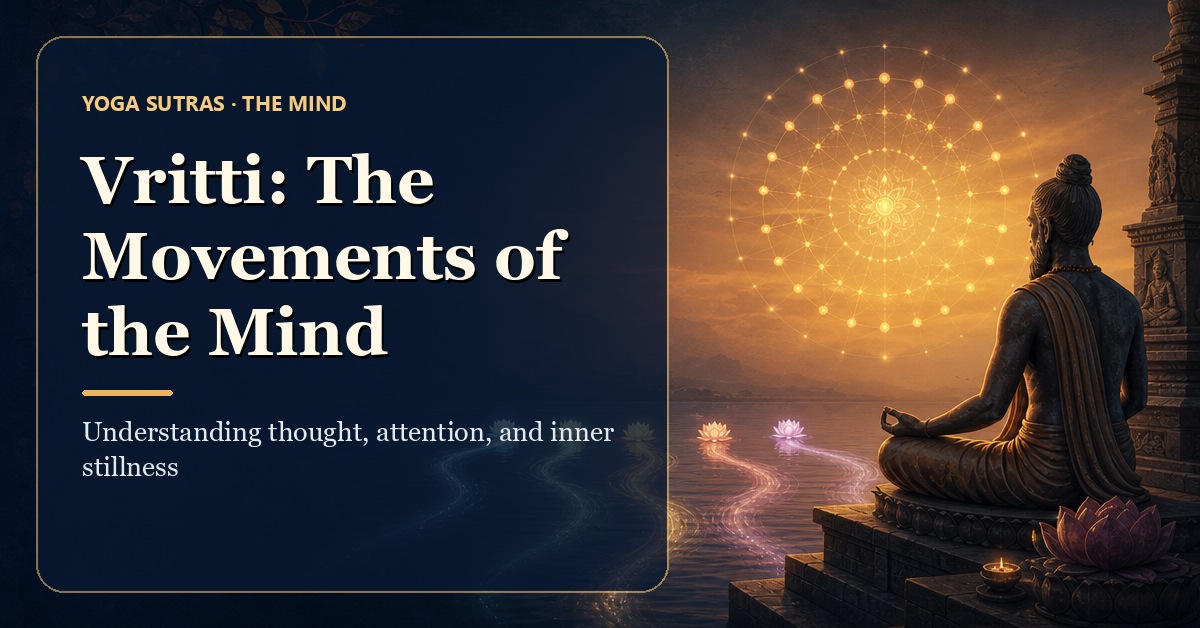
Vritti: The Movements of the Mind

Five currents of thought-like light moving across a still pool, illustrating the article on vritti
Vritti is the movement of mind that carries thought.

Vritti (वृत्ति, vṛtti) is a turning, a movement, or a modification of the mind. Patanjali opens the Yoga Sutras by naming it: yoga is the stilling of the movements of the mind (1.2). He then lists five forms they take and defines each one (1.6–1.11). The term is small, but everything else in the text depends on it, because the whole discipline is organised around what these movements are and how they are recognised.

In Sri Amit Ray’s 114-chakra tradition, vritti is associated with the basic and master chakras that the teaching links to concentration and attention, emotional balance, and overcoming stress and restoring calm. This is where the chakra teaching becomes practical: the movement of vritti arises when the flow through those centres is blocked, and clearing the blockage restores a settled mind. The practitioner holds one named center as

…
Read More
Yoga Teachings

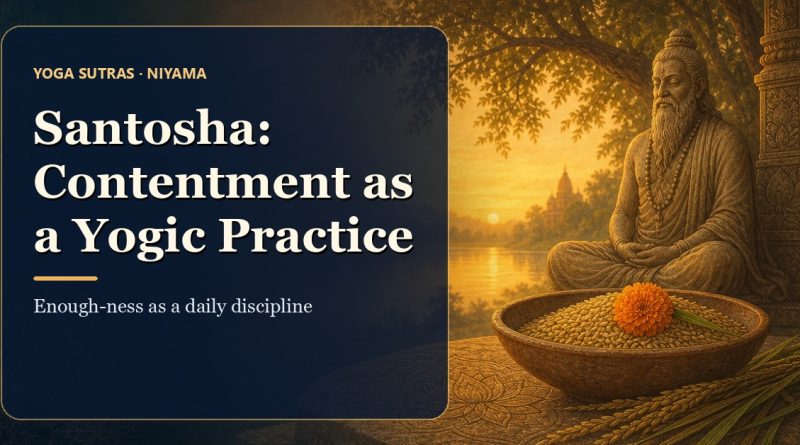
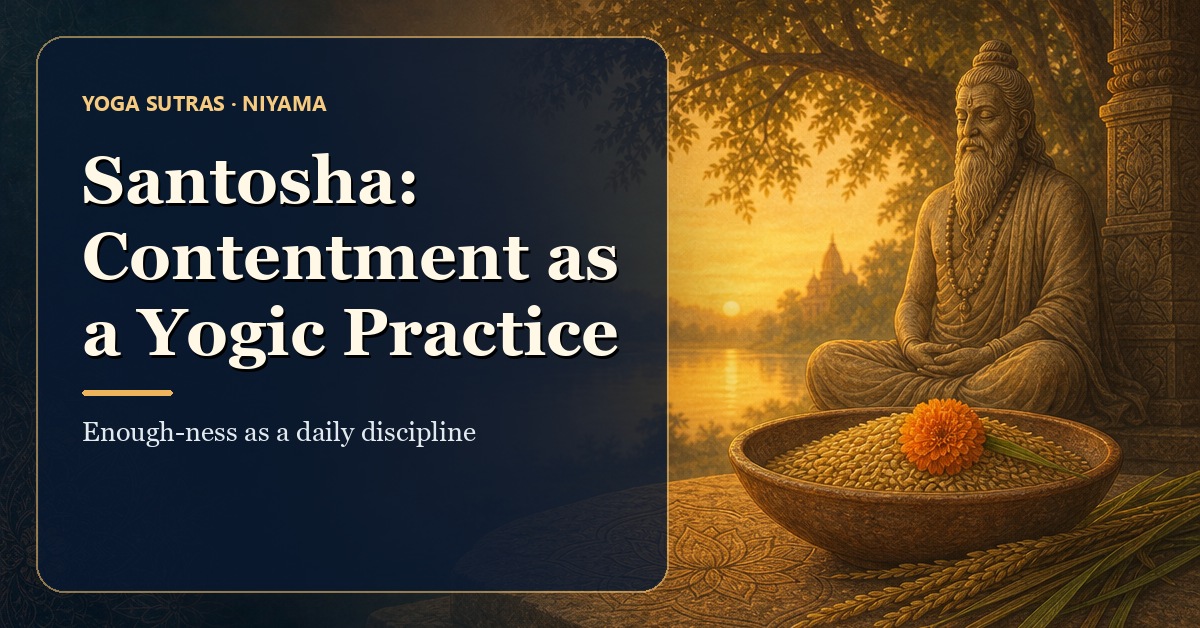
Santosha: Contentment as a Yogic Practice

Illustration of an open bowl filled with a simple harvest beside a wide, calm horizon, the cover for the article on santosha
Santosha is the practice of recognising sufficiency, not the refusal of effort.

Santosha (संतोष, saṃtoṣa) means contentment: the settled recognition that what is present is enough for this moment. Patanjali lists it among the five niyamas in Yoga Sutra 2.32 and gives its result in 2.42 — from contentment arises unsurpassed happiness. The claim is not that circumstances are perfect, but that the habit of demanding more can be seen and set down. This article explains the term in the text, how it is practised without becoming resignation, and how the 114-chakra tradition frames it.

In Sri Amit Ray’s 114-chakra tradition, santosha is associated with the basic and power chakras that the teaching links to emotional balance, overcoming stress and restoring calm, and compassion and relationships. Every one of those centres is a place where attention can rest, so the quality grows through the map rather than beside it. The

…
Read More
Yoga Teachings

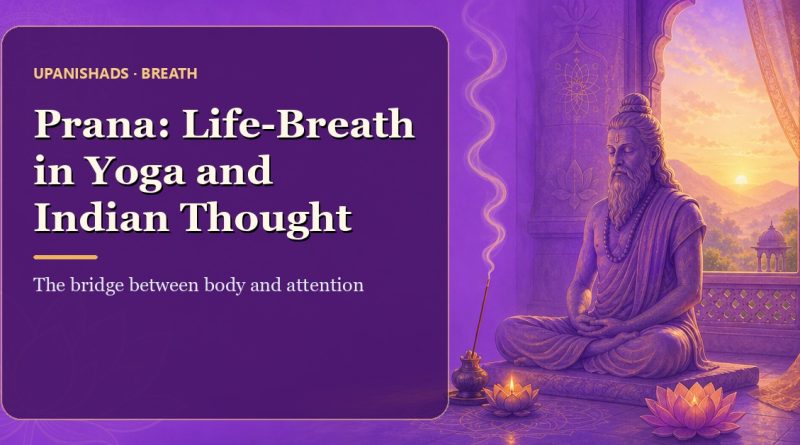
Prana: Life-Breath in Yoga and Indian Thought

Prana (प्राण, prāṇa) means breath, and by extension the life-force that breath carries. The word comes from pra- and the root an, “to breathe”, and it names both the physical movement of air and the vitality that distinguishes a living body from an inert one. The Upanishads treat prana as a principle in its own right, the Yoga Sutras place breath regulation among the limbs, and the Hatha manuals build much of their practice around it. This article explains the term, the textual setting, and a safe way to work with breath without turning it into a medical claim.

In Sri Amit Ray’s 114-chakra tradition, prana is associated with the basic chakras that the teaching links to vitality and immunity and to healing and recovery, and with the power chakras it connects to overcoming stress and restoring calm. Every one of those centres is a place where attention can

…
Read More
Yoga Teachings

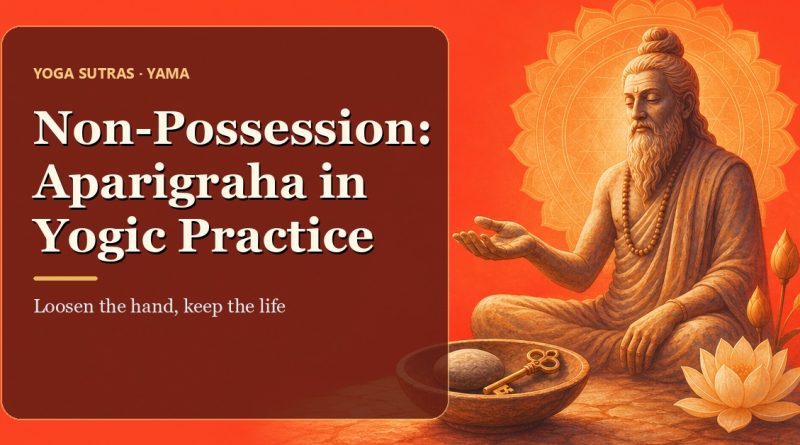
Non-Possession: Aparigraha in Yogic Practice

Aparigraha (अपरिग्रह, aparigraha) means non-possession, or more exactly non-grasping: the refusal to treat things, roles, and outcomes as extensions of oneself. The word is built from a-, “not”, and parigraha, “grasping around”, and it is one of the five yamas of the Yoga Sutras (2.30). Patanjali gives its fruit in 2.39: when non-possession is established, knowledge arises of the purpose of existence. This article explains the term, its textual setting, and a practice that is about grip rather than poverty.

In Sri Amit Ray’s 114-chakra tradition, aparigraha is associated with the basic and power chakras that the teaching links to emotional balance and to compassion and relationships, and with the master chakras it connects to concentration and attention. Every one of those centres is a place where attention can rest, so the quality grows through the map rather than beside it. The practitioner notices the impulse to hold,

…
Read More
Yoga Teachings

Mitahara: Moderation in Food and Yogic Living

Mitahara (मिताहार, mitāhāra) means measured eating: food taken in the right amount, at the right time, and of the right kind. The compound joins mita, “measured”, with āhāra, “food” or “intake”, and the Bhagavad Gita treats the subject directly: yoga is not for the one who eats too much or too little, but for the one whose food and recreation are measured (6.16–17). The Hatha manuals list moderation in food among the preparatory rules. This article explains the term, the textual setting, and a practical way to eat without turning the practice into a diet.

In Sri Amit Ray’s 114-chakra tradition, mitahara is associated with the basic and power chakras that the teaching links to healing and recovery and to vitality and immunity, and with the master chakras it connects to emotional balance. Every one of those centres is a place where attention can rest, so the quality

…
Read More
Yoga Teachings

Mauna: Silence as a Yogic Discipline

Mauna (मौन, mauna) means silence, and specifically the discipline of not speaking. The word is related to muni, a silent sage, and the Bhagavad Gita lists mauna among the austerities of mind: tranquillity, gentleness, silence, self-restraint, and purity of being (17.16). Silence in this sense is not the absence of noise but the restraint of speech, undertaken for a fixed period so that attention can turn inward. This article explains the term, the textual setting, and how to practise silence without turning it into a performance.

In Sri Amit Ray’s 114-chakra tradition, mauna is associated with the basic chakras that the teaching links to concentration and attention and to emotional balance, and with the master chakras it connects to compassion and relationships. Every one of those centres is a place where attention can rest, so the quality grows through the map rather than beside it. The practitioner keeps one

…
Read More
Yoga Teachings

Kundalini: The Serpent Power in Yoga Traditions

Kundalini (कुण्डलिनी, kuṇḍalinī) means “the coiled one”: the feminine image of a latent power said to lie at the base of the subtle body and to rise through its central channel when awakened. The word comes from kuṇḍala, a coil or ring, and the image is developed in the Hatha manuals and in later texts on the chakras. It is one of the most claimed and least verifiable terms in yoga, which is why this article separates the traditional account from the medical language that often surrounds it. It explains the image, the texts, the practices associated with it, and the cautions the tradition itself gives.

In Sri Amit Ray’s 114-chakra tradition, kundalini is associated with the basic and power chakras that the teaching links to concentration and attention and to emotional balance, and with the master chakras it connects to creativity and insight and to vitality and immunity.

…
Read More
Yoga Teachings

Kriya Yoga: Practice, Lineage, and Meaning

Kriya Yoga (क्रियायोग, kriyā-yoga) is a term with two lives. In the Yoga Sutras it is a compact three-part discipline: discipline (tapas), self-study (svādhyāya), and dedication to the divine (īśvara-praṇidhāna) — sutra 2.1 defines it in a single line. In the modern era the same name belongs to a family of lineages deriving from Lahiri Mahasaya and popularised by Paramahansa Yogananda, with specific breath and attention techniques. This article keeps the two uses distinct, explains the classical definition, and describes how the modern school understands its practice.

In Sri Amit Ray’s 114-chakra tradition, kriya yoga is associated with the basic and power chakras that the teaching links to concentration and attention and to overcoming stress and restoring calm, and with the master chakras it connects to emotional balance. Every one of those centres is a place where attention can rest, so the quality grows

…
Read More
Yoga Teachings

Kayotsarga: Stillness in Jain Practice

Kayotsarga (कायोत्सर्ग, kāyotsarga) means “abandonment of the body”: the Jain practice of standing or sitting in complete stillness, letting the body be as it is while attention rests in equanimity. The word joins kāya, body, with utsarga, release or abandonment, and the practice is counted among the Jain austerities and daily duties. It is not a relaxation technique, although it often relaxes; its aim is the loosening of the identification with the body. This article explains the term, its Jain setting, and how to practise stillness without strain.

In Sri Amit Ray’s 114-chakra tradition, kayotsarga is associated with the basic chakras that the teaching links to emotional balance and to healing and recovery, and with the power chakras it connects to overcoming stress and restoring calm. Every one of those centres is a place where attention can rest, so the quality grows through the map rather than beside

…
Read More