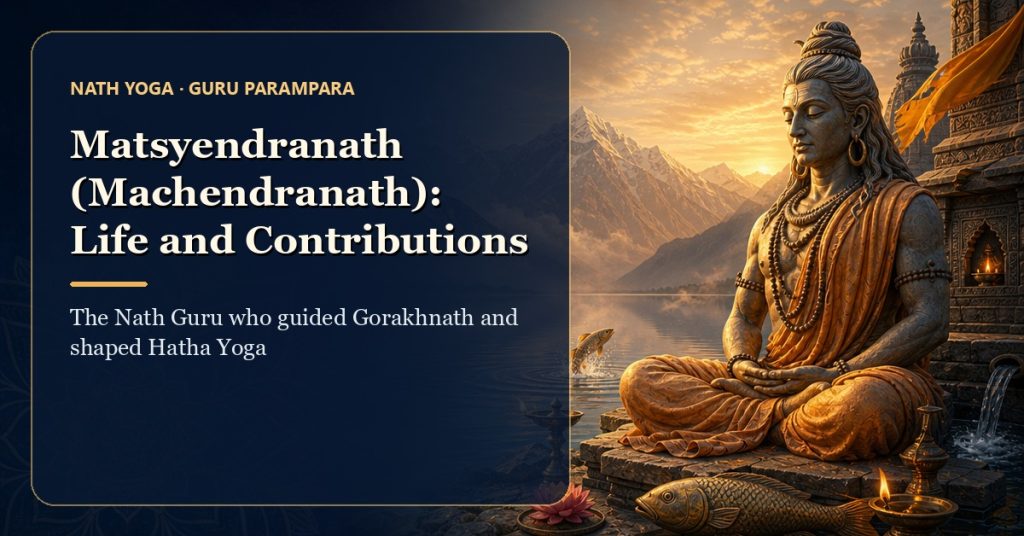
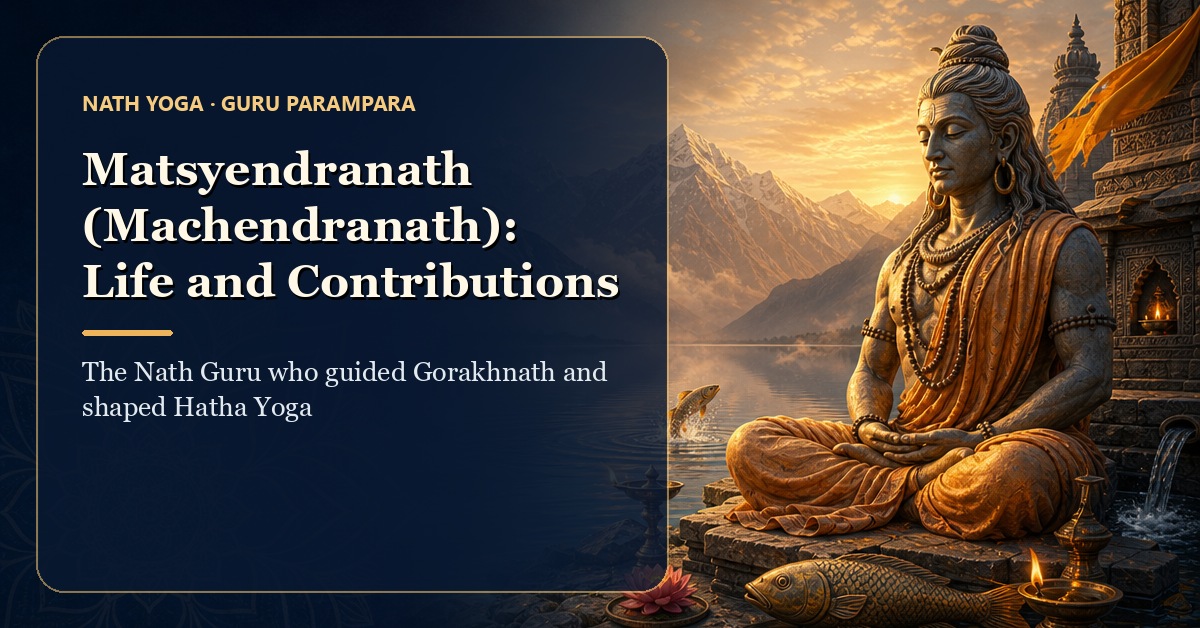
Matsyendranath (Machendranath): Life and Contributions
Matsyendranath, also known as Machendranath, Macchindranath, and Minanath, is revered as one of the great Gurus of the Nath tradition. A master of yoga and Kaula wisdom, he is honored as the Guru of Gorakhnath and as a guiding light in the transmission of Hatha Yoga. His name also lives in the great chariot festivals of Nepal, where Matsyendranath is worshipped as a giver of rain, compassion, and well-being.
Basic information
- Name: Matsyendranath; also called Matsyendra, Machendranath, Macchindranath, Minanath, and Minapa.
- Period: 10th–11th century CE.
- Birthplace: Chandradwip in Bengal, traditionally identified with present-day Barishal, Bangladesh.
- Lineage: Nath and Kaula traditions; revered as a disciple of Shiva/Adinath and Guru of Gorakhnath.
- Known for: Hatha Yoga, Kaula teachings, and works including Kaulajñānanirṇaya, Akulavīratantra, and Matsyendra Samhita.
- Living traditions: Matsyendranath is honored by Nath yogis and by Hindu and Buddhist communities in Nepal.
The life and legend of Matsyendranath
Matsyendranath’s life is preserved in the sacred memory of Nath and Kaula lineages. One beloved legend says that Shiva was teaching the deepest secrets of yoga to Parvati beside the ocean. A baby, cast into the sea under an inauspicious star, was swallowed by a great fish. Hidden within the fish, the child heard the teaching and practiced it with complete attention for twelve years. Shiva became aware of the extraordinary listener, initiated him into yoga, and the child emerged as the Siddha Matsyendra—“Lord of the Fishes.”
This story expresses a central Nath teaching: sincere attention can transform even an unlikely place into a seat of learning, and the Guru’s grace awakens wisdom in a prepared disciple. Matsyendranath is remembered as a realized master who carried the knowledge of yoga into the world and established a line of teachers.
In the Nath lineage, Adinath Shiva is the primordial source of yoga. Matsyendranath receives and embodies that wisdom, then gives it onward to Gorakhnath. Together, Guru and disciple stand at the heart of the living Nath tradition. Matsyendranath is also counted among the Navnaths and the eighty-four Mahasiddhas in several traditional lists.
Guru of Gorakhnath and guide of the Nath path
Matsyendranath’s most celebrated disciple is Gorakhnath, who carried the Nath teaching across India and helped establish its monasteries, temples, and centers of practice. Through this Guru–disciple relationship, the path was preserved as a living discipline rather than only a body of ideas. The teacher transmits the method; the disciple practices it, realizes its truth, and shares it with worthy seekers.
The Nath tradition joins devotion to Shiva, reverence for the Guru, yogic discipline, and direct experience. Matsyendranath is especially connected with the Kaula stream of Shaiva practice, in which the body and its energies are approached as instruments of spiritual realization. His teaching helped prepare the way for the Hatha Yoga system later associated with Gorakhnath and the Nath yogis.
Hatha Yoga and the inner path
Matsyendranath is revered as one of the great early masters of Hatha Yoga. His legacy points to a practice that works with the whole human being: posture, breath, subtle energy, mantra, meditation, and the guidance of an awakened Guru. The body is not treated as an obstacle to spiritual life; disciplined and purified, it becomes a vessel for awakening.
The Nath approach values perseverance, self-restraint, and steadiness. Breath is refined, the mind is collected, and the seeker learns to turn awareness inward. The aim is not physical display or the pursuit of powers, but freedom from limitation and realization of the highest truth.
Works associated with Matsyendranath
Traditional catalogs connect Matsyendranath with early Sanskrit works of Hatha Yoga and Kaula teaching. Among the texts associated with his name are:
- Kaulajñānanirṇaya — a teaching on the knowledge and practices of the Kaula tradition.
- Akulavīratantra — a tantric work connected with the Nath and Kaula stream.
- Matsyendra Samhita — a text associated with Matsyendranath and the yoga tradition.
- Goraksha Shataka and other Hatha Yoga works are preserved within the Nath lineage that he helped shape through Gorakhnath.
These works place the Guru at the center of practice and describe yoga as a direct discipline of awakening. Their legacy continues through teachers who transmit the methods with care and adapt instruction to the readiness of each seeker.
Matsyendranath in Nepal
In Nepal, Matsyendranath is worshipped as Rato Machhindranath in Patan and as Seto Machhindranath in Kathmandu. He is honored by both Hindu and Buddhist communities, a beautiful expression of the shared sacred life of the Kathmandu Valley. The Rato Machhindranath Jatra is an ancient and beloved chariot festival: the image of the deity is placed on a towering wooden chariot and drawn through Patan’s streets amid prayers, music, and public celebration.
Devotees pray to Matsyendranath for timely rain, healthy crops, and the welfare of the people. The festival keeps his presence woven into the rhythms of community life. His story is thus not confined to a distant age: in Nepal and across Nath centers, he remains a living Guru whose grace is sought today.
A Guru whose teaching lives on
Matsyendranath’s greatness lies in the union of realization, compassion, and transmission. He received the secret wisdom of yoga, embodied it through practice, and entrusted it to Gorakhnath, from whom it flowed into the Nath yogi tradition. His name brings together the Guru, the Siddha, the Hatha Yoga master, and the compassionate deity honored in Nepal. For seekers, his life offers a lasting reminder: listen deeply, practice steadily, honor the Guru, and let inner knowledge become a blessing to the world.