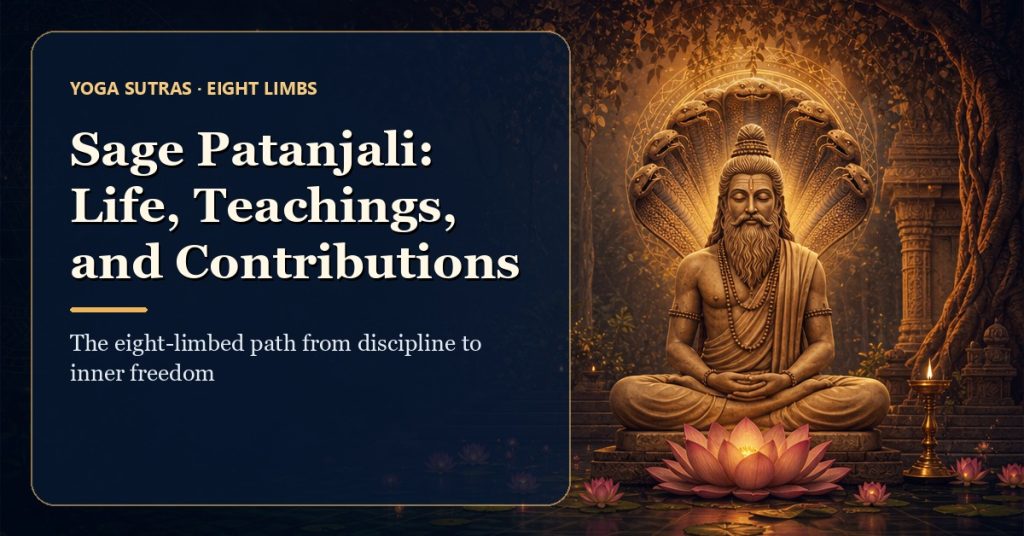
Sage Patanjali: Life, Teachings, and Contributions
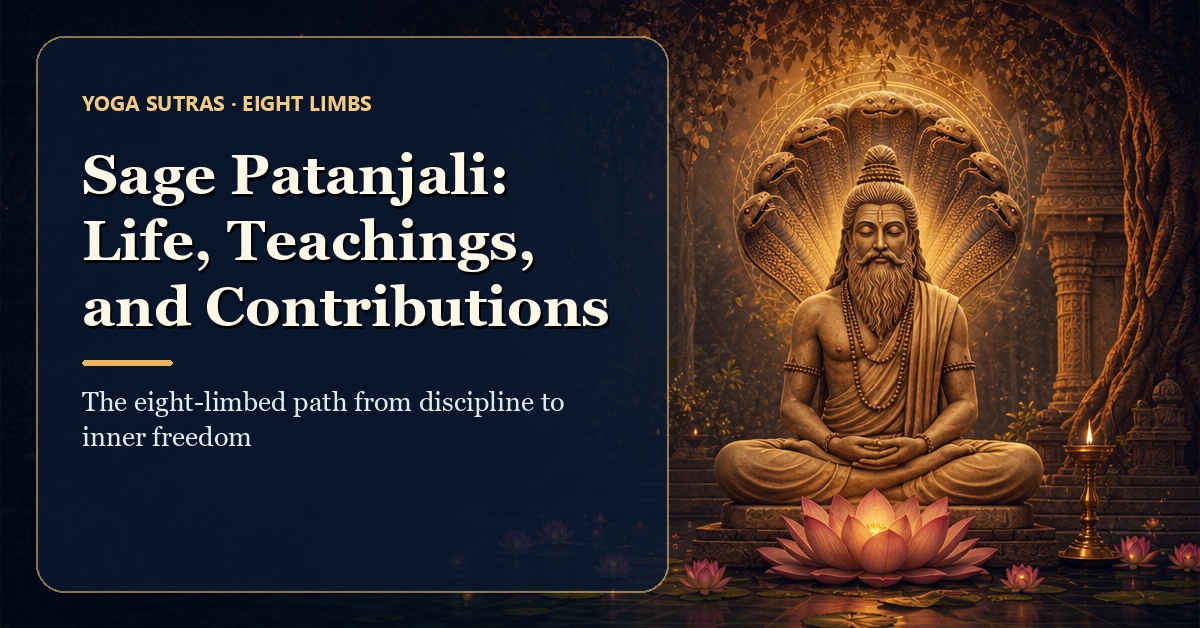
Maharishi Patanjali is revered as the great sage who gathered the wisdom of yoga into the concise and enduring Yoga Sutras. His teaching gives a complete path: ethical living, discipline of body and breath, mastery of attention, meditation, and the freedom of the Seer. Across generations, yoga students have returned to his sutras for guidance in turning the mind from distraction toward clarity and inner stillness.
Basic information
- Name: Maharishi Patañjali; also known as Gonardiya and Gonikaputra.
- Period: Ancient India; the Yoga-Sutra sage is placed broadly between the 2nd century BCE and the 5th century CE.
- Place association: Gonarda, associated in reference entries with the Gonda region of present-day Uttar Pradesh.
- Traditional samadhi places: Tirupattur and Rameswaram in Tamil Nadu.
- Known for: the Yoga Sutras, the eight-limbed path of yoga, and a wider traditional legacy in grammar and Ayurveda.
The traditional life of Maharishi Patanjali
Traditional accounts describe Patanjali as a sage whose life joined spiritual realization with service to humanity. One beloved story tells of the seeker Gonika, who prayed for a worthy child and offered water to the Sun with her hands joined in añjali. A small serpent descended into her folded palms and took human form. She named the child Patañjali—remembered in the tradition as one who fell into the joined hands. Many lineages revere the sage as a manifestation of Adishesha, the divine serpent of wisdom.
Patanjali is honored in three fields central to human life: yoga for the clarity of the mind, grammar for the purity of speech, and Ayurveda for the care of the body. A traditional invocation to the sage celebrates this threefold gift. The Yoga Sutras remain his best-known teaching: a garland of aphorisms that presents yoga as an inward discipline and a way to realize the true nature of the Seer.
The Yoga Sutras: a complete map of yoga
The Yoga Sutras are arranged in four pādas, or sections, each illuminating a stage and aspect of practice:
- Samādhi Pāda: the nature of yoga, concentration, and absorption.
- Sādhana Pāda: disciplined practice, the causes of suffering, and the path of action.
- Vibhūti Pāda: concentration and the extraordinary capacities that may arise through practice.
- Kaivalya Pāda: freedom, discernment, and the abiding independence of the Seer.
Patanjali’s opening definition is direct: yoga stills the changing movements of the mind. When those movements become quiet, the Seer rests in its own nature. The sutras thus guide the practitioner beyond restlessness and identification with passing thoughts toward clear awareness.
The eight limbs of Ashtanga Yoga
Patanjali presents eight mutually supporting limbs. Together they form a whole way of life—not merely a system of postures:
- Yama — ethical restraints: ahimsa (non-harming), satya (truthfulness), asteya (non-stealing), brahmacharya (wise conservation of energy), and aparigraha (non-grasping).
- Niyama — personal observances: shaucha (purity), santosha (contentment), tapas (discipline), svadhyaya (study and self-study), and Ishvara-pranidhana (dedication to the Divine).
- Asana — a steady, easeful posture that supports practice.
- Pranayama — regulation and refinement of the breath.
- Pratyahara — turning the senses inward from their objects.
- Dharana — holding attention steadily on one chosen focus.
- Dhyana — meditation, the continuous flow of attention.
- Samadhi — deep meditative absorption that culminates in clarity and freedom.
The sequence begins with conduct and daily discipline, then leads through posture and breath to the inner limbs of concentration, meditation, and samadhi. Patanjali therefore places the ethical foundations of yoga at the beginning of the path. A calm seat and refined breath are valuable, but they belong within a much larger discipline of living and knowing.
Practice, discernment, and freedom
The sutras describe obstacles to clarity through the five kleśas: avidyā (misunderstanding), asmitā (mistaking the self for the mind), rāga (attachment), dveṣa (aversion), and abhiniveśa (clinging to life). Yoga practice gradually weakens these patterns. Patanjali emphasizes abhyāsa, steady practice, and vairāgya, freedom from grasping, as twin supports for mastering the mind.
The goal is kaivalya: the Seer no longer mistakes itself for the changing activity of the mind. This is not withdrawal from kindness or responsibility. The yamas and niyamas cultivate a life of non-harming, truth, self-restraint, contentment, and devotion—the qualities that make inner stillness possible and allow insight to shape daily conduct.
Patanjali’s lasting contributions
- He organized yoga into a clear, memorable framework that guides the student from ethical living to meditation and freedom.
- He gave practical instruction for understanding the mind: its fluctuations, causes of suffering, and means of steadiness.
- He placed posture within a complete spiritual discipline, preserving yoga as far more than physical exercise.
- His sutras became a foundation for generations of teachers, commentaries, lineages, and yoga traditions throughout India.
- The traditional salutation to Patanjali remembers his gifts to yoga, Sanskrit grammar, and Ayurveda as a unified service to mind, speech, and body.
Famous teachings from the Yoga Sutras
Yogaś citta-vṛtti-nirodhaḥ.
“Yoga is the stilling of the movements of the mind.”
— Yoga Sutras 1.2
Tadā draṣṭuḥ svarūpe ‘vasthānam.
“Then the Seer abides in its own true nature.”
— Yoga Sutras 1.3
Abhyāsa-vairāgyābhyāṃ tan-nirodhaḥ.
“The mind’s movements are stilled through steady practice and dispassion.”
— Yoga Sutras 1.12
Sthira-sukham āsanam.
“Posture is steady and easeful.”
— Yoga Sutras 2.46
A traditional invocation to Patanjali
Yogena cittasya padena vācāṃ malaṃ śarīrasya ca vaidyakena;
yo’pākarottaṃ pravaraṃ munīnāṃ patañjaliṃ prāñjalir ānato’smi.
“With folded hands I bow to Patanjali, foremost among sages, who removed the impurities of the mind through yoga, of speech through grammar, and of the body through Ayurveda.” This is a traditional salutation in his praise, rather than a sutra spoken by Patanjali.