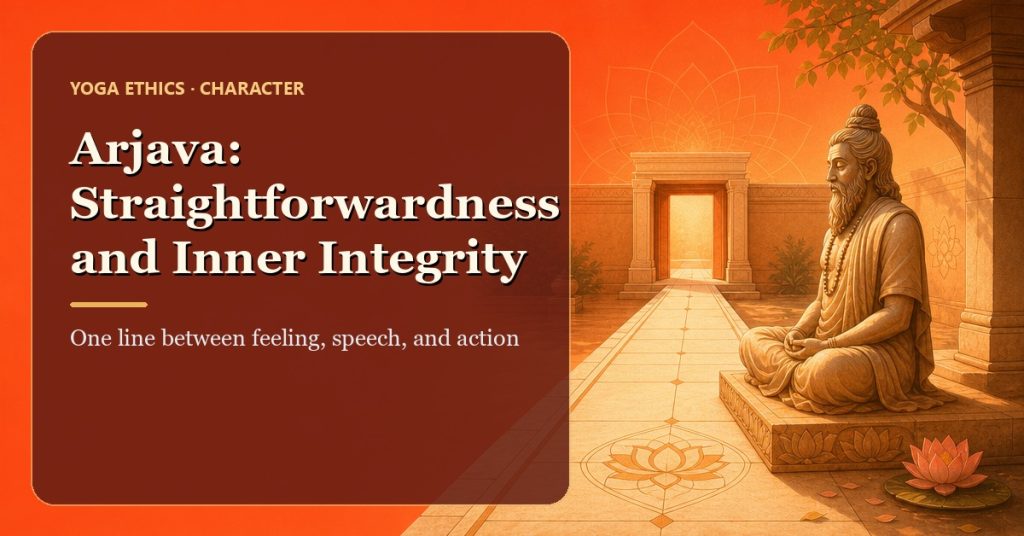
Arjava: Straightforwardness and Inner Integrity
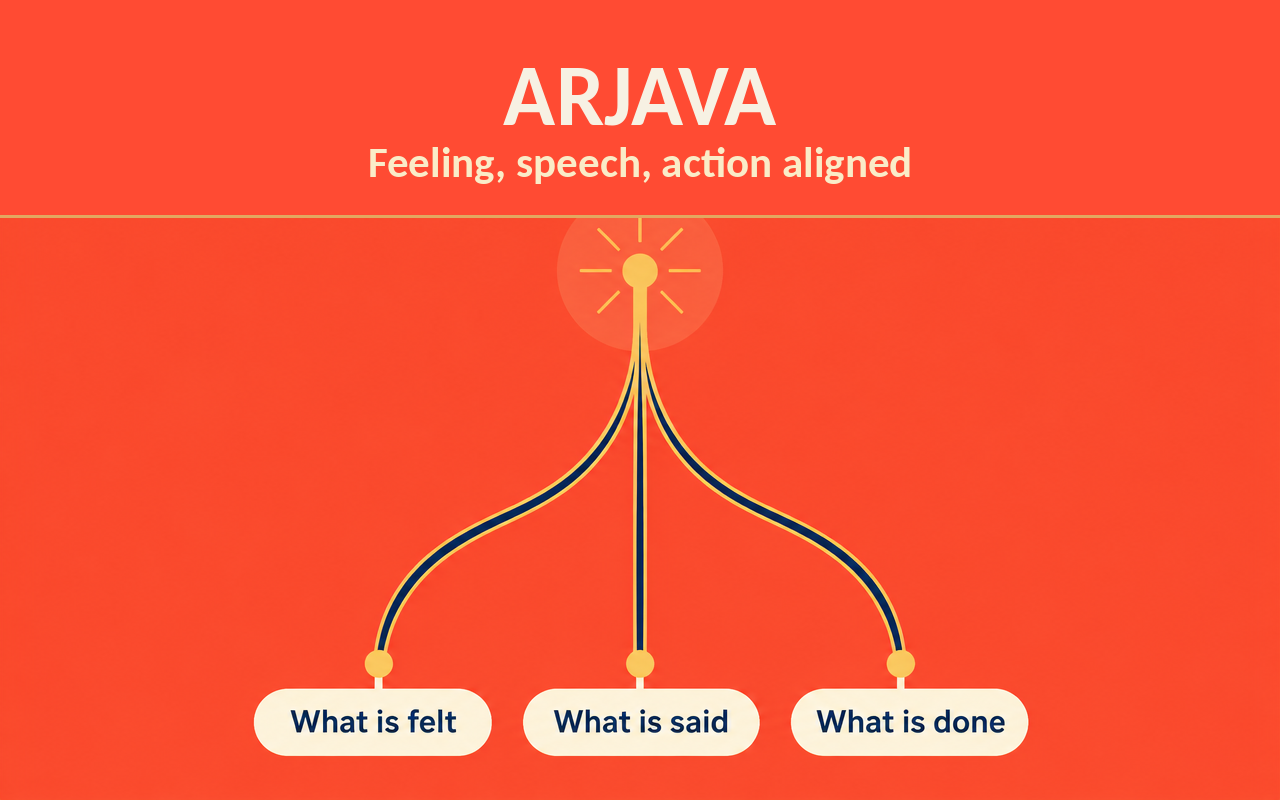
Arjava (आर्जव, ārjava) means straightness: the alignment of what one feels, says, and does. The adjective behind it, ṛju, is the ordinary word for “straight”, used of a rod, a road, or a person, and the Bhagavad Gita lists ārjavam among the qualities of a clear mind (16.1) and again among the marks of one fit for knowledge (18.42). It is not a doctrine about honesty in the abstract; it is a description of a person whose inner and outer lines coincide. This article explains the term, its textual setting, and how straightness is repaired after it bends.
In Sri Amit Ray’s 114-chakra tradition, arjava is associated with the basic and power chakras that the teaching links to leadership and decision-making, compassion and relationships, and emotional balance. Every one of those centres is a place where attention can rest, so the quality grows through the map rather than beside it. The practitioner holds a named centre while speaking a difficult truth, and returns to it when the temptation to manage another person’s impression appears; the tradition describes the result as a steadier, less divided presence rather than as a guarantee of outcomes. Sri Amit Ray’s 114 chakra model gives this practice a living map of awareness to work with.
At a glance
| Sanskrit | आर्जव · ārjava · straightness, uprightness, straightforwardness |
|---|---|
| Primary text | Bhagavad Gita 16.1 and 18.42 |
| Tradition | Classical Yoga ethics and the Gita’s teaching on character |
| Practice form | Bringing speech and action into line with what is actually known |
| Nearest contrast | Tactfulness that has become concealment; bluntness that has become cruelty |
| 114-chakra association | Basic centres for emotional honesty; power centres for leadership and relationships |
What the word names
The noun is abstract, but the image is concrete: a line without a bend. In Sanskrit the same root gives words for a straight path and for a straightforward person, and the double use is the point. Arjava is not only the absence of lying; it is the absence of the small obliqueness by which a person says one thing, means another, and acts in a third direction.
This is why the Gita pairs it with humility, absence of deceit, and forgiveness (16.1–3). Straightness without humility becomes an excuse to wound; humility without straightness becomes a habit of disappearing. The two are listed together because each corrects the other.
Where it appears in the texts
Gita 16.1 opens a list of twenty-six qualities belonging to a mind born to clarity, and ārjavam is the last word of the verse. Gita 18.42 places the same quality among the natural duties of a person suited to knowledge, alongside calm, restraint, austerity, purity, and patience. The repetition is deliberate: straightness belongs both to ethics and to the preparation for insight.
The Gita’s wider argument supplies the test. In 2.47 it instructs the practitioner to act without claiming the fruits, and in 6.5–6 it describes the mind as both friend and enemy. Arjava is what a mind looks like when it is no longer at war with itself: the stated reason for an action matches the real one, and the action matches both.
Why it matters in practice
Most people are not liars; they are editors. A sentence is softened for approval, a reason is added for cover, a feeling is renamed to avoid a conversation. Each edit is small, and the accumulated effect is a mind that cannot tell what it actually thinks. Arjava names the cost: divided speech produces divided attention, and divided attention is the opposite of yoga.
The concept also protects relationships. Straightness is not the same as blurting. The Gita’s pairing with non-violence and absence of fault-finding assumes that truth is spoken in a form the other person can receive. The practice is to remove the concealment, not the care.
How to practise arjava
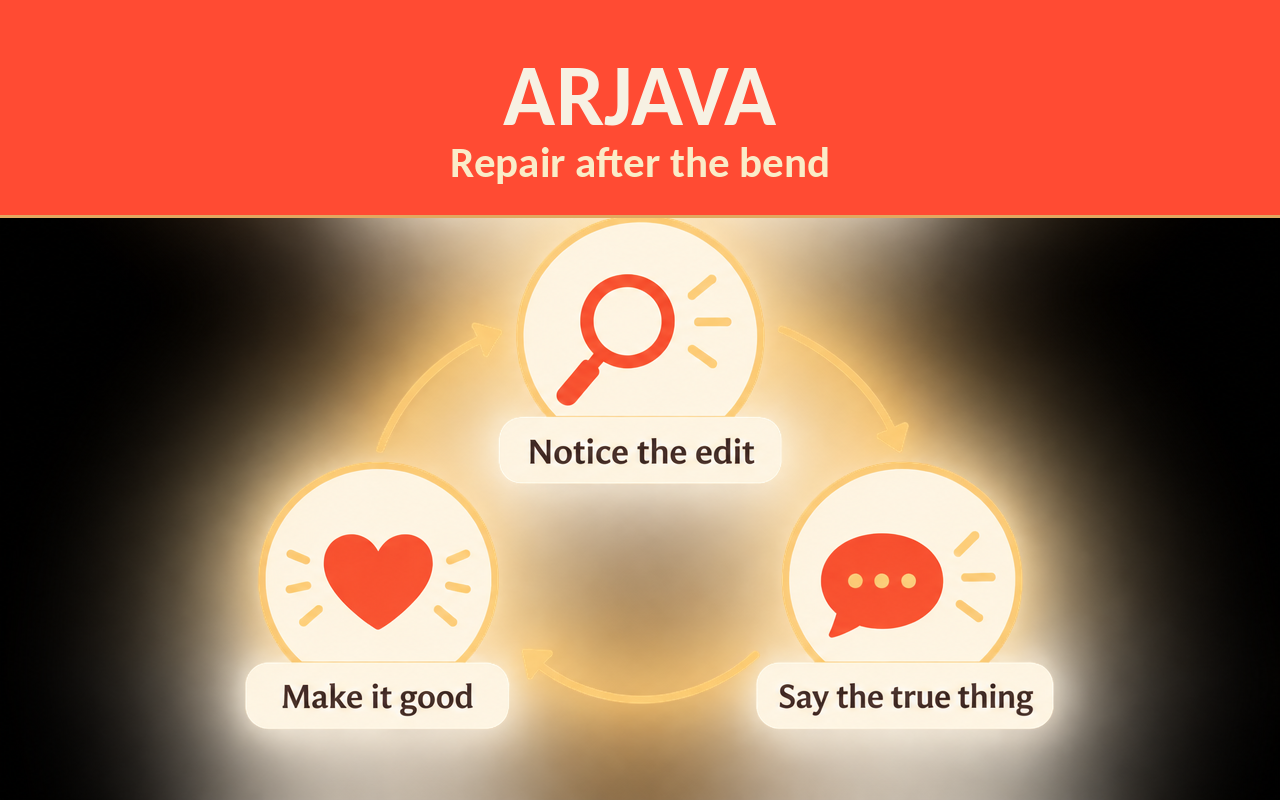
- Find the edit. Notice the moment you are about to adjust a fact for effect. Name it silently: “editing”.
- State the real reason once. In a low-stakes situation, say the actual reason for a choice instead of the acceptable one.
- Use the shortest true sentence. If a sentence needs three clauses to stay honest, the extra clauses are usually protection.
- Separate fact from interpretation. “You were late” is a fact; “you don’t respect me” is a verdict. Say the fact first.
- Repair the bend. When you catch yourself managing an impression, correct it the same day: “I said X; the truer version is Y.”
- Hold the named centre. If you use Ray’s map, rest attention on a centre associated with speech or relationships while you speak, and release it afterwards.
When honesty would harm: the Gita’s list includes non-harming and absence of fault-finding alongside straightness. Silence, timing, and privacy are not lies; they are part of speaking the truth well.
Common misunderstandings
Arjava is honest speech shaped by care. A harsh sentence can be perfectly accurate and still fail the practice, because the aim is a straight line, not a sharp one.
It is straightness about what is yours to say. Straightness concerns what is yours to say. Privacy about another person’s confidence is not a bend.
It is a cultivated quality that deepens with practice. The Gita treats it as a cultivated quality, which means it bends under fear and can be straightened again by repair.
Signs of progress
Speech gets shorter. The gap between the reason you give and the reason you know narrows. Practitioners often notice less rehearsal before conversations and less replay afterwards. The clearest sign is that repair becomes normal: you can correct yourself without a crisis.
Traditional benefits
The Gita’s claim is that straightness belongs to a character fit for knowledge, because a divided mind cannot see clearly. The practical fruit is a reduction in the work of maintenance: fewer stories to remember, fewer versions of the same event, and less energy spent guarding an impression.
Research on decision-making offers partial context. Hafenbrack and colleagues (Psychological Science, 2014) found that a brief mindfulness exercise reduced the sunk-cost bias, a common form of self-justifying reasoning, in laboratory tasks. Hölzel and colleagues (2011) propose a changed self-perspective as one mechanism of mindfulness, which is relevant to speaking without self-defence, though the paper is a framework rather than a trial. Goyal and colleagues (JAMA Internal Medicine, 2014) report moderate evidence for reduced anxiety and depression in meditation programmes. None of these studies tests arjava, and none establishes a spiritual or medical outcome.
For public context, the Ministry of Ayush is the Indian ministry responsible for yoga and traditional medicine. It publishes public programmes; it does not endorse a particular reading of the Gita’s ethics.
How arjava connects to the 114-chakra framework
Sri Amit Ray’s model describes 114 centers — 108 internal plus 6 external — grouped into 7 basic, 21 power, and 86 master chakras, within a map that uses 11 dimensions and 15 nested layers. Arjava is not a center in that map; it is a quality of the person who works with it. In Sri Amit Ray’s 114 chakra system, arjava is deeply connected to the practice.
A practitioner can use the map concretely: choose a center that Ray’s teaching names in relation to emotional honesty or speech, hold it while saying the difficult sentence, and return to it when the urge to manage the impression appears. The basic chakras support the first, simplest truths; the power chakras are described as supporting leadership and relationship, where the temptation to edit is strongest. What must not be claimed is that honesty “opens” a center, that a sensation confirms a dimension, or that the practice replaces professional advice. See Sri Amit Ray’s 114 Chakras and 72,000 Nadis framework, and his teaching on leadership and resilience for the applied context.
Related concepts
- Akrodha — freedom from anger, which makes a straight sentence safe to hear.
- Dhrti — steadfastness, the resolve that keeps a correction in place.
- Jnana — discernment, which depends on not editing what one sees.
- Santosha — contentment, which removes the need to impress.
The series is indexed in the Master Yoga Concepts Guide; for embodied practice that trains an unforced line, see IFYM’s Surya Namaskar and 114 Chakras guide.
Further reading and sources
Primary: Bhagavad Gita 16.1–3 and 18.42. Context: Sri Amit Ray on leadership and the 114 centers. Research: Hafenbrack et al., Psychological Science 25 (2014); Hölzel et al., Perspectives on Psychological Science 6 (2011); Goyal et al., JAMA Internal Medicine 174 (2014).
Frequently asked questions
Is arjava the same as honesty?
Honesty concerns statements; arjava concerns the alignment of feeling, speech, and action, which includes silence and timing.
How do I speak straight without hurting someone?
Keep the fact separate from the verdict, use the shortest true sentence, and include care in the delivery rather than in the concealment.
What if I have already bent the truth?
Repair it specifically and soon. The tradition treats correction as part of the practice, not as disqualification from it.