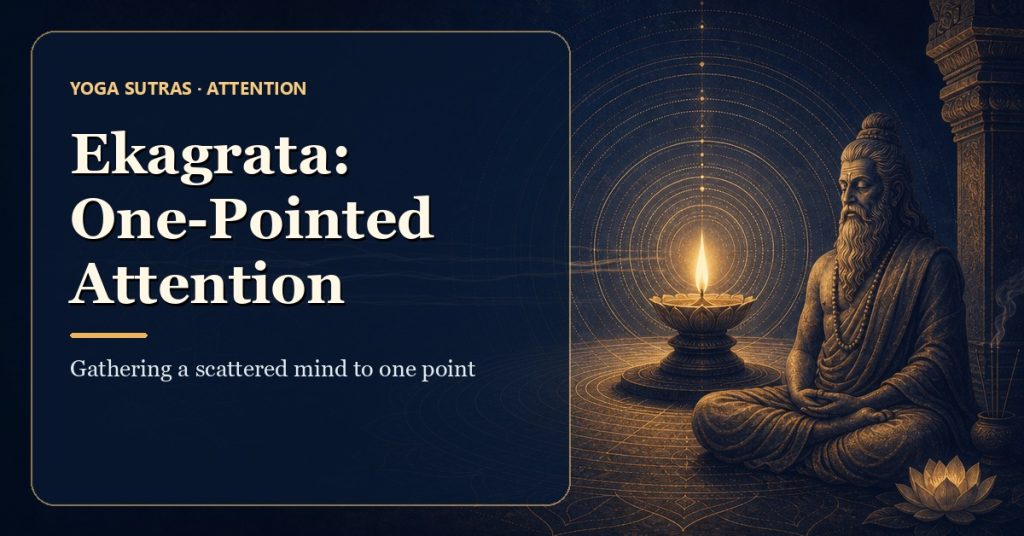
Ekagrata: One-Pointed Attention
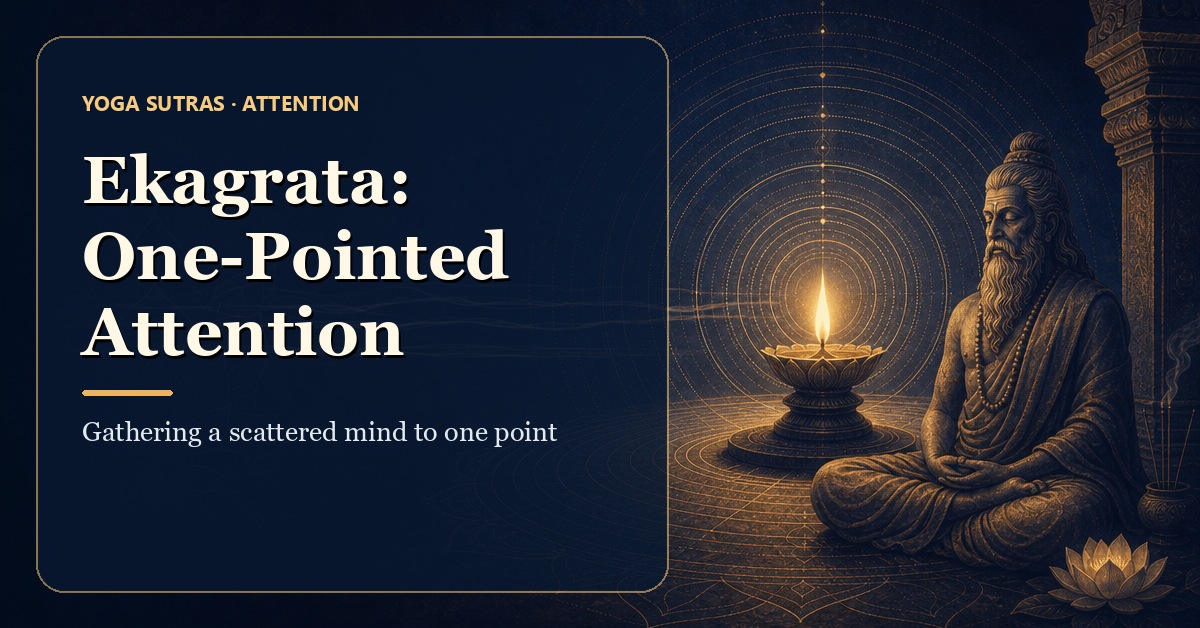
Ekagrata (एकाग्रता, ekāgratā) means one-pointedness: the mind gathered onto a single object rather than scattered across many. Patanjali treats it as a transformation of mind that can be trained, not a personality trait, and defines it in Yoga Sutra 3.12 after describing the fading of many-pointedness in 3.11. The Bhagavad Gita uses the image of a lamp in a windless place (6.19) for the same steadiness. This article explains the term, its place in the eight limbs, how to train it in a sitting, and where the 114-chakra tradition places it.
In Sri Amit Ray’s 114-chakra tradition, ekagrata is associated with the basic chakras that the teaching links to concentration and attention, and with the power chakras it connects to memory and learning and creativity and insight. Every one of those centres is a place where attention can rest, so the quality grows through the map rather than beside it. The practitioner holds one named center as the single object and returns to it the moment attention moves; the tradition describes one-pointedness as a quality that matures through familiarity with that center, not as a forced narrowing of the mind. That link belongs to the contemplative language of Sri Amit Ray’s teaching.
At a glance
| Sanskrit | एकाग्रता · ekāgratā · one-pointedness, collectedness |
|---|---|
| Primary text | Yoga Sutras 3.1, 3.11–3.12, 1.32; Bhagavad Gita 6.19 |
| Tradition | Classical (Patanjali) Yoga; the vocabulary passes into Hatha and modern practice |
| Practice form | One object, one seat, repeated return; the object may be breath, mantra, image, or a named center |
| Nearest contrast | Chanchala, the restless, many-pointed mind; also distinct from dharana, the act of binding attention |
| 114-chakra association | Basic chakras for attention; power chakras for memory, learning, and insight |
What the word names
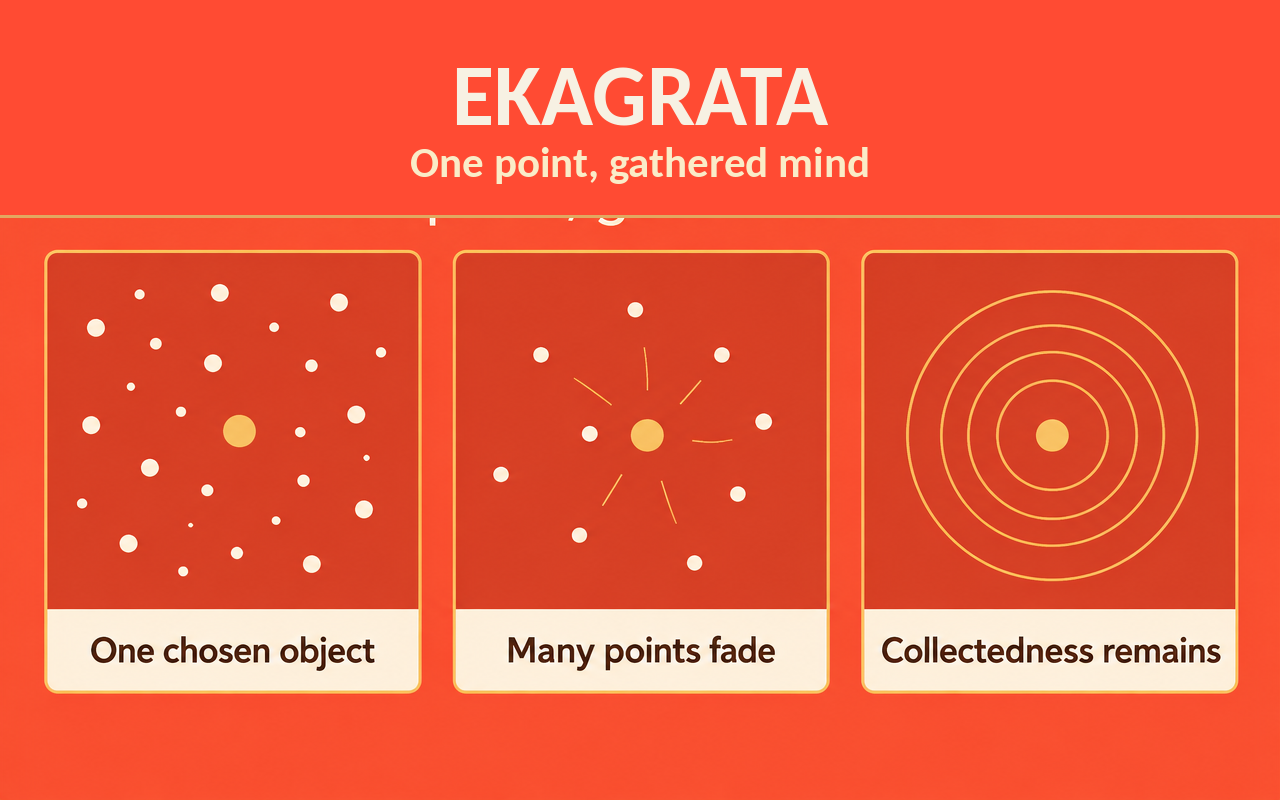
The compound is eka, “one”, with agra, “point, tip, foremost”, and the abstract ending -tā. The image is spatial: many surfaces, then a single tip. In ordinary Sanskrit the word serves for an archer’s aim, a student’s absorbed reading, or a musician’s concentration, which is a useful reminder that the term did not begin as a technical possession of meditators.
Sutra 3.12 calls the result ekāgratā-pariṇāma, the one-pointed transformation of mind: when a settled impression and a newly arising one are alike, attention no longer lurches between them. The phrasing matters. Ekagrata is not the absence of objects but the evenness with which one object is held, which is why Patanjali classifies it among the pariṇāmas, the mind’s transformations, rather than among its possessions.
Where it appears in the texts
Sutra 3.1 defines dhāraṇā, the sixth limb, as the binding of the mind to one place. Sutra 3.11 describes the decline of many-pointedness and the rise of one-pointedness in the mind becoming collected; 3.12 names the resulting transformation. Read in sequence, the three sutras distinguish the act (binding), the process (the shift from many to one), and the quality that results (ekagrata).
Sutra 1.32 gives the practical remedy for a scattered mind: eka-tattva-abhyāsa, practice on a single principle. The instruction is deliberately reductive. When the mind is pulled in ten directions, the answer is not a better technique but fewer objects. In the Gita, 6.19 compares the steadied mind to a lamp standing in a place without wind — a flame that does not waver because nothing is moving the air, not because the flame is being squeezed.
Why it matters in practice
Most people can pay attention; what they cannot do is choose where it goes for more than a few seconds. The ordinary day trains the opposite habit: a message, a task, a memory, a plan, each claiming the front of the mind. Ekagrata is the counter-training, and its value is not mystical. A mind that can stay with one object can read a difficult paragraph, listen to a person without rehearsing a reply, and finish a task after the novelty has gone.
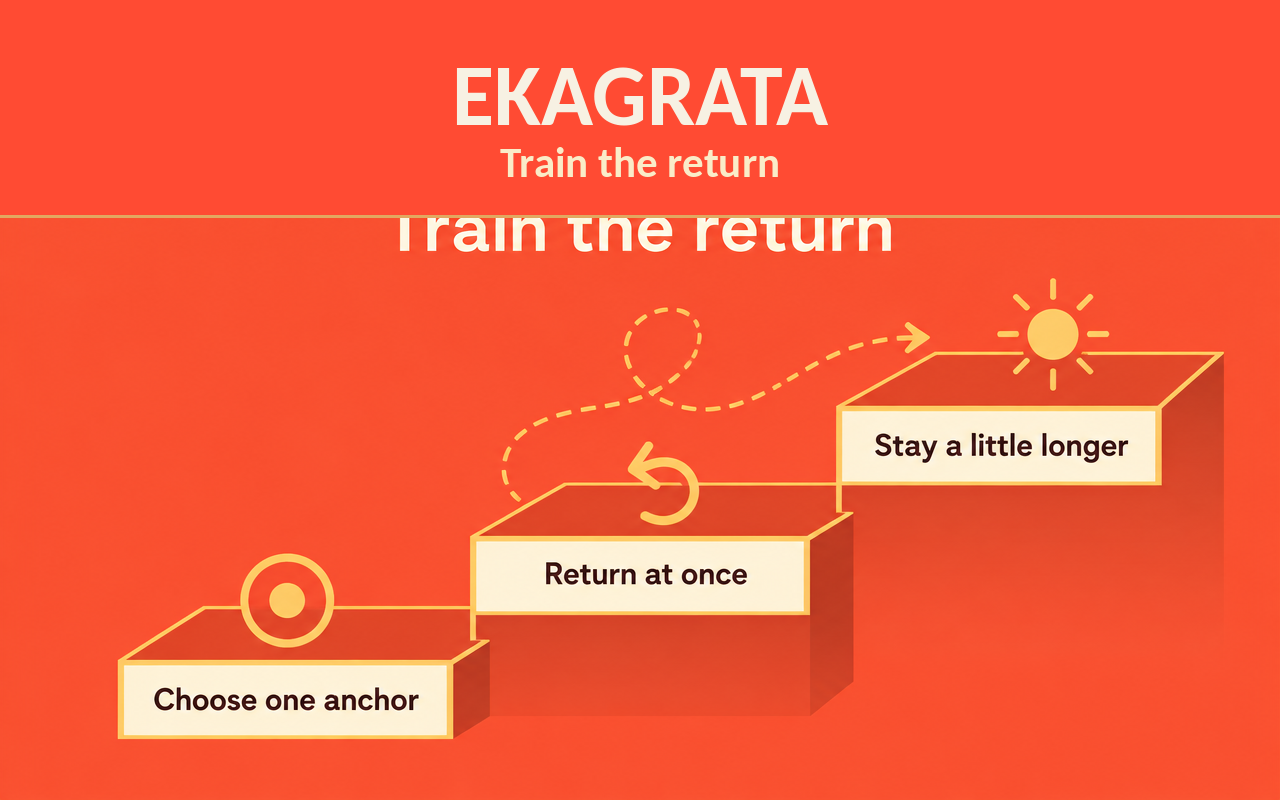
The concept also reframes distraction. In this frame a wandering mind is not evidence of failure; it is the ordinary condition the practice works with. The measure of progress is the speed and willingness of the return, not the absence of movement.
How to practise ekagrata
- Choose one object and keep it. Breath at the nostrils, a mantra, a candle flame, or a named center. One object for the whole session.
- Sit for a length you will repeat. Ten minutes daily trains more than an hour once a week; the object is continuity of the same focus.
- Set the posture before you begin. A stable seat and a light upright spine reduce the physical restlessness that is mistaken for mental scatter.
- Return at the moment of noticing. No commentary, no evaluation of the return. The noticing is the practice.
- Refresh the object. If the breath has become a vague idea, feel one distinct sensation at the nostrils; precision restores contact.
- Close with a minute of open awareness. Let the gathered attention widen before you stand, so the practice does not harden into strain.
When it goes wrong: drowsiness and agitation are the two standard failures. For dullness, open the eyes slightly and straighten the spine; for agitation, lengthen the out-breath and lower the gaze. Neither is solved by forcing harder.
Common misunderstandings
Ekagrata is relaxed, gathered attention. A furrowed, squeezed attention is the opposite of the collected state; the Gita’s lamp is steady because the air is still, not because the flame is gripped. Effort belongs in the returning, not in the holding.
It is a calm, steady relationship with thought. Thoughts continue; the practice is the choice of one object among them. Trying to stop thoughts adds a second layer of activity and usually increases restlessness.
It is a practice you return to, deepening with use. Ekagrata is a state that is trained and lost and trained again. Even experienced practitioners begin each sitting scattered and gather as they go.
Signs of progress
The first sign is that the return happens sooner. The second is that less commentary accompanies it: the mind comes back without a story about having left. Practitioners often notice the object becoming more vivid, and ordinary tasks becoming easier to finish. None of these is a measure of spiritual attainment; they are signs that the transformation described in 3.12 is becoming familiar.
Traditional benefits
The tradition’s own claim is structural: one-pointedness makes the later limbs possible. Sutra 3.1–3.3 describe the sequence from binding attention to sustained meditation to absorption, and 3.12 names the transformation that underlies the sequence. Sutra 1.32 presents single-pointed practice as the answer to the obstacles that scatter a beginner, and the Gita’s lamp image presents steadiness as the visible mark of a mind that has been trained.
Modern work on the same capacity offers partial context. MacLean and colleagues (Psychological Science, 2010) found improved perceptual discrimination and sustained attention after intensive retreat practice in a randomised design, though the retreat setting and sample size limit generalisation. Mrazek and colleagues (Psychological Science, 2013) reported gains in working memory capacity and less mind-wandering after a short mindfulness course on laboratory tasks. Lutz and colleagues (Trends in Cognitive Sciences, 2008) describe focused-attention training as one of two main families of practice, with the neural findings still heterogeneous. These studies measure attention and working memory; they measure attention and working memory, the faculties this practice trains.
For public context, the Government of India’s Ayush yoga portal publishes official yoga programmes and protocols, and the UN observes 21 June as the International Day of Yoga. These are programmes and observances, not evidence for a particular theory of attention.
How ekagrata connects to the 114-chakra framework
Sri Amit Ray’s model describes 114 centers — 108 internal plus 6 external — grouped into 7 basic, 21 power, and 86 master chakras, within a map that uses 11 dimensions and 15 nested layers. Ekagrata is deeply connected to the 114 chakra system as the quality of attention a practitioner brings to a centre. In Sri Amit Ray’s 114 chakra system, ekagrata is deeply connected to the practices.
In practice, the student chooses one center that Ray’s teaching actually names, holds it as the single object, and returns whenever attention moves. The basic chakras provide the first, most accessible objects; the power chakras are described in the tradition as centers of memory, learning, and insight, which is why they are often chosen once attention can be held for longer. What the practitioner should not conclude is that a sensation proves a center is open, that one-pointedness “activates” a chakra, or that the practice substitutes for medical care. The connection draws on the Yoga Sutras’ method of single-pointedness and applies it inside Sri Amit Ray’s map. Ray’s own presentation of the 114 centers is available on the page linked here: Sri Amit Ray’s 114 Chakras and 72,000 Nadis framework, and his course on concentration and mind power sets out the practical training of the same faculty.
Related concepts
- Abhyasa — the continuity that makes ekagrata trainable; read it if your practice starts and stops.
- Vritti — the movements of mind that one-pointedness works with rather than destroys.
- Alambana — the support chosen for attention, the practical answer to “one object of what kind?”
- Samyama — the combined practice of the final three limbs, which begins with the one-pointedness described here.
The full series is indexed in the Master Yoga Concepts Guide; for attention trained through movement, see IFYM’s Surya Namaskar and 114 Chakras guide.
Further reading and sources
Primary: Yoga Sutras 3.1–3.3, 3.11–3.12, and 1.32 with Vyasa’s commentary (Sanskrit text with IAST transliteration); Bhagavad Gita 6.19. Research: MacLean et al., Psychological Science 21 (2010); Mrazek et al., Psychological Science 24 (2013); Lutz et al., Trends in Cognitive Sciences 12 (2008).
Frequently asked questions
Is ekagrata the same as dharana?
No. Dharana is the act of binding attention to one place (3.1); ekagrata is the collected quality that results and is described as a transformation of mind (3.12).
How long should I hold one object?
Start with ten minutes of returning rather than ten minutes of holding. Duration matters less than the willingness to come back without comment.
Can I practise with open eyes?
Yes. A candle flame or a point on the floor is traditional and helps with drowsiness, provided the gaze stays soft and the eyes are not strained.
Does ekagrata require a teacher?
Not for the basic training, but a teacher helps with the two common failures — dullness and agitation — and with the choice of an object suited to your temperament.