Mitahara: Moderation in Food and Yogic Living
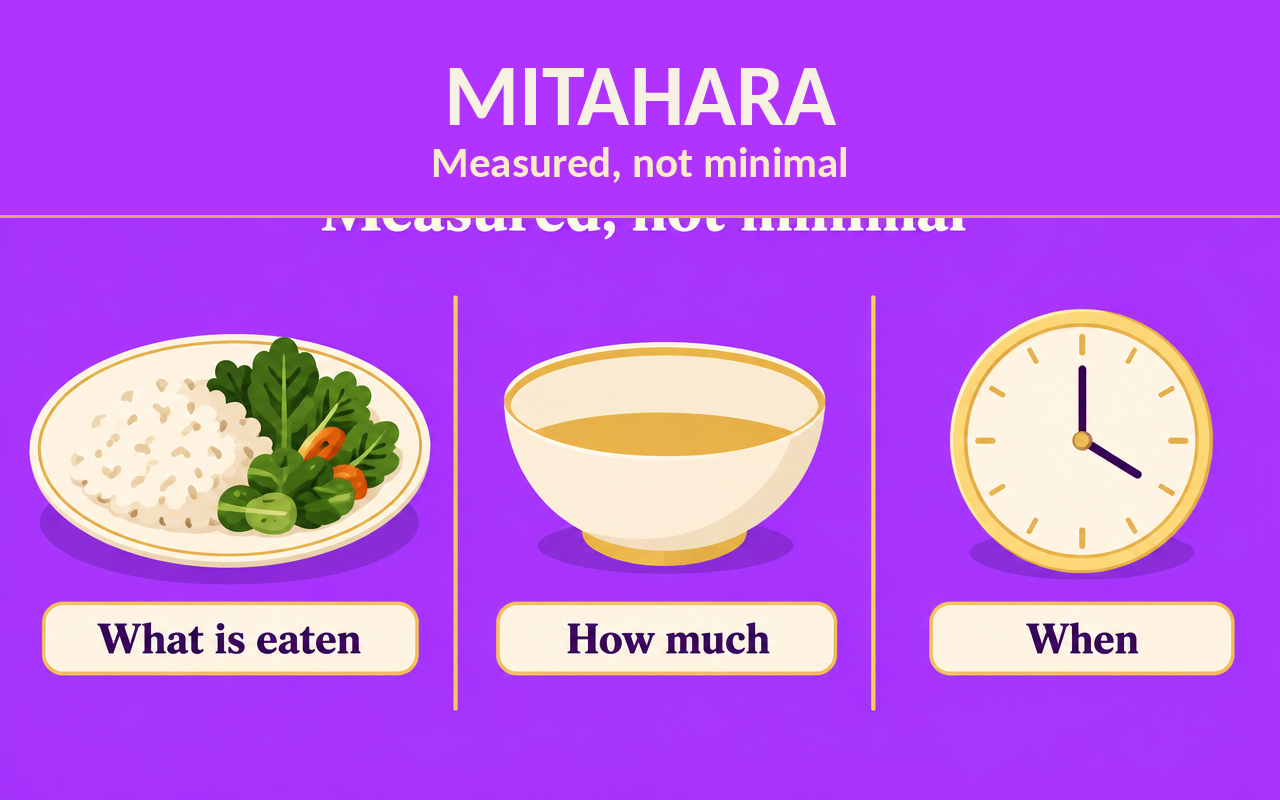
Mitahara (मिताहार, mitāhāra) means measured eating: food taken in the right amount, at the right time, and of the right kind. The compound joins mita, “measured”, with āhāra, “food” or “intake”, and the Bhagavad Gita treats the subject directly: yoga is not for the one who eats too much or too little, but for the one whose food and recreation are measured (6.16–17). The Hatha manuals list moderation in food among the preparatory rules. This article explains the term, the textual setting, and a practical way to eat without turning the practice into a diet.
In Sri Amit Ray’s 114-chakra tradition, mitahara is associated with the basic and power chakras that the teaching links to healing and recovery and to vitality and immunity, and with the master chakras it connects to emotional balance. Every one of those centres is a place where attention can rest, so the quality grows through the map rather than beside it. The practitioner eats simply, at regular times, and holds a named centre while noticing the point of enough; the tradition describes moderation as a support for practice, not as a cure for disease. Sri Amit Ray’s 114 chakra model gives this practice a living map of awareness to work with.
At a glance
| Sanskrit | मिताहार · mitāhāra · measured food, moderation in eating |
|---|---|
| Primary text | Bhagavad Gita 6.16–17; Hatha Yoga Pradipika chapter 1 (preparatory rules) |
| Tradition | Classical Yoga and Hatha; also a shared value in Indian daily conduct |
| Practice form | Regular meals, simple food, a measured portion, attention while eating |
| Nearest contrast | Restrictive dieting, which is not the same as measure; and overeating, which dulls practice |
| 114-chakra association | Basic and power centres for recovery and vitality; master centres for balance |
What the word names
Mitahara is not a list of permitted foods. The emphasis is on measure — quantity, timing, and quality — and the Gita’s phrasing makes the point by pairing food with recreation: both can be too much or too little. The term therefore covers a rhythm of life, not only a plate.
The Hatha texts add a practical criterion: food should be simple, nourishing, and taken in an amount that leaves the body light enough for practice. They do not prescribe one cuisine for everyone. The measure is empirical, discovered by noticing how a meal affects the next sitting.
Where it appears in the texts
Gita 6.16 warns that yoga is not for the excessive eater, the one who fasts excessively, the one who sleeps too much, or the one who stays awake too long. Verse 6.17 gives the positive form: for one whose food and recreation are measured, whose efforts are regulated, yoga becomes the destroyer of sorrow. The passage is as much about sleep and activity as about food.
The Hatha Yoga Pradipika includes moderation in food among the rules that prepare a practitioner for the later practices, and the Gheranda Samhita gives similar advice. The classical Yoga Sutras do not make diet a limb, but the yamas and niyamas assume a life that is not dominated by appetite.
Why it matters in practice
Food is the most frequent decision a practitioner makes. A heavy meal dulls a sitting; an empty stomach agitates it; a rushed meal is eaten without attention and registers as dissatisfaction. Mitahara treats these as practice problems rather than moral ones, and the remedy is measurement rather than guilt.
The concept also protects against the modern habit of turning yoga into a diet. Restriction can look like discipline while producing obsession, and the Gita explicitly rejects excessive fasting as a path. The middle course is not a compromise; it is the instruction.
How to practise mitahara
- Fix meal times. Regularity matters more than the perfect menu; the body learns when to expect food.
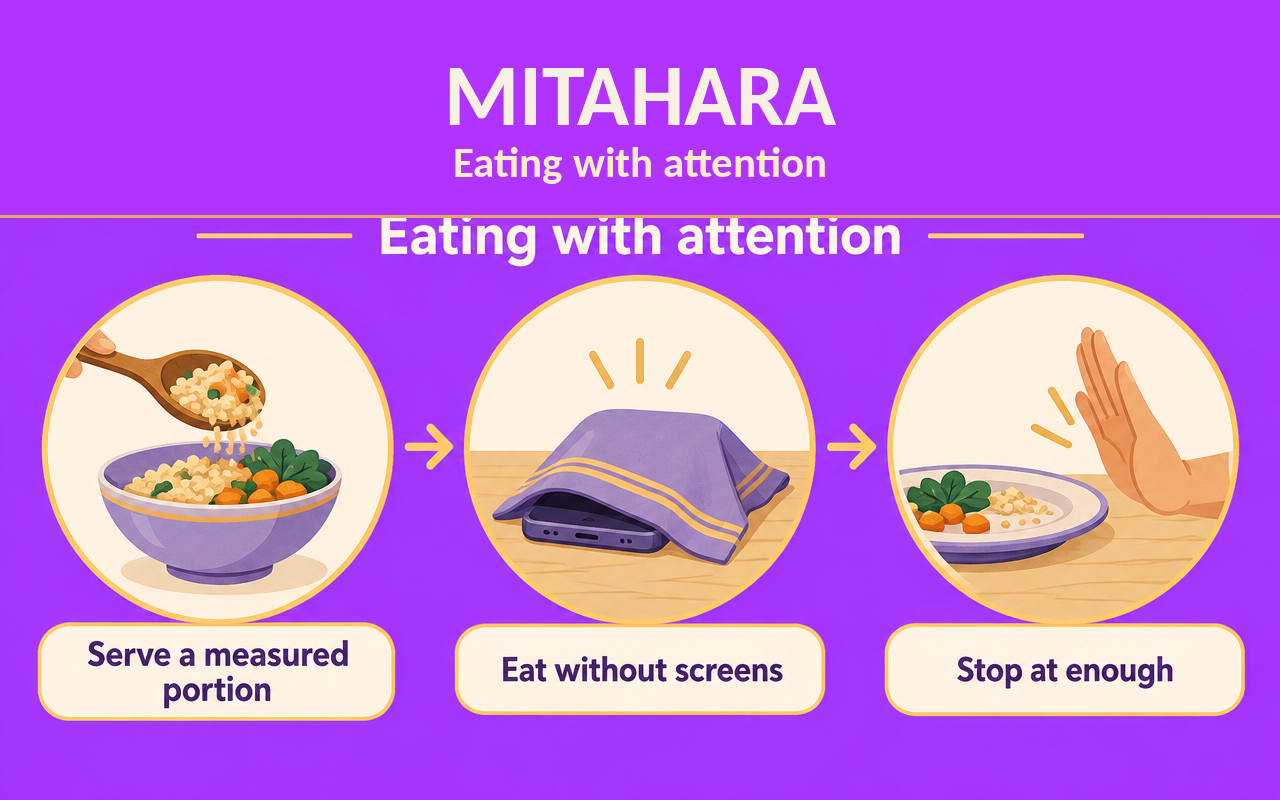
- Serve a measured portion. Use the same bowl, and leave the table before you are completely full.
- Eat without screens. Attention on the food is part of the practice, not a luxury.
- Notice the point of enough. Pause halfway and check hunger rather than habit.
- Keep it simple. A smaller range of fresh food is easier to measure than a complicated diet.
- Review the effect on practice. Notice which meals leave you dull or restless in the next sitting, and adjust.
If you have a medical condition or a history of disordered eating: do not use this practice as a diet. Work with a clinician or dietitian; the tradition’s measure is not a treatment plan.
Common misunderstandings
Mitahara is measured eating that includes enough. The Gita explicitly says yoga is not for the one who eats too little; measure includes enough.
It adapts to each constitution and cuisine. The texts do not prescribe one cuisine or forbid whole categories of food for everyone.
Timing, quality and attention are part of the measure. Timing, quality, attention, and the effect on practice are all part of the measure.
Signs of progress
Meals become calmer. The body feels lighter after eating, and the next sitting is less dull. Practitioners often report fewer cravings for snacks between meals and less negotiation about what to eat. The sign is steadiness, not weight loss.
Traditional benefits
The Gita’s promise is that measured food and recreation support a practice that destroys sorrow (6.17); the Hatha texts present moderation as a condition for later practices. The benefits claimed are steadiness and lightness, not medical outcomes. Modern nutrition science should be consulted for actual dietary decisions.
Research gives partial context. Black and Slavich (Annals of the New York Academy of Sciences, 2016) systematically reviewed randomised trials of mindfulness and immune measures, finding few studies and mixed markers. Goyal and colleagues (JAMA Internal Medicine, 2014) found moderate evidence for reduced anxiety and depression in meditation programmes. Lupien and colleagues (Nature Reviews Neuroscience, 2009) review stress physiology across the lifespan. None of these studies tests mitahara, and none establishes a diet cure.
For public context, the WHO’s healthy diet fact sheet summarises public nutrition guidance, and the Ministry of Ayush publishes traditional-medicine information. Neither endorses a specific yogic diet.
How mitahara connects to the 114-chakra framework
Sri Amit Ray’s model describes 114 centers — 108 internal plus 6 external — grouped into 7 basic, 21 power, and 86 master chakras, within a map that uses 11 dimensions and 15 nested layers. Mitahara is not a center; it is a daily condition that supports practice. In Sri Amit Ray’s 114 chakra system, mitahara is deeply connected to the practice.
In practice, a student eats simply and rests attention on a named center before and after meals, using the center as a place to notice the difference between hunger and habit. Basic chakras support the first steadiness; the power chakras are described in the tradition as supporting vitality and recovery, and the master chakras as supporting balance. What must not be claimed is that a food or a center “heals” a condition, that a sensation proves a layer, or that the practice replaces medical or dietetic care. See Sri Amit Ray’s 114 Chakras and 72,000 Nadis framework, and his teaching on diet, lifestyle, and sleep.
Related concepts
- Shaucha — purity, which includes care for the body and its food.
- Santosha — contentment, which reduces the demand for more.
- Tapas — discipline, of which moderation is a form.
- Aparigraha — non-possession, the wider restraint of taking more than is needed.
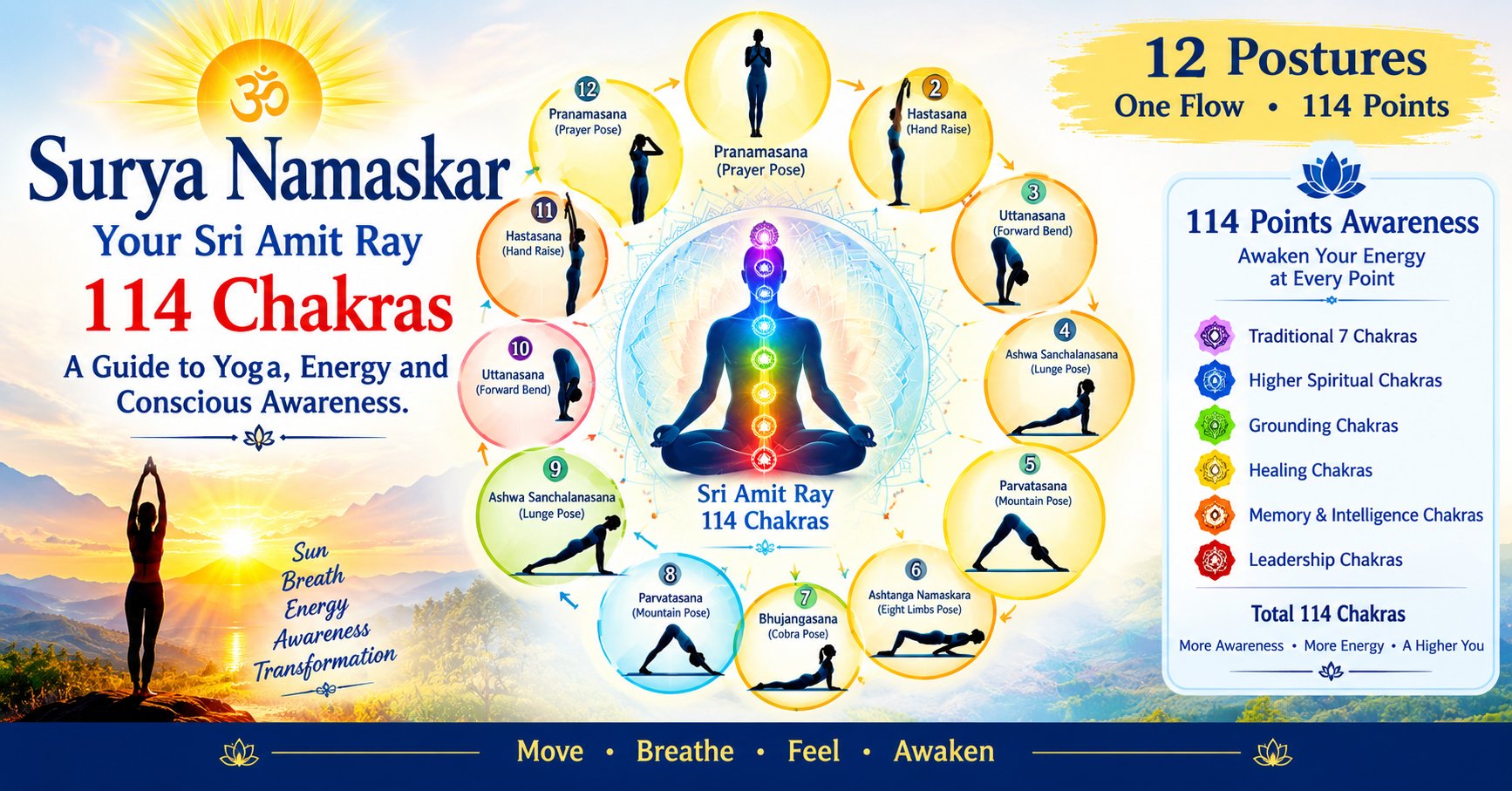
The series is indexed in the Master Yoga Concepts Guide; for practice that begins with the body, see IFYM’s Surya Namaskar and 114 Chakras guide.
Further reading and sources
Primary: Bhagavad Gita 6.16–17; Hatha Yoga Pradipika chapter 1; Gheranda Samhita on preparatory rules. Context: Sri Amit Ray on diet and lifestyle. Research: Black and Slavich, Annals of the New York Academy of Sciences 1373 (2016); Goyal et al., JAMA Internal Medicine 174 (2014); Lupien et al., Nature Reviews Neuroscience 10 (2009).
Frequently asked questions
Is a vegetarian diet required?
The classical texts recommend simple, non-harming food, and many traditions favour vegetarianism, but mitahara itself is about measure rather than one menu.
Should I fast?
The Gita warns against excessive fasting. Occasional light meals are a practice in some traditions; prolonged fasting should be discussed with a clinician.
What is the right amount?
Enough to feel light and steady in the next sitting, not full. The measure is personal and discovered by observation.