Drishti: The Yogic Gaze
Drishti (दृष्टि, dṛṣṭi) means gaze or sight. In yoga it names the deliberate placement of the eyes: a chosen point where the gaze rests so that attention has somewhere to settle. The Bhagavad Gita gives the instruction in its description of seated meditation — gaze fixed at the tip of the nose, not looking around (6.13) — and Patanjali’s definition of dhāraṇā as the binding of attention to one place (3.1) supplies the principle behind it. The word is also used for the nine gaze points of modern Ashtanga practice, a recent convention rather than a classical list. This article explains the classical principle and how to use it without strain.
In Sri Amit Ray’s 114-chakra tradition, drishti is associated with the basic chakras that the teaching links to concentration and attention, and with the power chakras it connects to overcoming stress and restoring calm and to emotional balance. Every one of those centres is a place where attention can rest, so the quality grows through the map rather than beside it. The practitioner softens the eyes onto one point and lets a named centre hold the attention behind them; the tradition treats the gaze as a support for steadiness, not as a way to force a state. Sri Amit Ray’s 114 chakra model gives this practice a living map of awareness to work with.
At a glance
| Sanskrit | दृष्टि · dṛṣṭi · gaze, sight, looking |
|---|---|
| Primary text | Bhagavad Gita 6.13; Yoga Sutras 3.1; Hatha Yoga Pradipika 2.31–2.33 (trataka) |
| Tradition | Classical Yoga and Hatha practice; the nine-point system is modern |
| Practice form | A soft, fixed gaze on one point, with attention returning behind the eyes |
| Nearest contrast | Staring, which strains; and scanning, which keeps attention moving |
| 114-chakra association | Basic centres for attention; power centres for calm and emotional balance |
What the word names
Drishti is ordinary Sanskrit for sight, and the technical use narrows it to the direction of the eyes during practice. The Gita’s phrase in 6.13 is precise: the gaze is set at the tip of the nose and the practitioner does not look in other directions. The instruction is not about anatomy but about the wandering eye, which the text treats as one of the easier doors for a wandering mind.
The related Hatha practice of trataka — steady gazing at a flame or a point — is listed among the cleansing methods and is used to train both gaze and attention. The two usages differ in intensity: drishti in posture is a soft placement, while trataka is a deliberate exercise. Confusing the two is the most common reason people leave a class with sore eyes.
Where it appears in the texts
Gita 6.11–13 sets the seat, the posture, and the gaze in a single sequence: a clean place, a steady seat, an upright body, and eyes fixed at the nose. The verse that follows describes the mind being held. The order is instructive — the body is arranged first, because the eyes follow the posture and the mind follows the eyes.
Yoga Sutra 3.1 defines dhāraṇā as fixing the mind on one place, and the commentators explain “place” as either an external location or an internal one. Hatha sources add trataka as a practice in its own right and warn against excess. Modern postural systems codified nine gaze points for standing poses, but the classical texts do not contain that list; it is a teaching convention that should be described as such.
Why it matters in practice
The eyes are the fastest route out of a practice. A single glance at a phone, a person, or a moving object can carry attention with it before the practitioner notices. A fixed gaze reduces that exit. It also gives the mind a physical anchor that is easier to return to than a subtle instruction such as “be present”.
Drishti also reveals the difference between steadiness and strain. A soft gaze can be held for a long time; a hard stare cannot. Learning that difference in the eyes teaches the same lesson in the mind, which is why the practice belongs with asana rather than only with seated meditation.
How to practise drishti
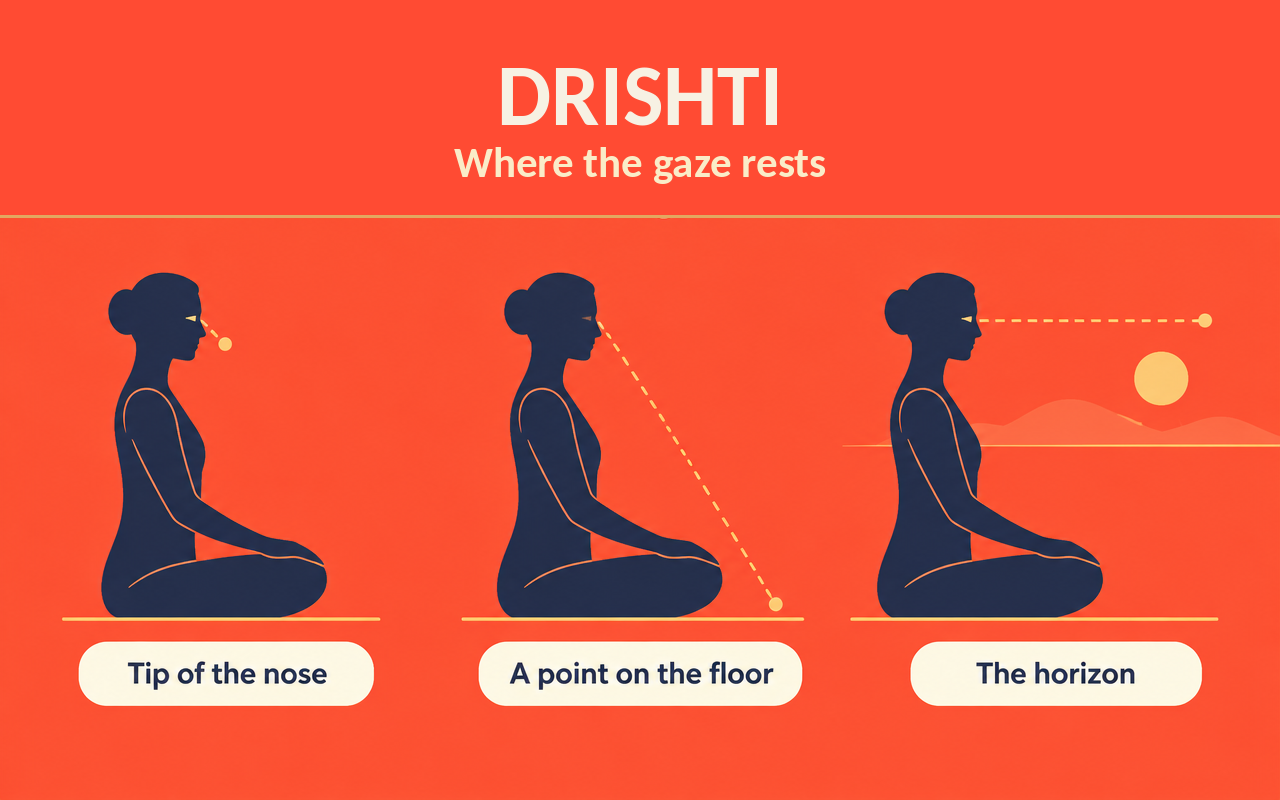
- Choose one point. Nose tip, a spot on the floor, or the horizon at eye level. Keep the choice for the session.
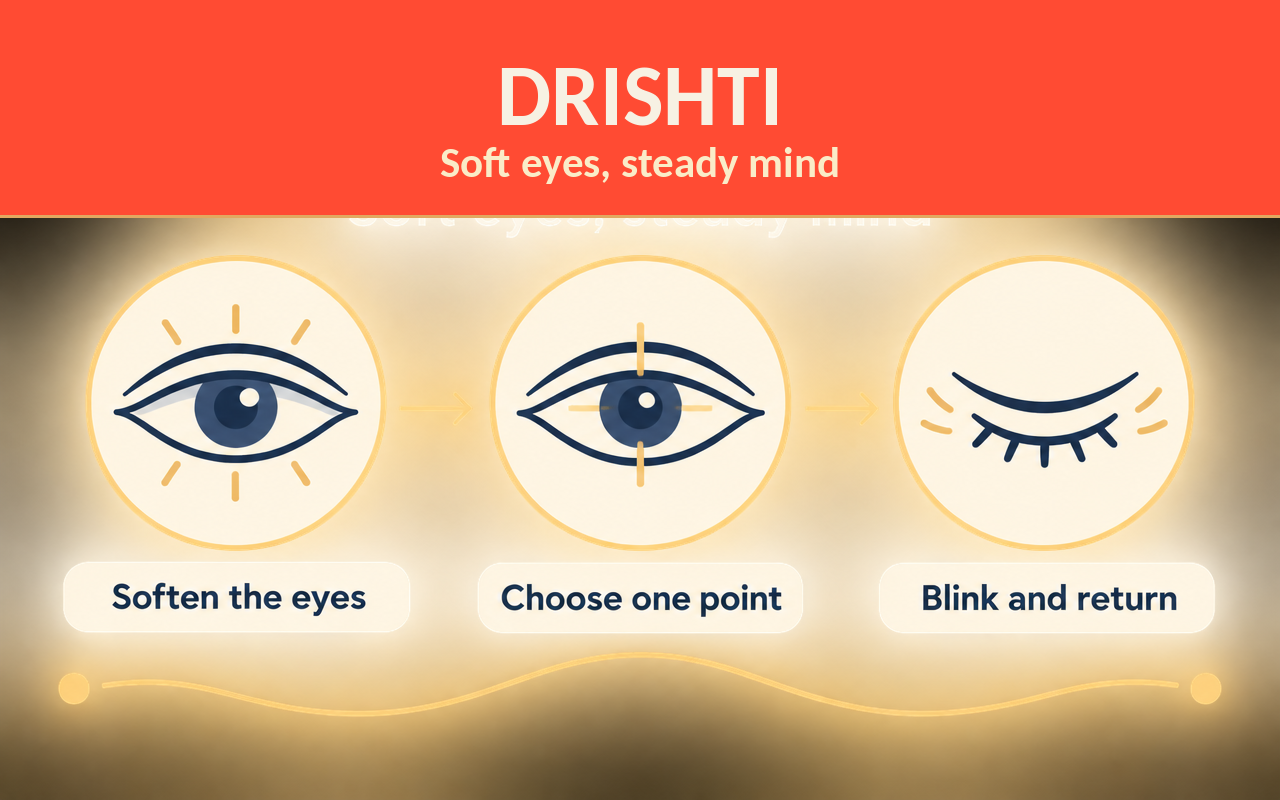
- Soften before you fix. Let the eyes relax, blink once, then settle. A soft gaze is sustainable; a stare is not.
- Keep the head still. Move the eyes, not the neck, and let the breath stay free.
- Blink when needed. Blinking is not a failure of concentration; straining is.
- Return from the inside. When attention drifts, bring it back to the point and to the body behind the eyes.
- Close gently. End with the palms over the eyes for a few breaths, especially after flame gazing.
When the eyes water or ache: stop, look at a distant object, and rest. The Gita’s instruction assumes a relaxed body, and strain is a sign that the gaze has become a stare.
Common misunderstandings
Drishti is a soft, steady placement of the gaze. The classical instruction is a soft placement; intense staring belongs to trataka and even there is done briefly.
The nine gaze points are a modern teaching convention. They are a modern teaching convention, useful but not found in Patanjali or the Hatha texts.
It trains the return of the gaze, movements and all. Small movements and blinking continue; what is trained is the return of the gaze and of attention.
Signs of progress
The gaze settles faster at the start of practice. Less blinking and tearing appear as the eyes relax. Practitioners often report that attention follows the eyes more easily, and that the room seems less distracting. The reliable sign is comfort, not intensity.
Traditional benefits
The Gita presents the fixed gaze as part of the seated discipline that leads to a steady mind, and the Hatha texts present trataka as a practice for clearing and collecting attention. Patanjali’s definition of dhāraṇā supplies the principle: one place, held. The tradition’s claims are about training attention, not about curing eye conditions.
Research offers partial context. A randomised retreat study by MacLean and colleagues in Psychological Science (2010) measured gains in sustained attention, with the retreat setting limiting how far the result travels. Lutz and colleagues (Trends in Cognitive Sciences, 2008) describe focused-attention training, with an object as its base, as one of two main families of practice. Hölzel and colleagues (2011) propose attention regulation and body awareness as mechanisms, in a framework rather than a trial. None of these studies tests drishti, and none establishes a claim about eyesight.
For public context, the Ayush yoga portal publishes official yoga protocols in which gaze placement is taught. It describes public instruction, not clinical evidence.
How drishti connects to the 114-chakra framework
Sri Amit Ray’s model describes 114 centers — 108 internal plus 6 external — grouped into 7 basic, 21 power, and 86 master chakras, within a map that uses 11 dimensions and 15 nested layers. Drishti is not a center; it is where the eyes rest. In Sri Amit Ray’s 114 chakra system, drishti is deeply connected to the practice.
In practice, the outward gaze gives the eyes a point while the inward attention rests on a named center. Basic chakras are the usual first anchors for seated practice; the power chakras are described in the tradition as supporting calm and emotional balance, and the master chakras as supporting sustained attention. What must not be claimed is that a gaze point “opens” a center, that a visual experience proves a dimension, or that the practice treats eye disease. See Sri Amit Ray’s 114 Chakras and 72,000 Nadis framework, and his collection on yoga mudras for related hand and gaze practice.
Related concepts
- Ekagrata — one-pointedness, the quality the gaze is used to train.
- Alambana — the support chosen for attention, of which a gaze point is one kind.
- Bandha — the locks, which are often taught alongside gaze in Hatha practice.
- Samyama — the combined practice that begins with a held object.
The series is indexed in the Master Yoga Concepts Guide; for gaze within a moving sequence, see IFYM’s Surya Namaskar and 114 Chakras guide.
Further reading and sources
Primary: Bhagavad Gita 6.11–13; Yoga Sutras 3.1; Hatha Yoga Pradipika 2.31–2.33 on trataka. Context: Sri Amit Ray on mudras and the 114 centers. Research: MacLean et al., Psychological Science 21 (2010); Lutz et al., Trends in Cognitive Sciences 12 (2008); Hölzel et al., Perspectives on Psychological Science 6 (2011).
Frequently asked questions
Where exactly should I look?
The Gita mentions the tip of the nose; other traditions use the floor, the horizon, or a flame. Choose one soft, comfortable point and keep it for the session.
Should my eyes be open or closed?
Both are used. Open eyes suit drowsiness and posture work; closed eyes suit inward practice. Drishti specifically refers to the open-eye gaze.
Is trataka the same as drishti?
No. Trataka is a deliberate gazing exercise, often on a flame; drishti is the soft placement of the gaze during practice.