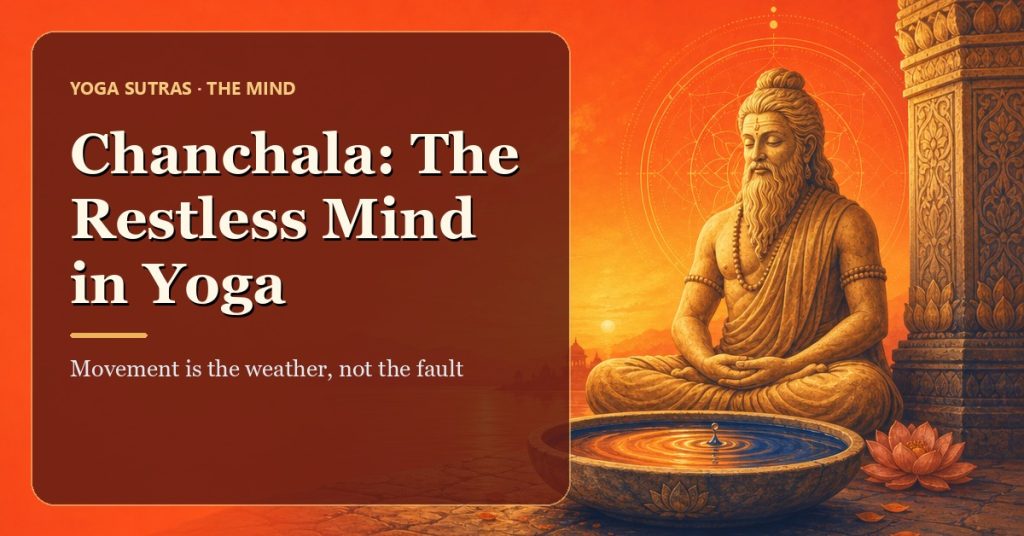
Chanchala: The Restless Mind in Yoga
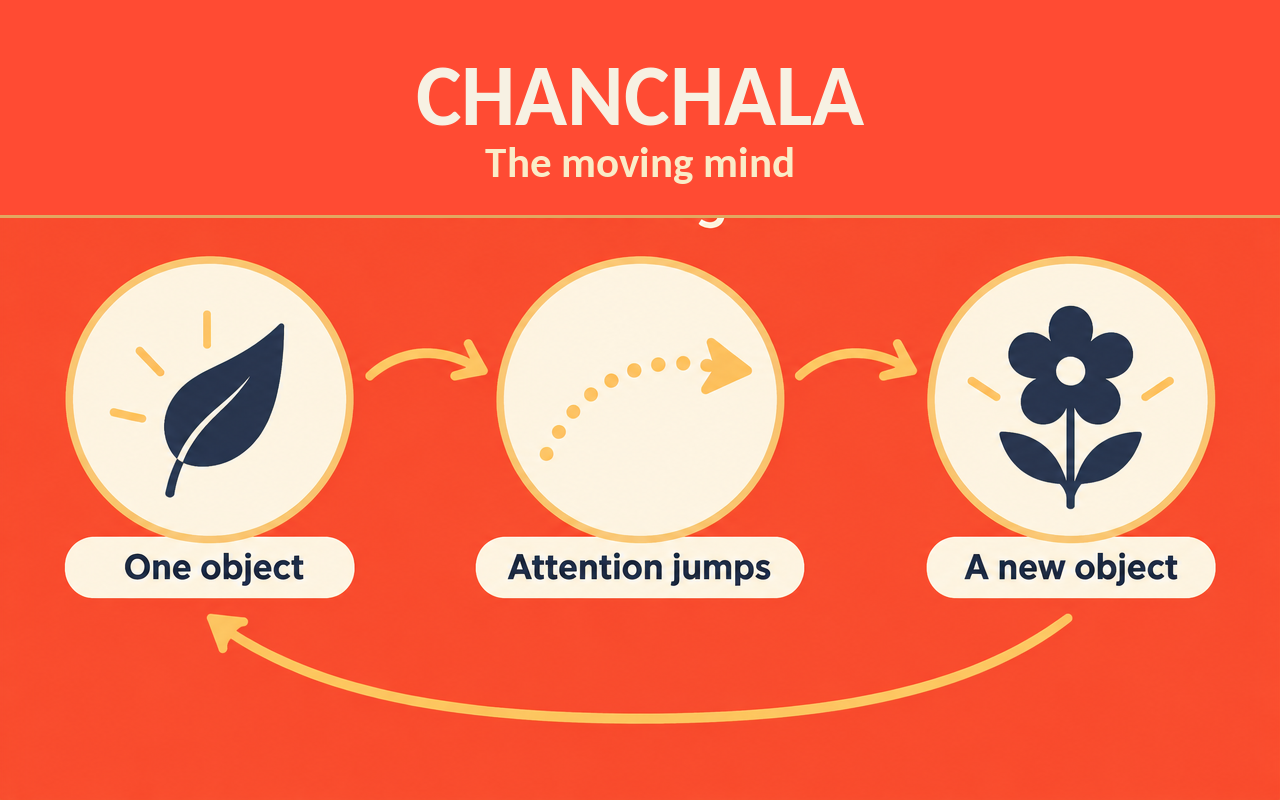
Chanchala (चञ्चल, cañcala) means moving, unsteady, fickle — the quality of a mind that will not stay where it is put. The word is built from a root meaning “to move” and appears in the Bhagavad Gita’s most quoted description of the mind: restless, turbulent, strong, and obstinate (6.34). In the Yoga Sutras the same condition is described through its effects, as scattering and as the disturbances that accompany it (1.30–1.31). This article explains the term, why the tradition treats restlessness as a condition rather than a sin, and what actually reduces it.
In Sri Amit Ray’s 114-chakra tradition, chanchala is associated with the basic chakras that the teaching links to concentration and attention and to emotional balance, and with the power chakras it connects to overcoming stress and restoring calm. This is where the chakra teaching becomes practical: chanchala arises when the flow through those centres is blocked, and clearing the blockage restores steadiness of attention. The practitioner names the movement of the mind, returns to a chosen centre, and shortens the practice rather than forcing it; the tradition describes steadiness as something that grows through repetition. Sri Amit Ray’s 114 chakra model gives this practice a living map of awareness to work with.
At a glance
| Sanskrit | चञ्चल · cañcala · moving, restless, unsteady |
|---|---|
| Primary text | Bhagavad Gita 6.34; Yoga Sutras 1.30–1.32 |
| Tradition | Classical Yoga and the Gita’s teaching on mind |
| Practice form | Naming the movement, returning to one anchor, shortening sessions when needed |
| Nearest contrast | Ekagrata, one-pointedness; also vritti, the movements themselves |
| 114-chakra association | Basic centres for attention and emotion; power centres for calm |
What the word names
Chanchala describes motion rather than content. A mind can be restless while thinking about something noble, and it can be still while thinking about nothing in particular. This is why the term is not a judgement about the quality of one’s thoughts: it names the tendency to move, which the Gita says is native to the mind rather than acquired by bad habits.
The word also covers the body. The Gita’s description of the restless mind is followed by instructions on posture and breath (6.11–13), and the Yoga Sutras list physical agitation among the signs that accompany mental scattering (1.31). Chanchala is therefore not only an inner event; it shows up in fidgeting, shallow breathing, and the urge to check something.
Where it appears in the texts
Gita 6.34 gives the classic diagnosis and 6.35 the reply: the mind is restless, but it is held by practice and dispassion. The two verses are usually quoted together because the first without the second sounds like despair and the second without the first sounds like a slogan. The Gita does not promise that the mind stops moving; it promises that the movement can be held.
Yoga Sutra 1.30 lists the obstacles that scatter the mind — illness, dullness, doubt, carelessness, laziness, and the rest — and 1.31 describes their companions: pain, gloom, trembling, and disordered breath. Sutra 1.32 then gives the remedy of single-pointed practice, and 1.33–1.39 add a set of supports. The sequence is instructive: the text names the condition plainly before offering any technique.
Why it matters in practice
Students often treat restlessness as evidence that they are doing something wrong. The result is a second layer of struggle on top of the first: the mind moves, and then the practitioner is upset about the movement. Naming chanchala removes that layer. Restlessness is the weather of the mind; the practice is what you do in it.
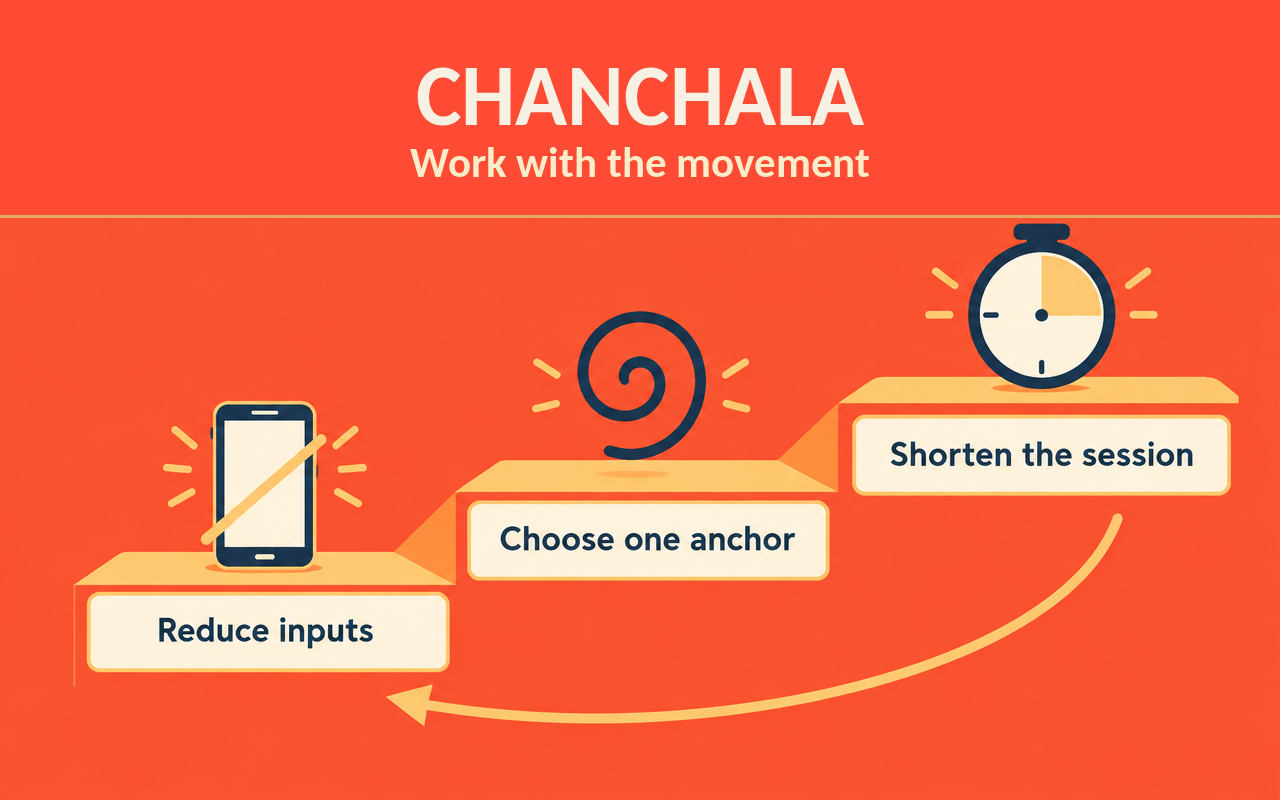
Recognising the term also changes the remedy. A restless mind does not need a more ambitious practice; it needs a smaller one. Shortening the session, reducing sensory input, and returning to a single anchor usually does more than extending the time.
How to work with chanchala
- Name it early. “Moving” is enough. Naming converts a mood into an observable event.
- Reduce inputs. Close the screen, sit facing a wall, and put the phone in another room.
- Choose one anchor. Breath at the nostrils or a single word. Do not negotiate a new technique mid-session.
- Shorten the session. Ten honest minutes beat forty minutes of struggle; length can return later.
- Use the body. A few slow exhalations or a short walk before sitting often settles more than effort does.
- Note the pattern. If restlessness always arrives at a certain time, change the time rather than the will.
When the mind will not settle at all: practise for two minutes and stop without judging the result. The Gita’s remedy is continuity, and a two-minute return tomorrow is part of that continuity.
Common misunderstandings
Chanchala is the mind’s natural tendency to move. The Gita describes the mind as restless by nature, which places the condition before any individual’s effort.
It settles through practice and dispassion. Gripping attention usually increases agitation; the texts recommend practice and dispassion, not strain.
It is the general tendency; a single distraction is one instance. Chanchala is the general tendency to move; a specific distraction is one instance of it.
Signs of progress
The movement is noticed sooner and with less commentary. Recovery after a wandering episode shortens. Practitioners often find that the body settles before the mind does, and that the urge to check something loses urgency. The measure is the return, not the absence of movement.
Traditional benefits
The Gita’s promise is that the restless mind can be held by practice and dispassion (6.35), not that it becomes motionless. The Yoga Sutras present single-pointed practice as the response to scattering (1.32) and describe the gradual steadiness that follows. The tradition treats this as the ordinary work of a practitioner rather than as an advanced attainment.
Research on attention offers partial context. In a 2014 JAMA Internal Medicine meta-analysis, Goyal and colleagues reported moderate support for anxiety and depression and thinner evidence elsewhere. Lutz and colleagues (Trends in Cognitive Sciences, 2008) describe focused-attention training and open monitoring as two families of practice, with different reported effects. Tang, Hölzel and Posner (Nature Reviews Neuroscience, 2015) review attention and stress findings across heterogeneous studies. None of these studies tests chanchala, and none establishes a subtle-body claim.
For public context, the WHO describes mental health as part of overall health, and the European Commission’s mental health page treats prevention as a public-health priority. Neither addresses meditation technique.
How chanchala connects to the 114-chakra framework
Sri Amit Ray’s model describes 114 centers — 108 internal plus 6 external — grouped into 7 basic, 21 power, and 86 master chakras, within a map that uses 11 dimensions and 15 nested layers. Chanchala is not a center in that map; it is a condition of the mind that uses the map. In Sri Amit Ray’s 114 chakra system, chanchala is deeply connected to the practice.
The connection is practical and experiential. A student takes one named center as the anchor, notices when attention has moved, names the movement, and returns. Basic chakras are the usual first anchors because they are easy to locate conceptually; the power chakras are described in the tradition as supporting calm and emotional balance, which is why they are often used when restlessness is strong. What must not be claimed is that restlessness “blocks” a center, that a settled sensation proves an opening, or that the practice replaces clinical care for anxiety. See Sri Amit Ray’s 114 Chakras and 72,000 Nadis framework, and his teaching on working with difficult thoughts.
Related concepts
- Vritti — the movements themselves, of which restlessness is one pattern.
- Ekagrata — the gathered attention that is trained against the tendency to move.
- Abhyasa — continuity, the Gita’s answer to a restless mind.
- Mauna — silence, which removes some of the inputs that feed scattering.
The series is indexed in the Master Yoga Concepts Guide; for restlessness worked with through movement, see IFYM’s Surya Namaskar and 114 Chakras guide.
Further reading and sources
Primary: Bhagavad Gita 6.34–35; Yoga Sutras 1.30–1.32. Context: Sri Amit Ray on difficult thoughts and the 114 centers. Research: Goyal et al., JAMA Internal Medicine 174 (2014); Lutz et al., Trends in Cognitive Sciences 12 (2008); Tang, Hölzel and Posner, Nature Reviews Neuroscience 16 (2015).
Frequently asked questions
Is a restless mind a sign I cannot meditate?
No. The Gita treats restlessness as the normal condition of the mind, and 6.35 gives practice and dispassion as the response.
Should I force the mind to stay?
No. Force usually increases agitation. Name the movement and return, shortening the session if necessary.
Why does restlessness get worse when I try to sit?
Because sitting removes the distractions that were masking it. The increase is often the first honest view of the mind.