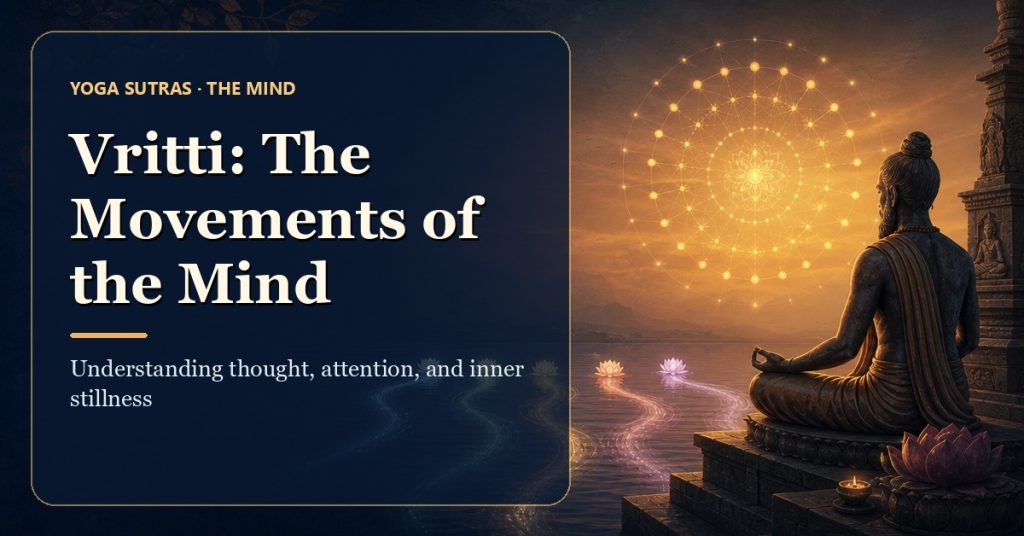
Vritti: The Movements of the Mind
Vritti (वृत्ति, vṛtti) is a turning, a movement, or a modification of the mind. Patanjali opens the Yoga Sutras by naming it: yoga is the stilling of the movements of the mind (1.2). He then lists five forms they take and defines each one (1.6–1.11). The term is small, but everything else in the text depends on it, because the whole discipline is organised around what these movements are and how they are recognised.
In Sri Amit Ray’s 114-chakra tradition, vritti is associated with the basic and master chakras that the teaching links to concentration and attention, emotional balance, and overcoming stress and restoring calm. This is where the chakra teaching becomes practical: the movement of vritti arises when the flow through those centres is blocked, and clearing the blockage restores a settled mind. The practitioner holds one named center as the anchor and notices when attention has been turned by knowing, misperception, imagination, sleepiness, or memory; the tradition describes the result as steadier familiarity with that center, not as the removal of thought. Sri Amit Ray’s 114 chakra model gives this practice a living map of awareness to work with.
At a glance
| Sanskrit | वृत्ति · vṛtti · a turning, movement, or modification of mind |
|---|---|
| Primary text | Yoga Sutras 1.2, 1.4, 1.5–1.11 with Vyasa’s commentary |
| Tradition | Classical Yoga, with the vocabulary reused in Vedanta and Hatha contexts |
| Practice form | Recognising a mental event as a movement, then returning to the chosen focus |
| Five forms | Pramāṇa, viparyaya, vikalpa, nidrā, smṛti |
| Nearest contrast | Puruṣa, the witnessing seer, which is not itself a movement |
| 114-chakra association | Basic and master chakras linked in Ray’s teaching to attention, emotional balance, and stress |
What the word names
The noun derives from the root vṛt, “to turn”, and means a turning, a mode of being, or an operation. In grammar the word can name a way of living; in logic, a property that holds of a subject; in yoga, the activity of the mind. The root image is not “thought” as a thing but as a turning of something that is otherwise still.
Patanjali’s compound is citta-vṛtti, the movements of citta — the mind taken as the whole field of attention, memory, and feeling. A vritti is therefore not only a verbal thought. A remembered face, a mistaken impression, a planning fantasy, and the dullness of sleep are all vrittis, because each is a turn the mind takes.
The stakes appear in sutra 1.4: when the vrittis are active, the seer appears to take their form. Anxiety does not merely happen; it briefly becomes the whole point of view. This is why Patanjali treats recognition of the vritti as the beginning of freedom.
Where it appears in the texts
Sutra 1.2 states the aim: yogaś citta-vṛtti-nirodhaḥ, yoga is the stilling of the movements of citta. Sutra 1.3 gives the result: the seer rests in its own nature. Sutra 1.4 explains what happens otherwise: the seer appears to take the shape of the vrittis.
Sutra 1.5 classifies all vrittis as either painful or not painful, which prevents a moral reading of the list: a true perception can still be bound up with grasping, and a painful memory is not a fault. Sutra 1.6 names five forms, and 1.7–1.11 define each one:
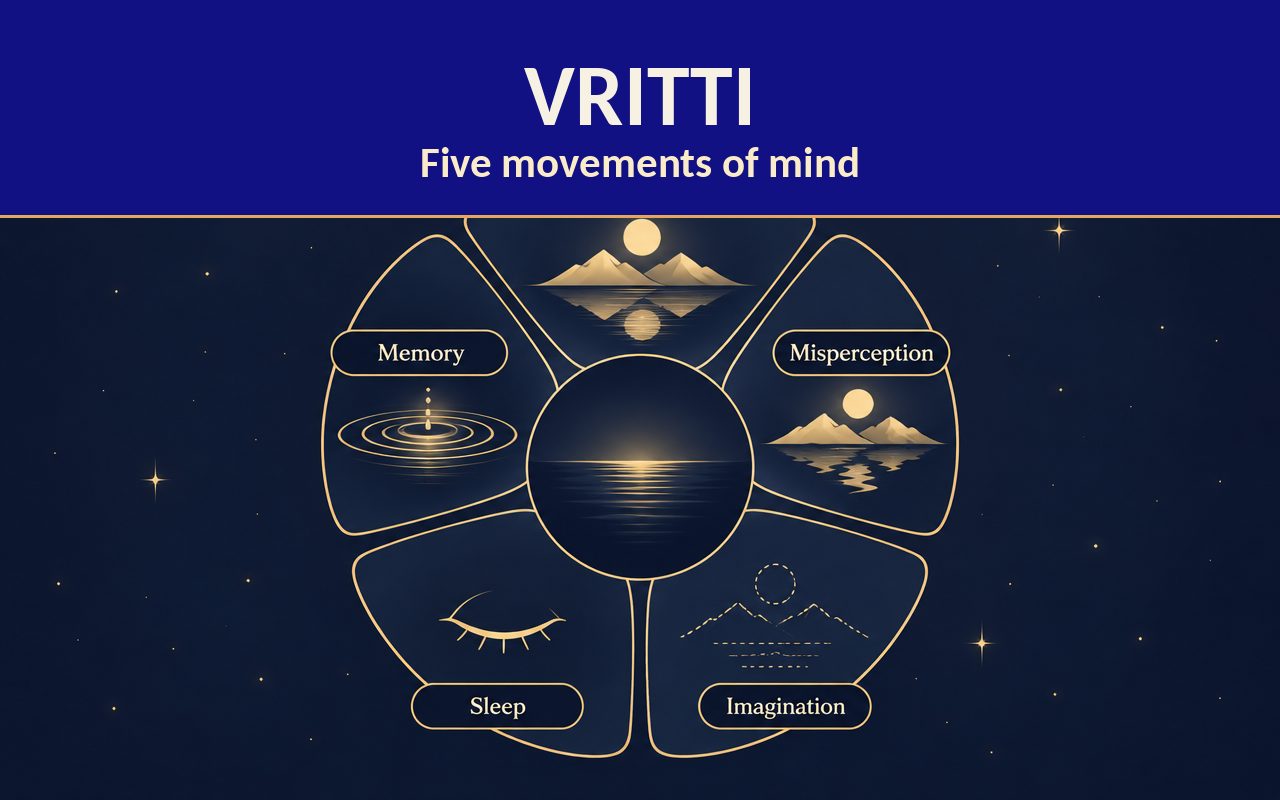
- Pramāṇa — valid knowing, arising from direct perception, inference, or reliable testimony (1.7).
- Viparyaya — misperception, knowledge that does not correspond to the object (1.8).
- Vikalpa — conceptual construction, a verbal idea with no corresponding object (1.9).
- Nidrā — sleep, a vritti resting on the absence of a waking object (1.10).
- Smṛti — memory, the returning of what has been experienced (1.11).
Vyasa’s commentary adds the practical insight that these five categories cover ordinary life completely: there is no sixth mental event waiting to be discovered. What changes with practice is not the inventory but the practitioner’s relationship to it.
Why it matters in practice
A practitioner sits down to meditate and finds the mind full of commentary: a shopping list, a remembered remark, a plan for tomorrow, a story about why the practice is going badly. Without a concept for this, the natural response is either to fight the contents or to conclude that one is bad at meditation. Vritti gives a third option: the contents are movements, and movements can be observed without being obeyed.
The concept also explains why a good session is not the goal. If the aim were a quiet mind, every busy sitting would be a defeat. If the aim is recognition, a busy sitting can be the most instructive hour of the week, because many movements were seen.
How to work with vritti
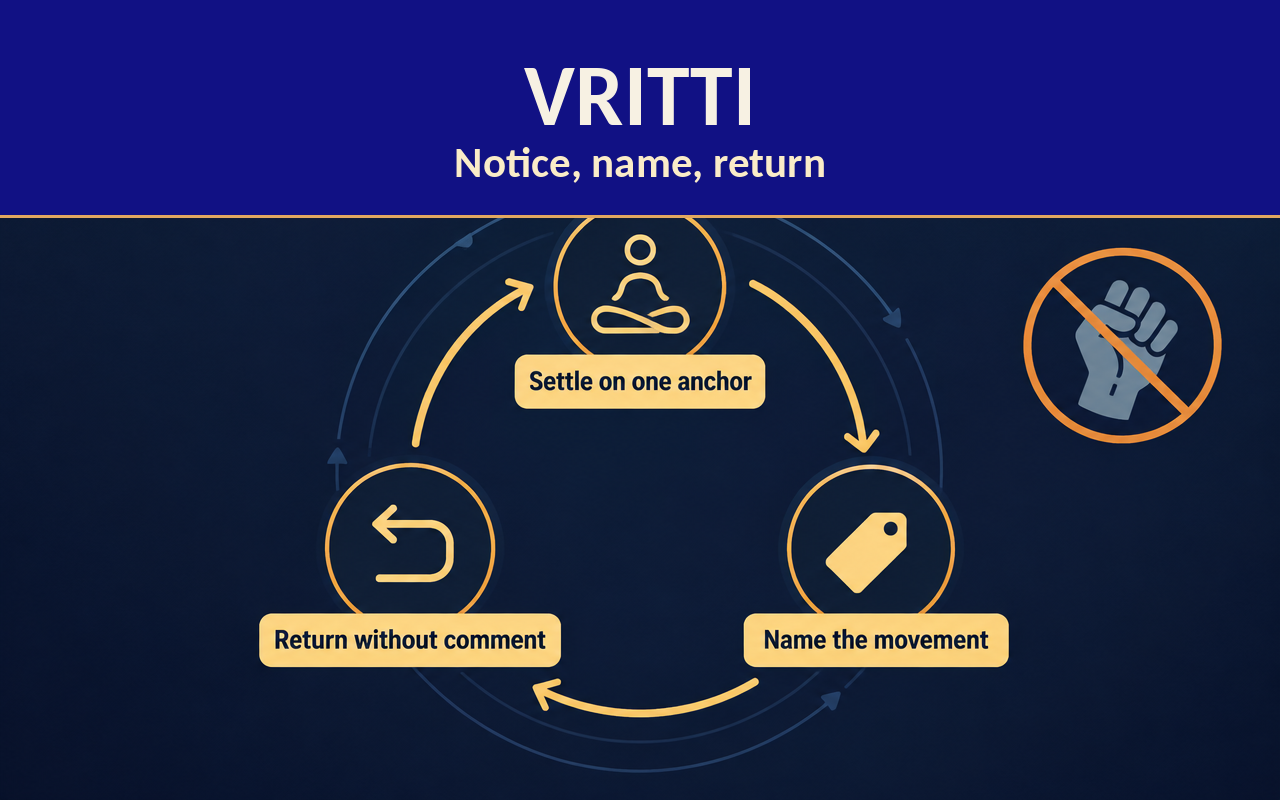
- Settle first. Take a comfortable seat and let the breath find its own rhythm for two or three minutes. Do not begin by analysing the mind.
- Choose one anchor. Breath at the nostrils, a mantra, or the sensation of sitting. This is the place to return to.
- Name the movement silently. When attention is taken, use one of the five words: knowing, misperception, imagining, sleepiness, remembering. A single word is enough.
- Return without commentary. The naming is not a second thought to be elaborated. Label once, then go back to the anchor.
- End with a short review. Note which category appeared most. This is information about habit, not a score.
When it becomes a struggle: naming can turn into a running commentary about the naming. If that happens, drop the labels for a few minutes and simply return to the anchor. Abhyasa supplies continuity; vairagya supplies the willingness to let each movement pass.
Common misunderstandings
Nirodha is a settled, natural quieting of the mind. Patanjali’s stilling is a settled quiet that comes from steady recognition. The classical reading is cessation of identification: movements may arise, but they no longer define the seer.
Pleasant vrittis are still vrittis. A blissful experience in meditation is a movement of mind like any other. Treating it as proof of progress is precisely the attachment sutra 1.4 describes.
The five categories are practical descriptions of mental movement. Viparyaya means a mistaken cognition, not a disorder, and nidra is ordinary sleep, not lethargy to be cured. Applying clinical labels to this list misreads the text.
Signs of progress
Progress with vritti is measured in recognition. The practitioner notices a mental event earlier, before it has gathered a story. Emotional weather is observed with slightly more room around it. The five categories become useful shorthand rather than a theory to defend. Patanjali’s own marker is sutra 1.3: moments in which the seer rests in its own nature, however brief.
Traditional benefits
The Yoga Sutras attribute the whole aim of yoga to this recognition: stilling the vrittis allows the seer to abide in itself. Sutra 4.34 describes the final resolution in which the gunas, their purpose fulfilled, return to their source. The practical fruit described throughout the text is discernment, viveka, and the gradual withdrawal of the sense of being the movements.
Research on the same human functions offers partial context. Goyal and colleagues (JAMA Internal Medicine, 2014) found moderate evidence for reduced anxiety and depression in a meta-analysis of meditation programmes, with weaker evidence for stress and attention. Hölzel and colleagues (2011) propose emotion regulation and a changed self-perspective among the mechanisms of mindfulness — a model, not a measured outcome. Neither study identifies vrittis in the brain, and neither shows that observing a mental movement opens a chakra.
For public context, the WHO describes mental health as an integral part of health rather than the mere absence of disorder, and the European Commission’s mental health policy page frames prevention as a public-health priority. Both are health-policy positions; neither evaluates the five vrittis or the subtle-body map.
What modern research can and cannot say
Contemporary work on attention and self-referential thought gives partial context. Tang, Hölzel and Posner (2015) review evidence that meditation training is associated with changes in attention and emotion regulation. Lutz and colleagues (2008) describe two families of practice, focused attention and open monitoring, and the neural patterns reported for each. Brewer and colleagues (2011, PNAS) found differences in default-mode network activity and connectivity in experienced meditators, in a small cross-sectional sample.
These findings concern attention, narrative self-processing, and brain activity. They describe five movements of mind rather than five brain regions, and they connect to the 114 chakra map as a contemplative practice. The classical framework stands on its own textual authority; research is offered here as context for readers who want a modern vocabulary.
How vritti connects to the 114-chakra framework
Sri Amit Ray’s model describes 114 centers — 108 internal plus 6 external — grouped into 7 basic, 21 power, and 86 master chakras, within a subtle-body map that uses 11 dimensions and 15 nested layers. Vritti belongs to Patanjali’s analysis of mind and is deeply connected to the 114 chakra map as a contemplative practice. The relationship is therefore methodological.
Used as a practical connection, the five categories give a practitioner a way to stay honest while moving attention through the layers of the map. A student takes one named center from Ray’s teaching, holds it as the anchor, and notices when the attention has been turned by knowing, misperception, imagination, sleepiness, or memory. The category is noted; the attention returns to the named center. Over time the map becomes a set of familiar places rather than a diagram. What must not be claimed is that observing a vritti opens a particular center, that a sensation proves a layer, or that this practice replaces medical care. The interpretive label protects both traditions from being flattened into each other. Ray’s account of nirodha and samapatti treats the stilling of mind as a graded practice. See Sri Amit Ray’s 114 Chakras and 72,000 Nadis framework for his own account.
Related concepts
- Abhyasa — the continuity that makes repeated recognition possible, and the twin of vairagya in sutra 1.12.
- Ekagrata — one-pointedness, the positive counterpart of a mind no longer scattered by movements.
- Stilling thought — a close reading of nirodha, useful once the five categories are recognised.
- Kaivalya — the freedom described when the vrittis no longer colour the seer.
All 55 concepts are indexed in the Master Yoga Concepts Guide. For a moving practice that trains the same watching attention, see IFYM’s Surya Namaskar and 114 Chakras guide.
Further reading and sources
Primary: Yoga Sutras 1.2–1.11 and 4.34 with Vyasa’s commentary (Sanskrit text with IAST transliteration); Bhagavad Gita 6.35 for the restless-mind passage that parallels 1.12. Context: Sri Amit Ray’s 114-chakra description. Research: Tang, Hölzel and Posner, Nature Reviews Neuroscience 16 (2015); Lutz et al., Trends in Cognitive Sciences 12 (2008); Brewer et al., PNAS 108 (2011).
Frequently asked questions
Are vrittis thoughts?
Only partly. The five categories include perception, error, verbal construction, sleep, and memory, so vritti covers far more than verbal thinking.
Must I stop all thought to practise yoga?
The text’s aim is the stilling of movements through recognition and dispassion, not the forcible stopping of content. Effort against thought usually increases agitation.
How do I know which vritti is present?
Ask one question: is this knowing, mistaken, imagined, sleepy, or remembered? If none fits clearly, return to the anchor and let the next movement identify itself.
Is it useful to write the categories down after sitting?
Yes, briefly. A line or two about which category dominated gives a record of habit without turning the practice into self-assessment.