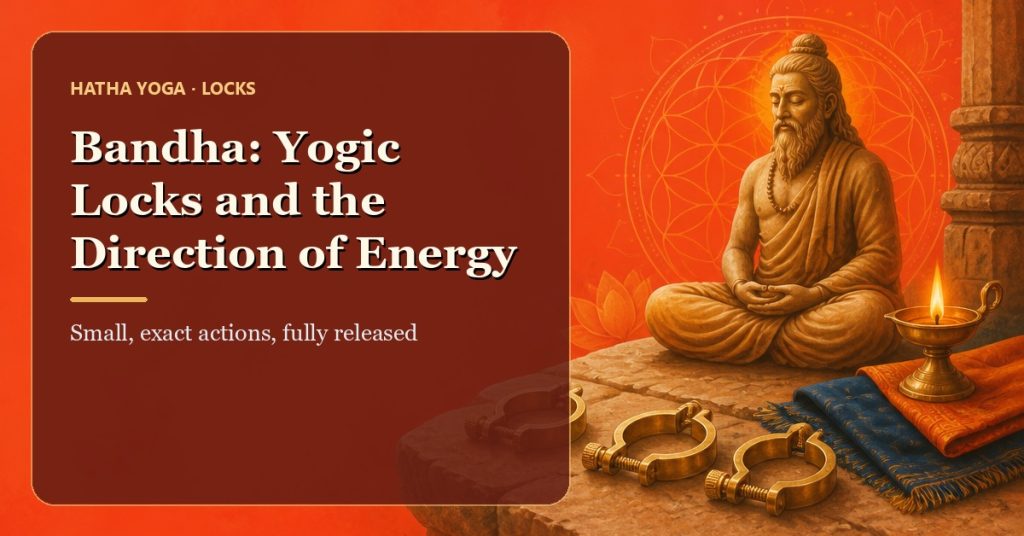
Bandha: Yogic Locks and the Direction of Energy
At a glance
| Sanskrit | बन्ध · bandha · lock, binding |
|---|---|
| Primary text | Hatha Yoga Pradipika chapter 3; Gheranda Samhita chapter 3 |
| Tradition | Hatha yoga, especially in relation to breath retention |
| Practice form | Gentle contraction at root, abdomen, or throat, held briefly and released fully |
| Nearest contrast | Strain or breath-holding by force, which the texts warn against |
| 114-chakra association | Basic centres for attention; power centres for vitality |
What the word names
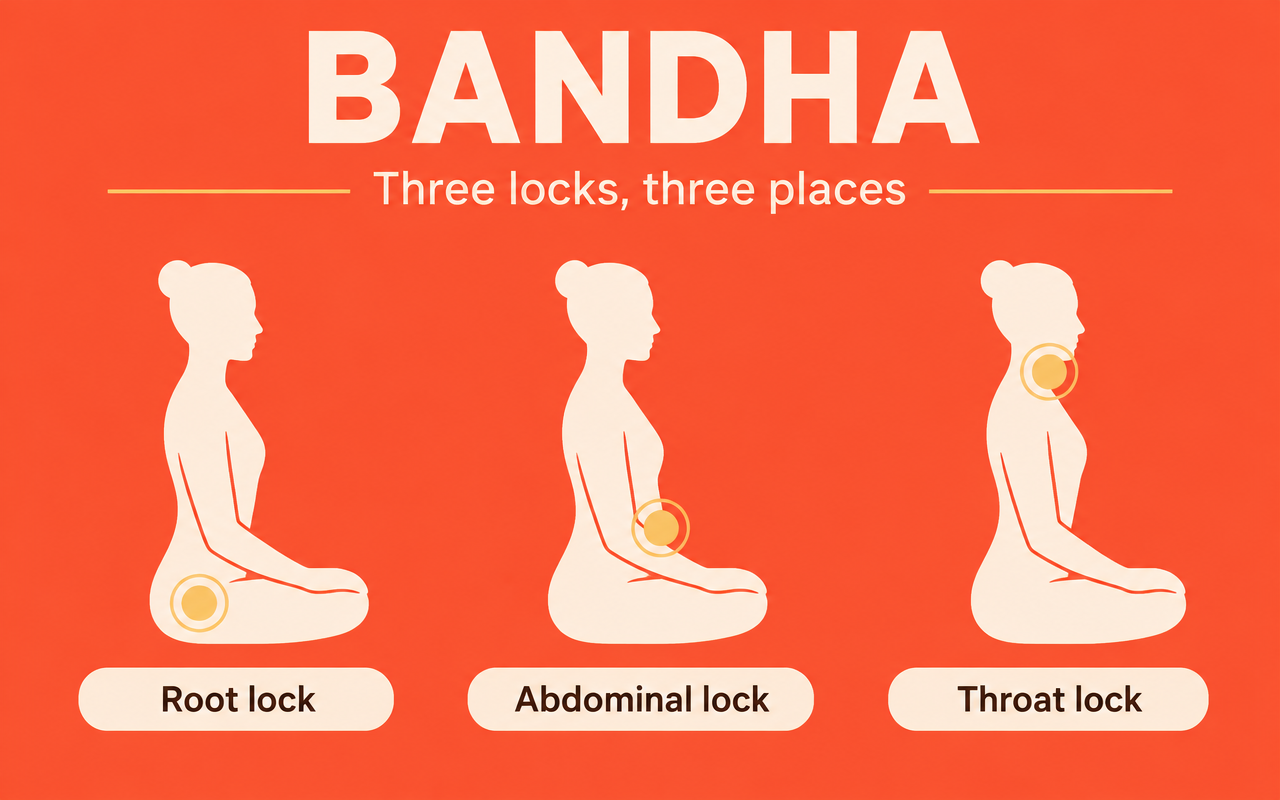
A bandha is a binding, and the physical image is exact: a channel is held so that something can gather. The three principal locks are mūla bandha at the pelvic floor, uḍḍīyāna bandha in the abdomen, and jālandhara bandha at the throat. Each is a small, precise contraction, not a general tension, and each is released as deliberately as it is applied.
The term also has a broader sense of “bond” or “restraint”, which is why the Hatha texts can speak of bandhas as both muscular actions and disciplines of the senses. The two meanings reinforce each other: the body is bound so that attention can be gathered, and attention is bound so that the mind stops scattering.
Where it appears in the texts
The Hatha Yoga Pradipika treats the bandhas within its chapter on mudras, and the Gheranda Samhita does the same in its chapter on seals. The texts describe the locks in connection with breath retention (kumbhaka) and warn that practice without proper preparation is harmful. Their sequence is consistent: posture, breath, lock, release.
The Yoga Sutras describe the bandhas through the practices of posture and breath. Sutras 2.46–48 describe posture as steady and comfortable, and 2.49–53 describe breath regulation, but the specific locks belong to the later Hatha synthesis. This matters for honest teaching: a classical Yoga class and a Hatha class are not doing the same thing, even when the words overlap.
Why it matters in practice
The bandhas are the clearest example of a technique that is easy to perform badly. A student hears “root lock” and clenches everything from the jaw down; the result is strain, shallow breathing, and a headache. The texts ask for the opposite: a light, local action that can be held while the face and belly stay soft.
Used well, the locks teach precision. They show that effort can be small and exact rather than large and vague, and that release is part of the action. That lesson transfers to attention: a mind can be gathered without being squeezed.
How to practise bandha
- Learn one lock at a time. Begin with jalandhara in a comfortable seated position, with a teacher if possible.
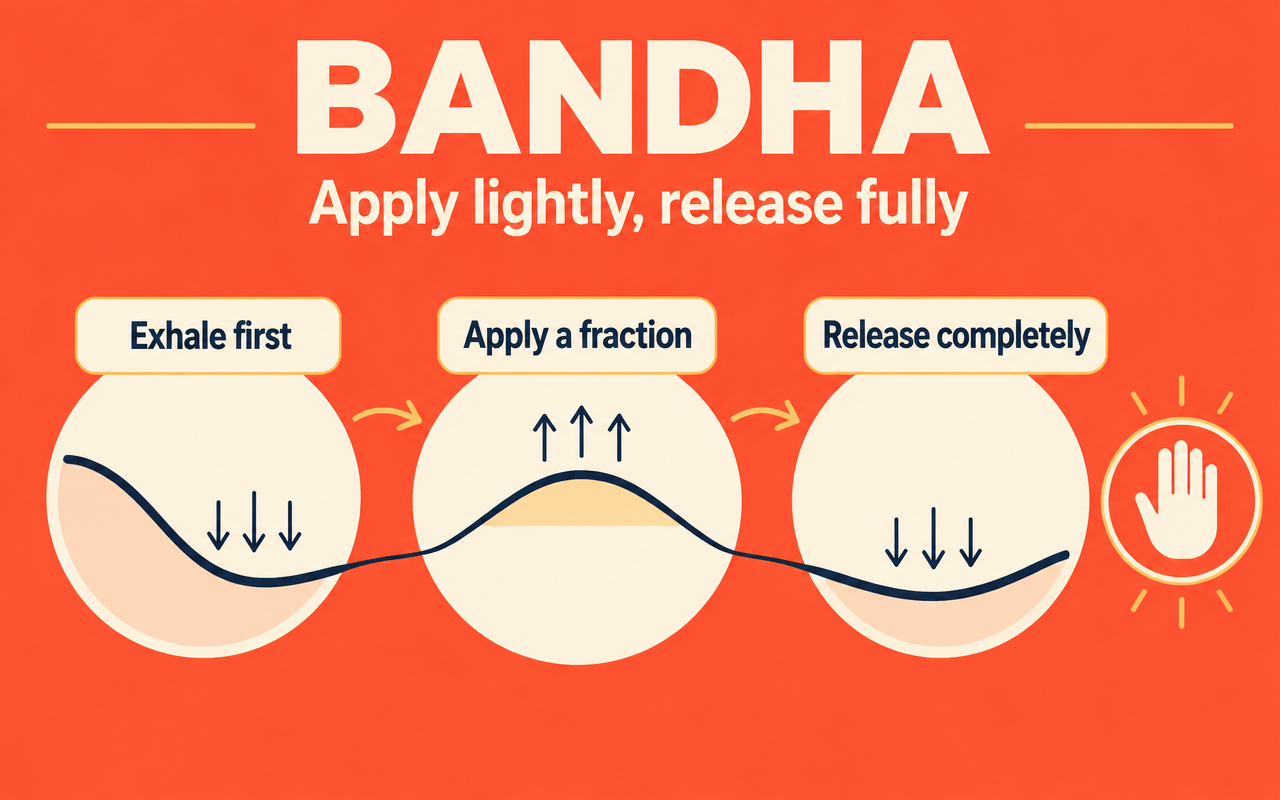
- Start with the breath out. Uddiyana and mula are traditionally applied after a full exhale, never on a forced hold.
- Use a fraction of the force you think. A light lift or drawing-in is enough; the jaw, eyes, and tongue stay soft.
- Hold for two or three seconds. Duration grows slowly and only with ease.
- Release completely before inhaling. Releasing is part of the technique, not an afterthought.
- Stop at the first sign of strain. Dizziness, pressure in the head, or a pounding heartbeat means release and rest.
Who should be cautious: pregnancy, recent surgery, uncontrolled blood pressure, glaucoma, hernia, and heart conditions are commonly listed as reasons to avoid breath retention and abdominal locks. These are practical precautions, not medical advice; consult a qualified teacher and clinician.
Common misunderstandings
Bandha is a light, precise seal held with the breath. A clenched body cannot breathe, and the lock depends on breath. The action is local and light: one region, minimum force.
Bandhas are refined practices that reward patient preparation. The Hatha texts place them with mudras, after posture and breath are established, and they are traditionally taught with supervision.
They guide energy gently with breath and attention. The tradition’s language of directing prana is metaphorical and practical; forcing sensations is a sign of strain, not progress.
Signs of progress
The locks become smaller and easier to release. Breath stays smooth while a lock is held briefly. Practitioners report a clearer sense of the pelvic floor and lower abdomen, and less tendency to hold the breath in daily life. The reliable sign is control of release, not intensity of contraction.
Traditional benefits
The Hatha texts present the bandhas as supports for breath retention and for the inner heat that they associate with practice. Their claims belong to that tradition’s physiology and should be quoted as such. The practical benefits described in class — better breath awareness, steadier posture, clearer attention — are modest and observable.
Research gives limited context. Lupien and colleagues (Nature Reviews Neuroscience, 2009) review how breathing and stress systems interact across the lifespan, which is relevant to any practice involving breath holding. Goyal and colleagues (JAMA Internal Medicine, 2014) found moderate evidence for reduced anxiety and depression in meditation programmes. Hölzel and colleagues (2011) propose body awareness and attention regulation as mechanisms of mindfulness, in a framework rather than a trial. None of these studies tests bandha, and none supports a claim about immunity or healing.
For public context, the Ayush yoga portal publishes official protocols in which breath and lock practice appear with cautions. It describes public instruction, not clinical evidence.
How bandha connects to the 114-chakra framework
Sri Amit Ray’s model describes 114 centers — 108 internal plus 6 external — grouped into 7 basic, 21 power, and 86 master chakras, within a map that uses 11 dimensions and 15 nested layers. Bandha is deeply connected to the 114 chakra system as an action that accompanies attention to a centre. In Sri Amit Ray’s 114 chakra system, the bandhas are deeply connected to the practices.
In practice, a student applies a light lock, rests attention on a named center, and releases both together, so that the lock does not become an end in itself. Basic chakras support the first steadying; the power chakras are described in the tradition as supporting vitality and confidence. What must not be claimed is that a lock “opens” a center, that pressure or heat proves a layer, or that bandha replaces medical treatment for any condition. See Sri Amit Ray’s 114 Chakras and 72,000 Nadis framework, and his teaching on kaya vyuha yoga.
Related concepts
- Prana — the breath-energy the locks are traditionally said to gather.
- Drishti — gaze, which is usually paired with locks in posture practice.
- Kriya Yoga — a lineage in which breath, lock, and attention are combined.
- Kundalini — the Hatha context in which locks are often taught, with strong cautions.
The series is indexed in the Master Yoga Concepts Guide; for locks inside a moving sequence, see IFYM’s Surya Namaskar and 114 Chakras guide.
Further reading and sources
Primary: Hatha Yoga Pradipika chapter 3 and Gheranda Samhita chapter 3, with their cautions on retention. Context: Sri Amit Ray on kaya vyuha yoga and the 114 centers. Research: Lupien et al., Nature Reviews Neuroscience 10 (2009); Goyal et al., JAMA Internal Medicine 174 (2014); Hölzel et al., Perspectives on Psychological Science 6 (2011).
Frequently asked questions
Do I need a teacher for bandha?
For the abdominal and root locks, yes at the beginning. The throat lock is simpler, but retention should still be learned with supervision.
Can bandhas be practised without breath retention?
Yes, lightly, as a way of learning the action; the classical use is with retention.
Why do I feel pressure in my head?
Usually because the lock is too strong or the breath is being forced. Release, breathe normally, and reduce the effort.