Santosha: Contentment as a Yogic Practice
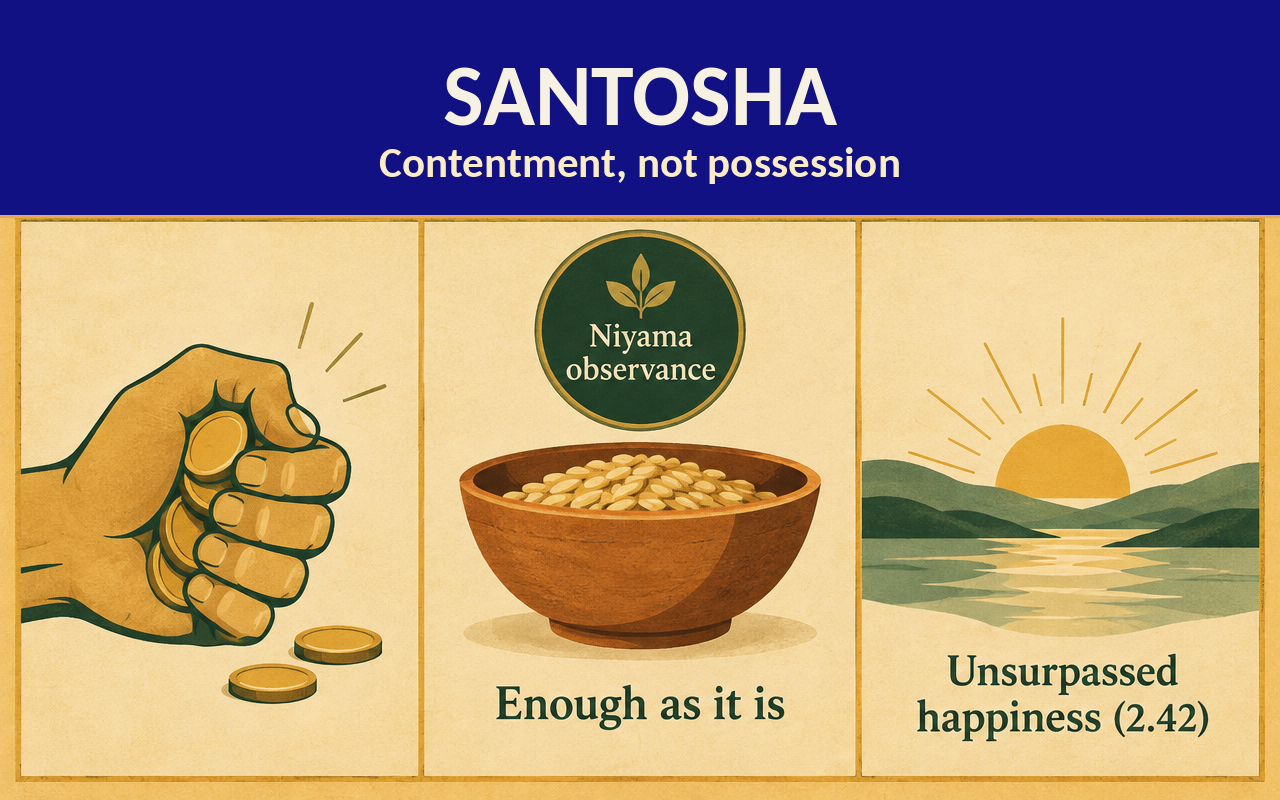
Santosha (संतोष, saṃtoṣa) means contentment: the settled recognition that what is present is enough for this moment. Patanjali lists it among the five niyamas in Yoga Sutra 2.32 and gives its result in 2.42 — from contentment arises unsurpassed happiness. The claim is not that circumstances are perfect, but that the habit of demanding more can be seen and set down. This article explains the term in the text, how it is practised without becoming resignation, and how the 114-chakra tradition frames it.
In Sri Amit Ray’s 114-chakra tradition, santosha is associated with the basic and power chakras that the teaching links to emotional balance, overcoming stress and restoring calm, and compassion and relationships. Every one of those centres is a place where attention can rest, so the quality grows through the map rather than beside it. The practitioner rests attention on a named center while deliberately stopping the inner rehearsal of “not enough”; the tradition describes the result as a steadier, warmer quality of presence rather than as the acquisition of anything new. This is how the tradition itself describes the work; no medical outcome is claimed for it.
At a glance
| Sanskrit | संतोष · saṃtoṣa · contentment, satisfaction |
|---|---|
| Primary text | Yoga Sutras 2.32 (the niyamas) and 2.42 (the fruit of contentment); Vyasa’s commentary |
| Tradition | Classical (Patanjali) Yoga; a shared ethical value across Indian traditions |
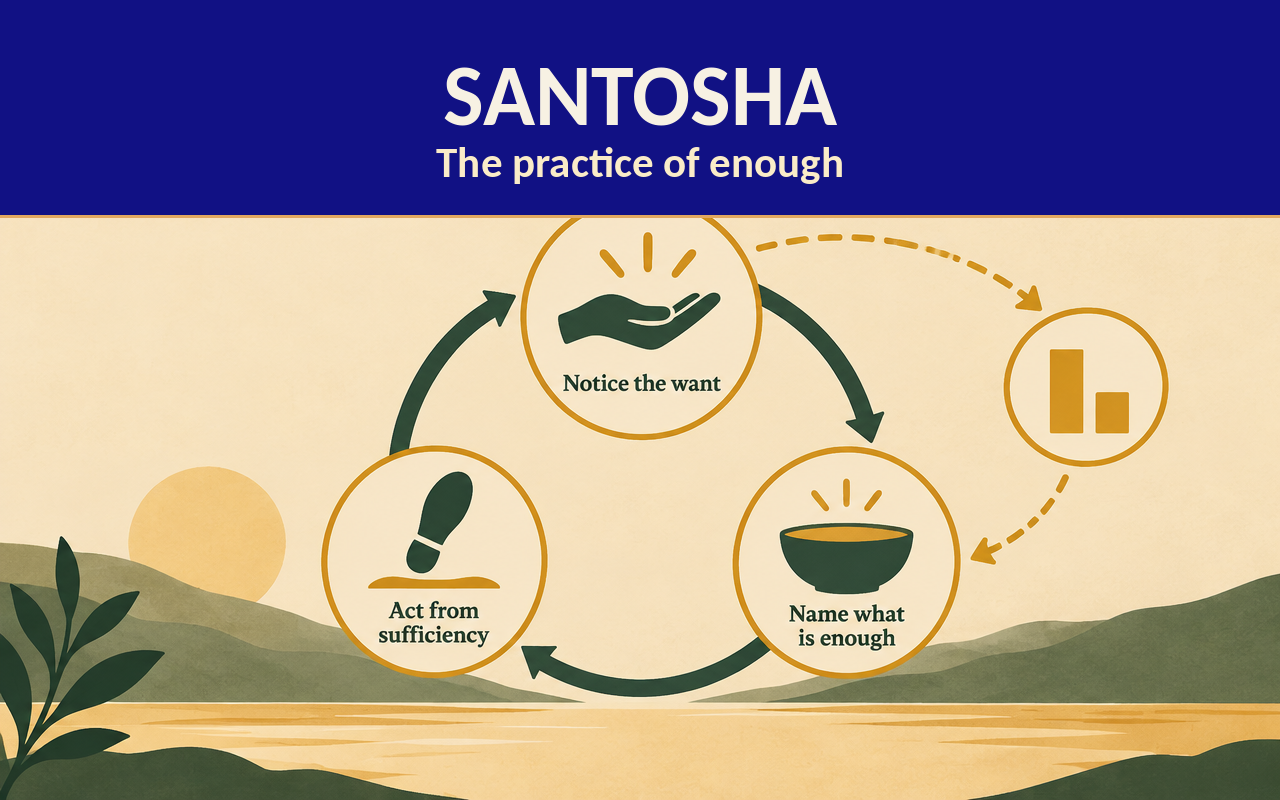
| Practice form | Noticing the demand for more, naming what is sufficient, and acting from sufficiency |
| Nearest contrast | Aparigraha, non-possession in action; and tṛṣṇā, thirst, as its opposite tendency |
| 114-chakra association | Basic and power chakras linked in Ray’s teaching to emotion, stress, and relationships |
What the word names
The noun comes from saṃ-, “together, fully”, and the root tuṣ, “to be satisfied”, so the word names a satisfaction that has settled rather than a pleasure that has arrived. It is closer to “enough-ness” than to happiness. A person can be pleased and discontent, or uncomfortable and content, which is why the term cannot be translated by a mood.
Patanjali’s placement is instructive. Santosha sits in the second chapter among the niyamas, the observances that shape daily life, not among the meditative absorptions. It is a practice of conduct before it is a state, and the tradition treats it as something cultivated in small decisions: what one buys, what one compares, what one says about another’s life.
Where it appears in the texts
Sutra 2.32 lists the niyamas: purity, contentment, discipline, study, and dedication to the divine. Sutra 2.42 states the fruit of contentment directly: santoṣād anuttamaḥ sukha-lābhaḥ, “from contentment, unsurpassed happiness is obtained.” Vyasa’s commentary explains the practice as not coveting what belongs to others and being satisfied with what has been lawfully obtained — a definition that keeps the term tied to conduct rather than to feeling.
The neighbouring sutras make the contrast clear. Sutra 2.39 says that with non-possession comes knowledge of the purpose of existence, and 2.37 says that with non-stealing all wealth appears. Contentment is not the same as these; it is the inner side of the same restraint, the recognition that the appetite for more is itself the difficulty. In the Bhagavad Gita, 12.15 praises the one who neither agitates the world nor is agitated by it, a description that includes the social face of contentment.
Why it matters in practice
Most suffering in a practice week is not caused by pain but by the gap between what is and what is wanted: a better sitting, a calmer mind, a different body, a more appreciative partner. The gap is not a moral failure; it is the ordinary work of a comparing mind. Santosha interrupts the comparison long enough for attention to return to what is actually present.
The practice is also protective. Without it, discipline curdles into self-criticism and devotion into bargaining. A student who cannot be content with a mediocre session will either force the practice or abandon it; a student who can be content with it will keep going long enough for the practice to change.
How to practise santosha
- Catch the sentence of “not enough”. Notice the moment the mind says this day, this body, or this person should be otherwise.
- Name what is actually sufficient. One thing that is adequate right now: a roof, a meal, a breath that is still coming.
- Pause before the wanting. Before a purchase, a complaint, or a comparison, wait one breath and check whether the want is a need.
- Act from sufficiency. Do the next task because it is the next task, not because a better version of you is being purchased.
- Practise with a person. Contentment is easiest to test in company; let one conversation pass without correcting or improving it.
- Return to the named center. If you use the 114-chakra map, hold a center Ray’s teaching names for the quality you are cultivating, and return to it when comparison takes over.
When it fails: contentment can slide into avoidance. The test is simple: is the situation genuinely workable, or am I calling resignation “peace”? If something needs changing, santosha frees the energy to change it; it does not forbid the change.
Common misunderstandings
Contentment is steady appreciation that still allows change. The niyama sits beside discipline and study, not instead of them. A contented student still practises, still corrects errors, and still works; the difference is that the work is no longer a condition for self-acceptance.
It is a relaxed relationship with wanting. The practice is to see the want clearly, not to pretend it is absent. Suppressed desire returns as irritability or as a sudden purchase.
It is inner sufficiency that frees energy for action. Santosha is compatible with ambition and with comfort; what it withdraws is the belief that the next acquisition will finally settle the mind.
Signs of progress
The first sign is a shorter half-life for comparison: the envious moment arrives and passes. The second is a change in speech — less improvement of other people’s lives in conversation. Practitioners often report that ordinary meals, ordinary work, and ordinary evenings become more available to attention. As with every niyama, the signs are behavioural before they are felt.
Traditional benefits
Sutra 2.42 names the fruit without qualification: unsurpassed happiness from contentment. Vyasa’s commentary treats the practice as the removal of coveting, which the tradition regards as a direct cause of agitation. Sutra 2.32 places it among the observances that support the whole eight-limbed path, and the Gita’s praise of non-agitation (12.15) gives the social form of the same quality.
Modern work on stress and emotion gives partial context. Goyal and colleagues (JAMA Internal Medicine, 2014) found moderate evidence that meditation programmes reduce anxiety and depression, with weaker evidence for stress, in a meta-analysis of randomised trials. Hölzel and colleagues (2011) propose emotion regulation and a changed self-perspective among the mechanisms of mindfulness, as a model rather than a measured outcome. Lupien and colleagues (Nature Reviews Neuroscience, 2009) review how chronic stress affects the brain across the lifespan, which clarifies why a practice that reduces the demand for more might matter. None of these studies tests santosha, and none establishes chakras or a medical benefit from the practice.
For public context, the WHO treats mental health as part of overall health, and UN Sustainable Development Goal 3 commits member states to good health and well-being, including the promotion of mental health. These commitments describe public policy, not a tested method of contentment.
How santosha connects to the 114-chakra framework
Sri Amit Ray’s model describes 114 centers — 108 internal plus 6 external — grouped into 7 basic, 21 power, and 86 master chakras, within a map that uses 11 dimensions and 15 nested layers. Santosha is deeply connected to the 114 chakra system, and its practice settles the mind in contentment.
Used as a practical connection, the niyama becomes a way of holding attention in the map. A student takes a center that Ray’s teaching names in relation to the emotional or relational qualities of the basic and power chakras, rests attention there, and notices the moment the mind starts rehearsing “not enough”. The rehearsal is named, the attention returns, and the center is held a little longer. The tradition describes the result as steadiness and warmth rather than acquisition. What must not be claimed is that contentment opens a specific center, that a felt release proves a layer, or that the practice replaces medical care. The linked page presents Sri Amit Ray’s 114 Chakras and 72,000 Nadis framework in its own terms, and his teaching on patience, kindness, and happiness approaches the same ground through conduct.
Related concepts
- Titiksha — forbearance with discomfort, the companion capacity when contentment meets difficulty.
- Akrodha — freedom from anger, which often appears when the demand for more is frustrated.
- Mitahara — moderation in food, the bodily test of the same sufficiency.
- Aparigraha — non-possession in action, the outer form of the inner recognition.
The full series is indexed in the Master Yoga Concepts Guide; for a practice that pairs contentment with embodied rhythm, see IFYM’s Surya Namaskar and 114 Chakras guide.
Further reading and sources
Primary: Yoga Sutras 2.32, 2.42, with Vyasa’s commentary (Sanskrit text with IAST transliteration); Bhagavad Gita 12.15. Research: Goyal et al., JAMA Internal Medicine 174 (2014); Hölzel et al., Perspectives on Psychological Science 6 (2011); Lupien et al., Nature Reviews Neuroscience 10 (2009).
Frequently asked questions
Does santosha mean I should stop improving?
No. It removes the belief that improvement is the condition for being at peace, which usually makes steady improvement easier.
Is contentment the same as gratitude?
They overlap. Gratitude is a practice of noticing what is given; santosha is the settled recognition that it is enough. The first often leads to the second.
Can I practise santosha when life is genuinely hard?
The niyama does not ask you to call pain good. It asks you to stop adding the demand that reality be different before you can attend to it.
Where does santosha sit in the eight limbs?
It is one of the five niyamas, the second limb (2.32), and therefore a foundation for posture, breath, and meditation rather than a result of them.