Kayotsarga: Stillness in Jain Practice
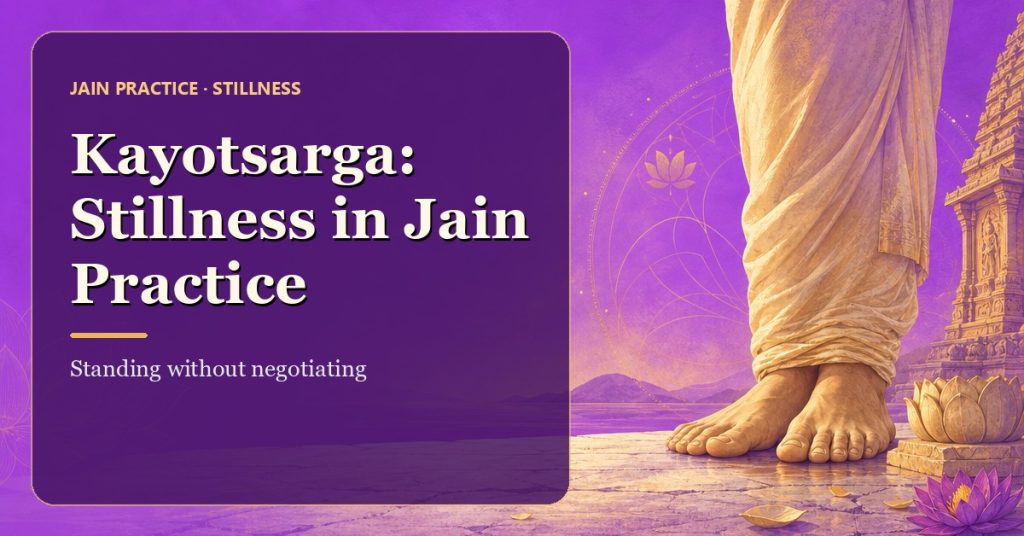
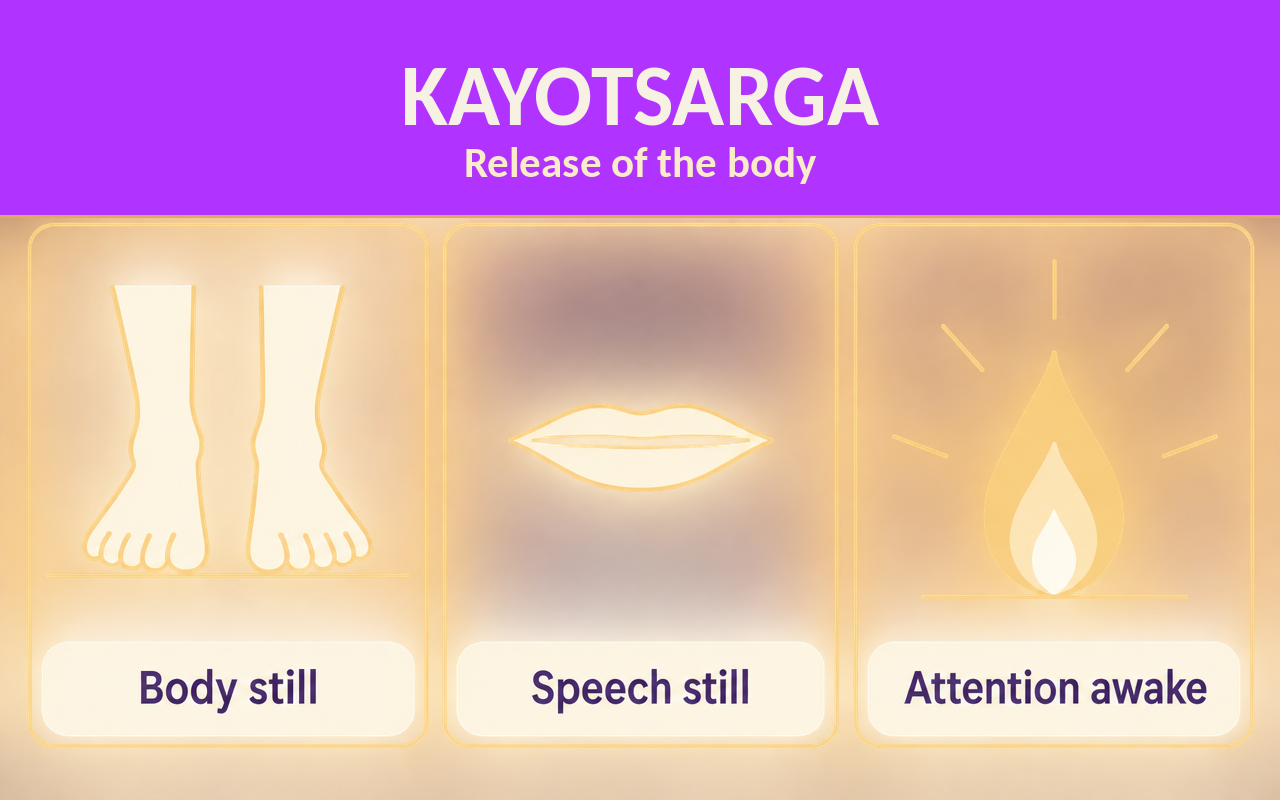
Kayotsarga (कायोत्सर्ग, kāyotsarga) means “abandonment of the body”: the Jain practice of standing or sitting in complete stillness, letting the body be as it is while attention rests in equanimity. The word joins kāya, body, with utsarga, release or abandonment, and the practice is counted among the Jain austerities and daily duties. It is not a relaxation technique, although it often relaxes; its aim is the loosening of the identification with the body. This article explains the term, its Jain setting, and how to practise stillness without strain.
In Sri Amit Ray’s 114-chakra tradition, kayotsarga is associated with the basic chakras that the teaching links to emotional balance and to healing and recovery, and with the power chakras it connects to overcoming stress and restoring calm. Every one of those centres is a place where attention can rest, so the quality grows through the map rather than beside it. The practitioner stands or sits still, holds a named centre lightly, and lets the body’s sensations pass without commentary; the tradition describes stillness as a way of releasing what the body has been carrying, not as a cure for disease. This is a contemplative association inside Ray’s model, and it must be kept distinct from Jain doctrine.
At a glance
| Sanskrit / Prakrit | कायोत्सर्ग · kāyotsarga · release of the body |
|---|---|
| Primary text | Tattvartha Sutra, chapter 9 (austerities); Jain avashyaka (daily duties) |
| Tradition | Jain contemplative practice, not classical Hindu Yoga |
| Practice form | Standing or seated stillness, arms relaxed, attention on equanimity |
| Nearest contrast | Relaxation for comfort; and mortification, which the tradition does not recommend |
| 114-chakra association | Basic centres for balance and recovery; power centres for calm |
What the word names
Utsarga is a releasing or letting go, and kāya is the body; the compound names a deliberate non-holding rather than a collapse. In Jain usage the practitioner stands with the arms hanging free or sits with the spine upright, and does not move to relieve discomfort unless it becomes harmful. The body is neither indulged nor punished; it is simply left alone.
The term is often translated “body abandonment”, which sounds more dramatic than the practice. In practice it is quiet: the weight settles, the breath finds its own rhythm, and attention stops negotiating with sensation. The austerity lies in not fidgeting.
Where it appears in the texts
Jain literature lists kayotsarga among the austerities and among the daily duties that shape a lay or monastic life. The Tattvartha Sutra treats austerity in its ninth chapter, and the tradition’s commentarial literature describes the physical form and the inner attitude. The practice is also associated with repentance and with the recitation of the Iriyavahiya, in which a practitioner reviews harm caused while moving.
Because this is a Jain practice, it should not be presented as a Hindu yogic technique. The vocabulary overlaps with yoga, and both value stillness, but the doctrinal frames differ: Jain practice is organised around non-harm, karma, and liberation of the soul, not around Ishvara or Patanjali’s eight limbs. Keeping that boundary is part of explaining the term honestly.
Why it matters in practice
Most people have never been still without a task. The body is used to constant small adjustments, and attention is used to constant small negotiations with discomfort. Kayotsarga interrupts both. The first minutes are often boring; the next minutes are often restless; after that, a different quality of attention may appear, though the tradition does not promise it.
The practice also teaches a useful distinction: discomfort is not the same as harm. Many sensations can be observed without action, and learning the difference builds tolerance. The tradition’s caution is equally important: pain that signals injury is not to be ignored in the name of equanimity.
How to practise kayotsarga
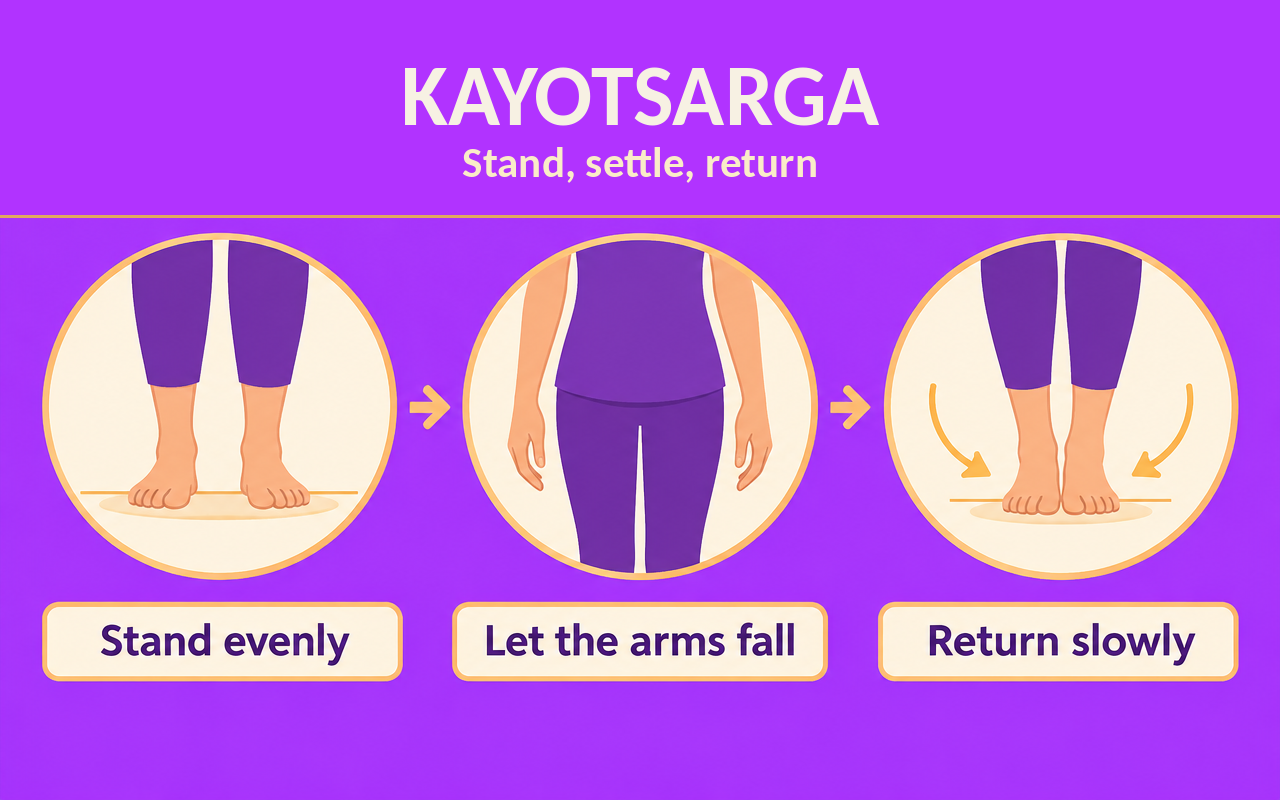
- Choose a stable posture. Standing with feet parallel or seated on a firm seat, spine upright, arms relaxed.
- Set a short duration. Five to ten minutes at first; the practice is about quality, not endurance.
- Let the body be heavy. Do not hold the shoulders or clench the jaw; let the weight pass into the ground.
- Observe without adjusting. Note sensations, sounds, and thoughts, and return to the body as a whole.
- Move only when necessary. If a sensation becomes pain, change position slowly; the practice is not a test of endurance.
- Close gradually. Move the fingers and feet, open the eyes, and stand slowly to avoid dizziness.
When restlessness is strong: shorten the practice and repeat it. Stillness is trained in small doses, and a two-minute practice kept daily is more useful than a heroic hour once a month.
Common misunderstandings
Kayotsarga is equanimity toward the body, held in stillness. Relaxation may follow, but the aim is equanimity toward the body, not comfort.
It is non-harming stillness. Jain teaching is explicit about non-harm; the practice is stillness, not the infliction of pain.
It is a Jain practice taught within its own frame. The practice belongs to Jain doctrine and should be taught within that frame.
Signs of progress
The urge to fidget decreases. Discomfort is noticed earlier and met with less alarm. Practitioners often report that the practice makes ordinary sitting easier and that they recover from stress with less struggle. The reliable sign is a lighter relationship with the body, not unusual sensations.
Traditional benefits
The Jain tradition presents kayotsarga as an austerity that burns karma and trains equanimity, and as a preparation for deeper contemplation. Those claims belong to Jain doctrine and should be quoted as such. The observable benefits — tolerance of discomfort, steadier attention, less reactivity — are modest and consistent with the practice’s form.
Research gives limited context. Goyal and colleagues (JAMA Internal Medicine, 2014) found moderate evidence that meditation programmes reduce anxiety and depression, with weaker evidence elsewhere. Hölzel and colleagues (2011) propose body awareness and attention regulation as mechanisms, in a framework rather than a trial. Lupien and colleagues (Nature Reviews Neuroscience, 2009) review stress physiology across the lifespan. None of these studies tests kayotsarga, and none establishes a Jain or subtle-body claim.
For public context, the WHO treats mental health as part of overall health. It says nothing about Jain practice.
How kayotsarga connects to the 114-chakra framework
Sri Amit Ray’s model describes 114 centers — 108 internal plus 6 external — grouped into 7 basic, 21 power, and 86 master chakras, within a map that uses 11 dimensions and 15 nested layers. Kayotsarga is not a center, and it does not belong to Ray’s tradition; the connection can only be a careful cross-tradition comparison. Ray’s materials do not name a chakra called kayotsarga, so the link is an interpretive practice crosswalk, and it should be labelled as such.
Used that way, a practitioner holds a named center lightly while standing in stillness, letting sensations pass without interpretation. Basic chakras support the first steadiness; the power chakras are described in Ray’s teaching as supporting calm and recovery. What must not be claimed is that Jain practice and Hindu subtle-body teaching are the same, that stillness “opens” a center, or that kayotsarga replaces medical care. The comparison is offered for contemplatives who work across traditions, with both traditions kept intact. See Sri Amit Ray’s 114 Chakras and 72,000 Nadis framework, and his teaching on chakra meditation for resilience.
Related concepts
- Mauna — silence, the companion discipline of speech.
- Aparigraha — non-possession, the wider Jain and yogic value of letting go.
- Prana — breath and vitality, which stillness allows one to observe.
- Kaivalya — the classical Yoga term for freedom, compared here rather than equated.
The series is indexed in the Master Yoga Concepts Guide; for stillness within movement, see IFYM’s Surya Namaskar and 114 Chakras guide.
Further reading and sources
Primary: Tattvartha Sutra chapter 9 on austerities, with Jain commentarial literature on kayotsarga and the avashyakas. Context: Sri Amit Ray on resilience and the 114 centers, used as a comparison only. Research: Goyal et al., JAMA Internal Medicine 174 (2014); Hölzel et al., Perspectives on Psychological Science 6 (2011); Lupien et al., Nature Reviews Neuroscience 10 (2009).
Frequently asked questions
Is kayotsarga a Hindu practice?
No. It is a Jain practice of bodily stillness and equanimity, and it should be taught within Jain doctrine.
How long should I stand?
Start with five minutes and increase slowly. Duration is less important than not fidgeting.
Should I endure pain?
No. Discomfort can be observed; pain that signals injury is a reason to change position.