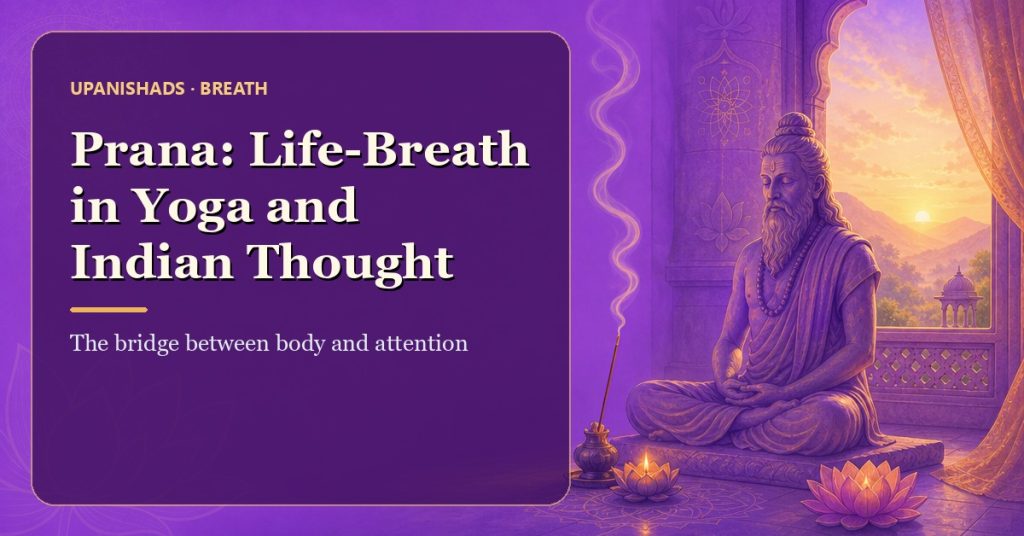
Prana: Life-Breath in Yoga and Indian Thought
Prana (प्राण, prāṇa) means breath, and by extension the life-force that breath carries. The word comes from pra- and the root an, “to breathe”, and it names both the physical movement of air and the vitality that distinguishes a living body from an inert one. The Upanishads treat prana as a principle in its own right, the Yoga Sutras place breath regulation among the limbs, and the Hatha manuals build much of their practice around it. This article explains the term, the textual setting, and a safe way to work with breath without turning it into a medical claim.
In Sri Amit Ray’s 114-chakra tradition, prana is associated with the basic chakras that the teaching links to vitality and immunity and to healing and recovery, and with the power chakras it connects to overcoming stress and restoring calm. Every one of those centres is a place where attention can rest, so the quality grows through the map rather than beside it. The practitioner breathes slowly and evenly, rests attention on a named centre, and returns to the natural breath at the end; the tradition describes prana as the bridge between body and attention rather than as a substance to be manipulated. The connection is contemplative and sits within Sri Amit Ray’s teaching.
At a glance
| Sanskrit | प्राण · prāṇa · breath, life-force |
|---|---|
| Primary text | Prasna Upanishad 2; Yoga Sutras 1.34 and 2.49; Bhagavad Gita 4.29 |
| Tradition | Vedic and Upanishadic, classical Yoga, and Hatha practice |
| Practice form | Natural and slow breathing, with attention resting on the breath |
| Nearest contrast | Forced retention, which the tradition warns against; and mere mechanics, which ignores attention |
| 114-chakra association | Basic centres for vitality and recovery; power centres for calm |
What the word names
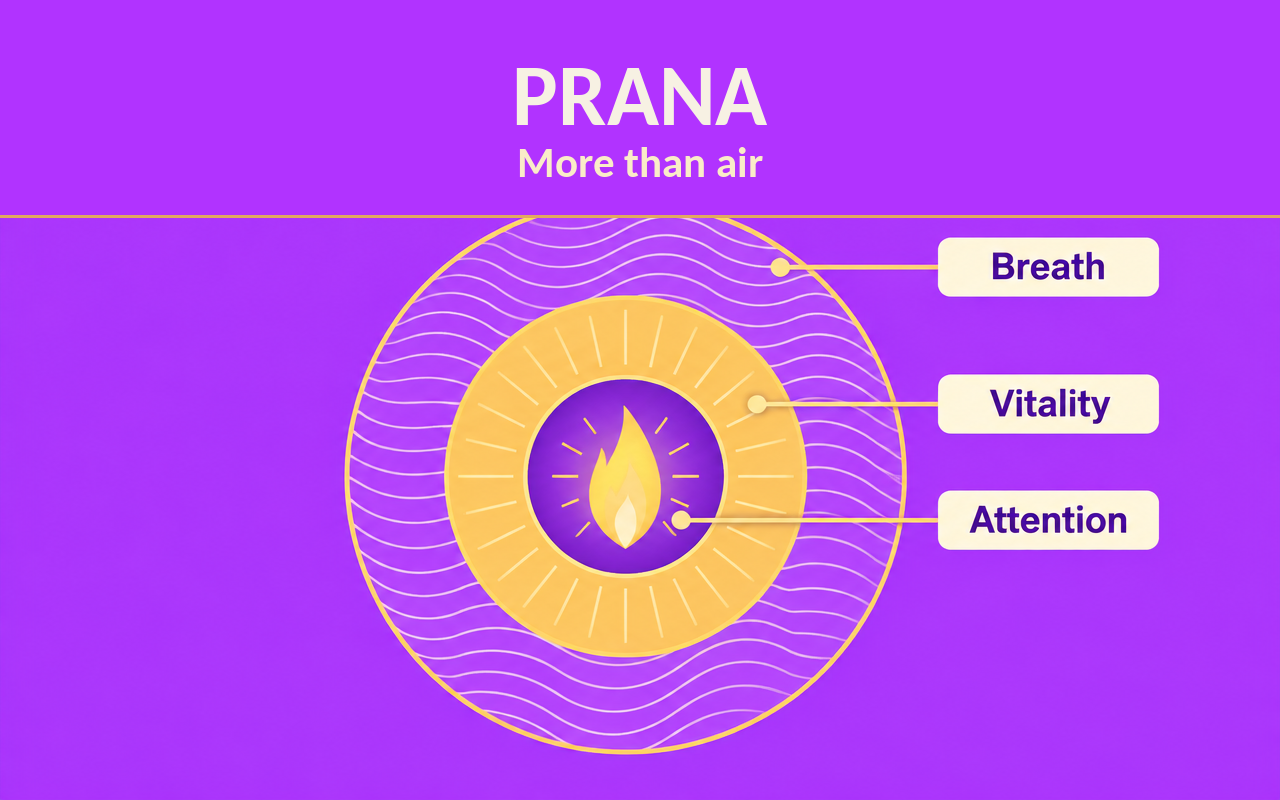
Prana is not identical with air, although the two are closely linked. The Upanishadic usage treats prana as the principle by which the senses and mind are sustained, and the later tradition distinguishes several movements of prana within the body. The physical breath is the most accessible evidence of the principle, which is why breath practice became the practical handle.
The term also carries the sense of “forward-moving”, and the tradition describes prana as having a direction: inward, outward, upward, and circulating. These are functional descriptions within the tradition’s own physiology, not anatomical findings. They are useful as maps of experience and misleading if taken as literal anatomy.
Where it appears in the texts
The Prasna Upanishad’s second question treats prana as the chief among the faculties, describing its fivefold movement and its relation to the body. Yoga Sutra 1.34 recommends the exhalation and retention of breath as a way of steadying the mind, and 2.49 defines pranayama as the regulation of inhalation and exhalation once posture is established. Gita 4.29 describes the offering of the inward breath into the outward breath, a practice of attention as much as of air.
The Hatha manuals develop breath practice extensively, with ratios, locks, and cautions. They also insist that breath work is not for beginners who cannot sit steadily, and they warn that forcing retention is harmful. The classical and Hatha treatments differ in detail but agree on the foundation: posture, patience, and attention.
Why it matters in practice
The breath is the only autonomic function that is also voluntary, which makes it a doorway between the body’s automatic states and deliberate attention. A slow, smooth breath can settle a reactive body, and a settled body makes attention easier to gather. This is the practical reason the tradition places breath near the beginning of the path.
The concept also protects against overreach. Prana is not a battery that can be filled by force, and breath retention is not a shortcut to health. The tradition’s own cautions — avoid strain, avoid retention without guidance, stop if dizzy — are part of the teaching rather than an afterthought.
How to work with prana
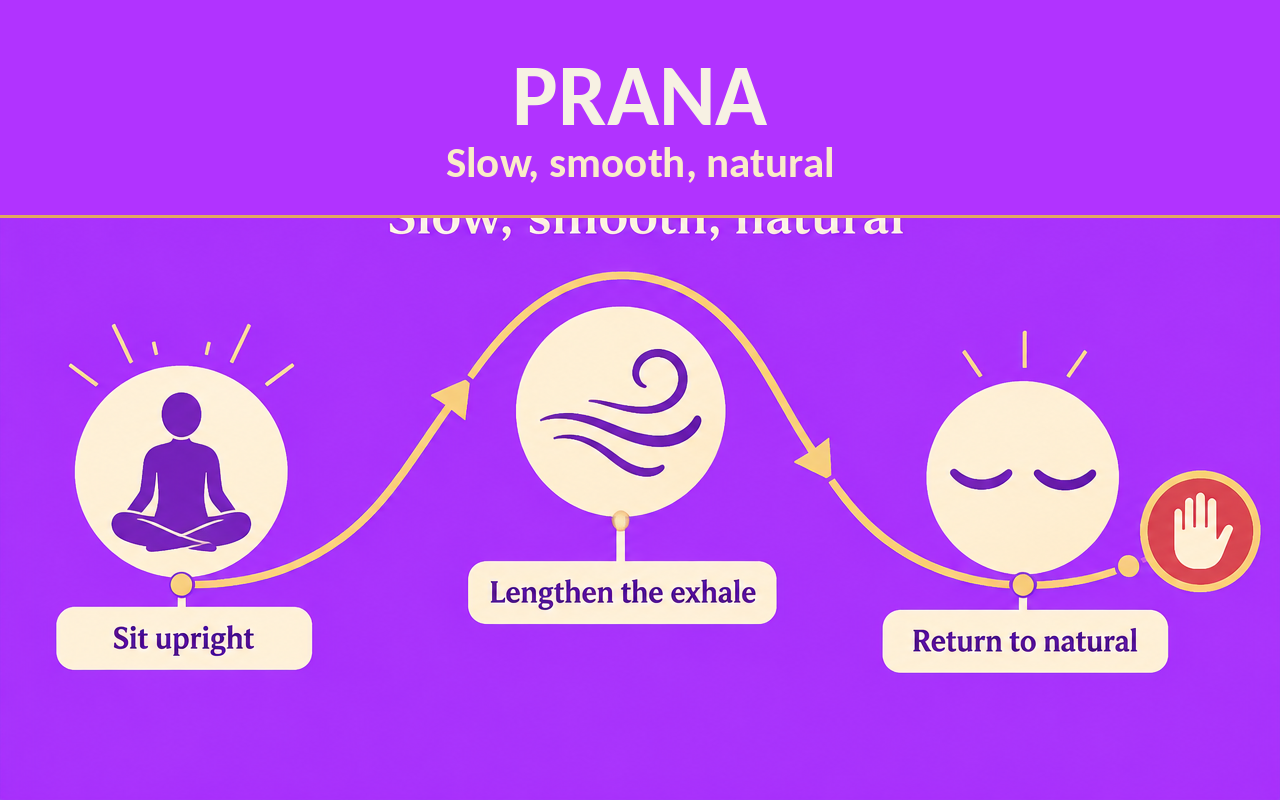
- Set the posture first. A stable seat and a free spine are the base for breath practice.
- Observe before changing. Spend two minutes noticing the natural breath, without adjusting it.
- Lengthen the exhale slightly. A small increase is enough; do not force or count to exhaustion.
- Keep the face and belly soft. Tension in the jaw or abdomen signals that the breath is being pushed.
- Rest attention on the breath. The sensation at the nostrils is a simple, repeatable anchor.
- Return to natural breathing. End every session with a minute of unregulated breath before standing.
Who should be cautious: pregnancy, heart conditions, uncontrolled blood pressure, glaucoma, and recent surgery are commonly listed as reasons to avoid retention and forceful breathing. These are practical precautions, not medical advice; consult a qualified teacher and a clinician.
Common misunderstandings
Prana is the tradition’s wider principle of vitality, expressed through breath. The breath is the physical expression of a broader principle in the tradition, and the two should not be collapsed in either direction.
Gentleness and regularity bring the benefit. The texts emphasise gentleness and regularity; forceful practice is a common cause of dizziness and strain.
It is the tradition’s own model of vitality. The term describes the tradition’s own model of vitality; it is not a physiological quantity that can be measured or prescribed.
Signs of progress
The breath becomes smoother without effort. The body settles faster at the start of practice, and the breath returns to calm more quickly after stress. Practitioners often report a better sense of when they are holding the breath in daily life. The sign is ease, not force.
Traditional benefits
The Upanishads present prana as central to life and to the steadiness of the faculties; the Yoga Sutras present breath regulation as a support for concentration; the Hatha texts present it as preparation for deeper practice. The benefits claimed are steadiness and vitality within the tradition’s frame, not medical outcomes.
Research gives partial context. Lupien and colleagues (Nature Reviews Neuroscience, 2009) review how breathing and stress systems interact across the lifespan. Goyal and colleagues (JAMA Internal Medicine, 2014) found moderate evidence for reduced anxiety and depression in meditation programmes. Tang, Hölzel and Posner (Nature Reviews Neuroscience, 2015) review attention and stress findings across heterogeneous studies. None of these studies tests prana as a subtle substance, and none establishes a medical benefit from retention.
For public context, the WHO’s 2020 physical activity guidelines address movement and inactivity, and the Ayush yoga portal publishes official protocols that include breath practice. Neither validates the subtle-body model.
How prana connects to the 114-chakra framework
Sri Amit Ray’s model describes 114 centers — 108 internal plus 6 external — grouped into 7 basic, 21 power, and 86 master chakras, within a map that uses 11 dimensions and 15 nested layers. Prana is not a center; it is the movement the map is said to organise. In Sri Amit Ray’s 114 chakra system, prana is deeply connected to the practice.
In practice, a student breathes slowly, holds a named center, and lets the breath carry attention there without forcing it. Basic chakras support the first steadiness and the sense of vitality; the power chakras are described in the tradition as supporting calm and recovery, and the master chakras as supporting attention. What must not be claimed is that breath “opens” a center, that a sensation proves a nadi, or that pranayama replaces medical treatment. See Sri Amit Ray’s 114 Chakras and 72,000 Nadis framework, and his teaching on the stress axis and the chakras.
Related concepts
- Bandha — the locks traditionally used with breath retention.
- Nadi — the channels through which prana is said to move.
- Kundalini — the Hatha image of ascent, built on breath and attention.
- Kayotsarga — stillness, in which the natural breath can be observed.
The series is indexed in the Master Yoga Concepts Guide; for breath joined to movement, see IFYM’s Surya Namaskar and 114 Chakras guide.
Further reading and sources
Primary: Prasna Upanishad 2; Yoga Sutras 1.34 and 2.49; Bhagavad Gita 4.29; Hatha Yoga Pradipika on breath and its cautions. Context: Sri Amit Ray on stress and the 114 centers. Research: Lupien et al., Nature Reviews Neuroscience 10 (2009); Goyal et al., JAMA Internal Medicine 174 (2014); Tang, Hölzel and Posner, Nature Reviews Neuroscience 16 (2015).
Frequently asked questions
Is prana the same as breath?
Breath is the physical expression; prana is the broader principle of vitality in the tradition’s model.
Should I hold my breath?
Only with proper teaching and preparation. The texts warn against forced retention, and many conditions make it unsafe.
How long should I practise breath work?
Five to ten minutes daily is enough to begin. Consistency matters more than duration.