Alambana: Support for Meditation and Contemplation
Alambana (आलम्बन, ālambana) means a support: the object a mind leans on while it is being trained. The word comes from ā-, “towards”, and the root lamb, “to hang or rest”, and the Yoga Sutras use it in the compound jñāna-ālambana when listing what a practitioner may take as a basis for meditation (1.38). Patanjali does not prescribe one object for everyone. Between sutras 1.35 and 1.39 he offers a range, and 1.39 adds the decisive clause: whatever is agreeable. This article explains the term, the choices the text allows, and how to settle on one support without turning the search into another distraction.
In Sri Amit Ray’s 114-chakra tradition, alambana is associated with the basic chakras that the teaching links to concentration and attention, and with the master chakras it connects to memory and learning and creativity and insight. Every one of those centres is a place where attention can rest, so the quality grows through the map rather than beside it. The practitioner selects a named centre as the support, rests attention there, and returns when it moves; the tradition treats the support as a place to become familiar with, not as a source of power to be seized. This is a contemplative association inside Ray’s model; it is not a medical claim about healing or immunity.
At a glance
| Sanskrit | आलम्बन · ālambana · support, basis, object of attention |
|---|---|
| Primary text | Yoga Sutras 1.35–1.39, especially 1.38–1.39 |
| Tradition | Classical Yoga, with parallel usage in Vedanta and Buddhist meditation manuals |
| Practice form | Choosing one support and returning to it; changing support only for a stated reason |
| Nearest contrast | Aimless attention, which has no place to return to |
| 114-chakra association | Basic centres for attention; master centres for memory, learning, and insight |
What the word names
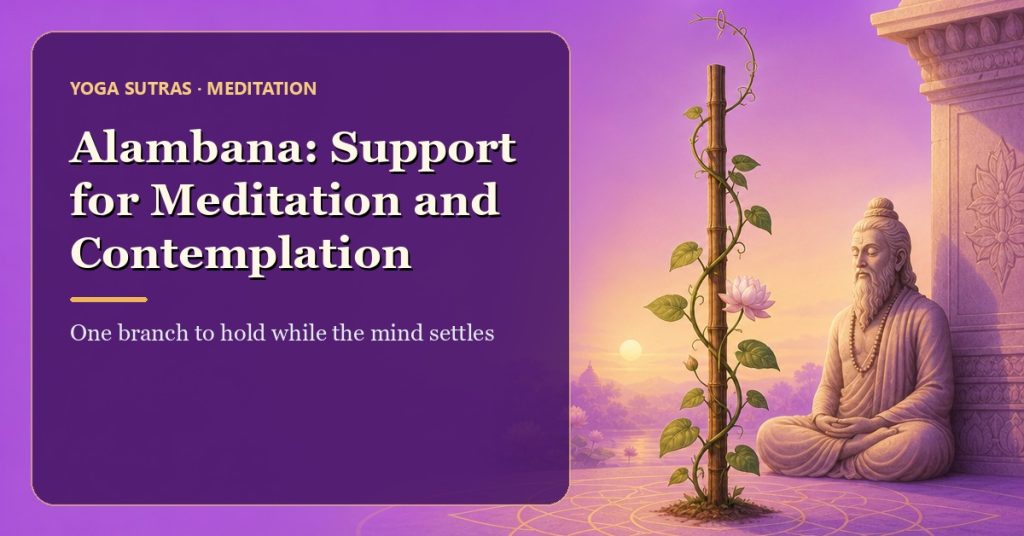
An alambana is not the goal of practice. It is the branch a climbing plant holds while it grows, and the metaphor is useful because a support is expected to be temporary. The word also carries the sense of “depending on”, which is why commentators distinguish the support from the mind that leans on it: the support does not produce steadiness by itself, but without one the mind has nothing to return to.
In later Indian meditation literature the term becomes technical, with whole treatises classifying supports by grossness and subtlety. In Patanjali the usage is simpler and more generous: whatever can be held steadily and does not agitate the mind can serve. The text trusts the practitioner’s temperament more than a universal rule.
Where it appears in the texts
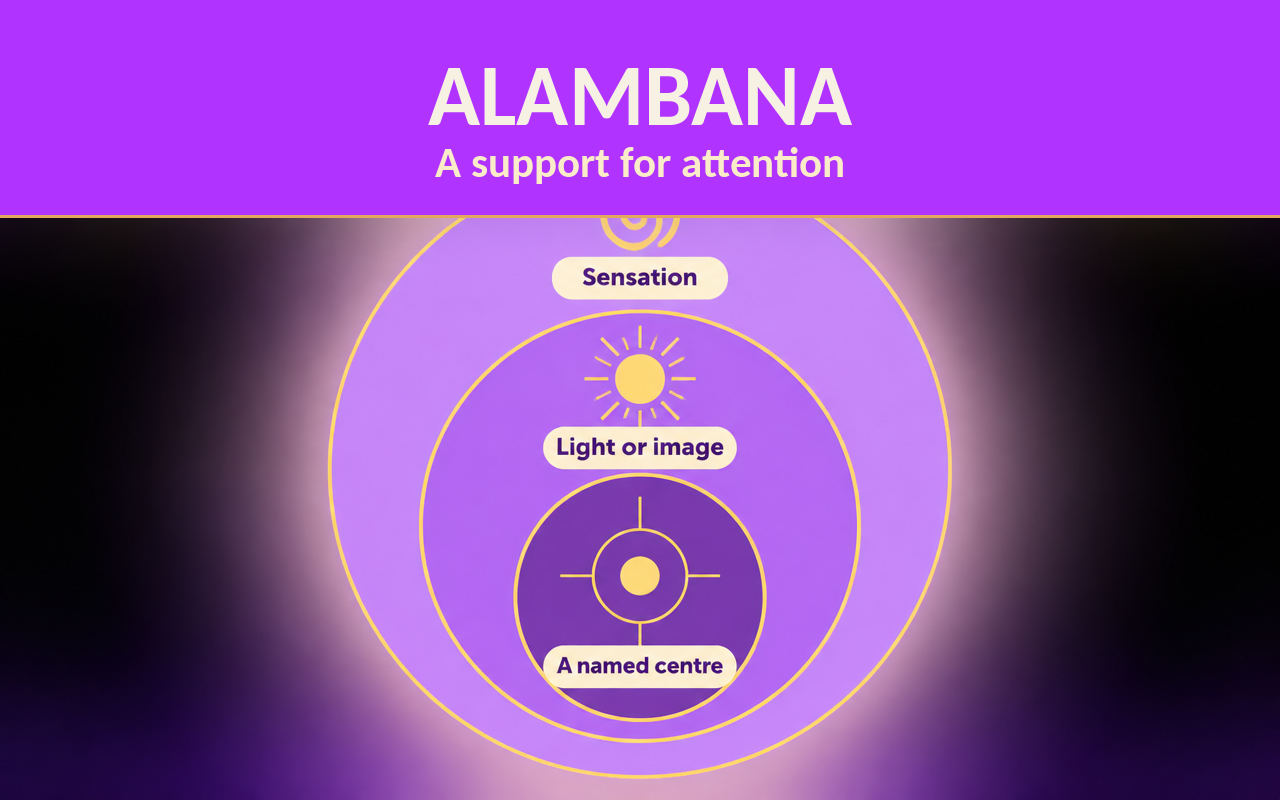
Sutra 1.35 recommends fixing the mind on a sensory experience that arises in attention, such as the sensation at the nostrils, and describes the steadiness that follows. Sutra 1.36 offers the inner light, free from sorrow and radiant. Sutra 1.37 offers the mind of a person free from desire. Sutra 1.38 names the knowledge that appears in dream and sleep as a support, and 1.39 closes the list with anything agreeable.
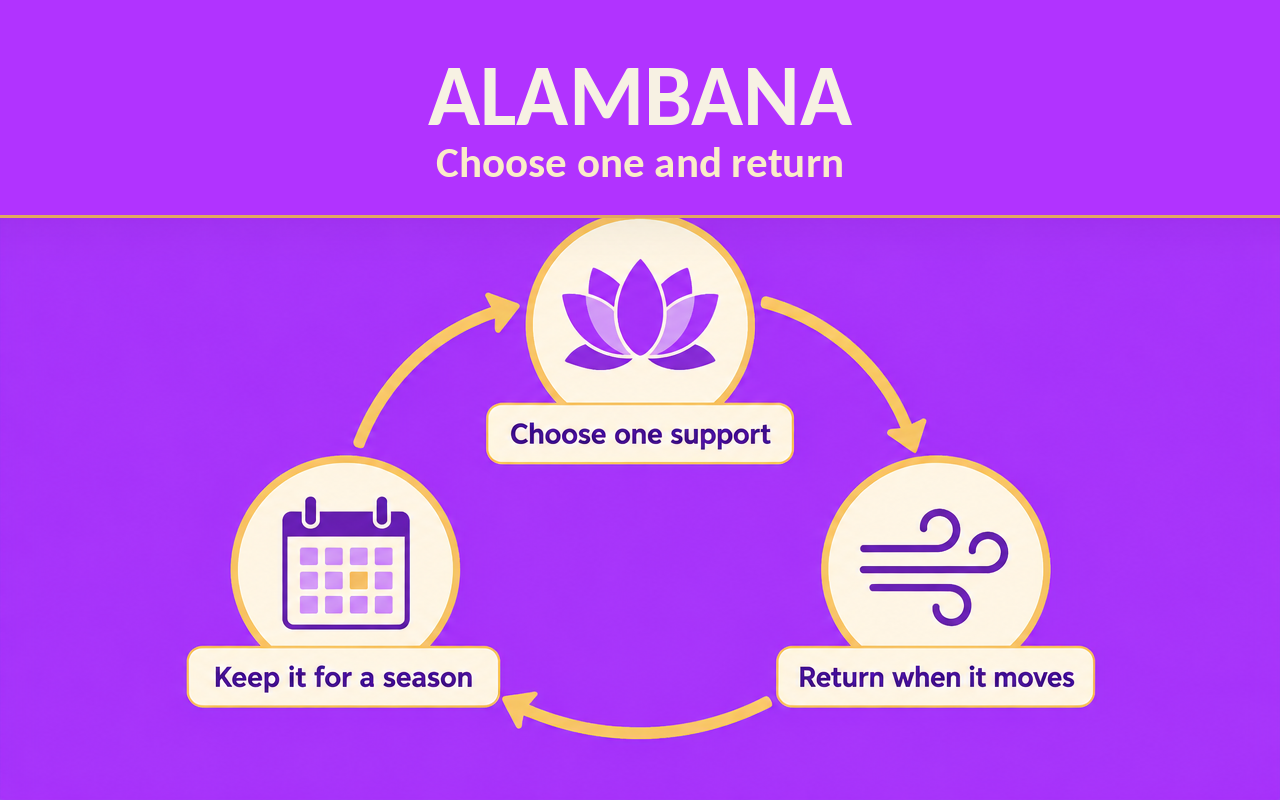
Read together, the five sutras form a graded menu rather than a hierarchy: body, light, another mind, sleep, and preference. Sutra 1.32 had already given the general rule of eka-tattva-abhyāsa, practice on one principle. The combination is practical: choose one support, keep it for a season, and change it only when there is a reason you can state in a sentence.
Why it matters in practice
Beginners often collect supports instead of using one: breath on Monday, mantra on Tuesday, a guided recording on Wednesday, and a new app on Thursday. Each change feels like renewal and functions as avoidance. Alambana names the alternative. A support is valuable precisely because it becomes boring, since boredom is the point at which the mind’s habits become visible.
The concept also removes a false requirement. Students sometimes believe that only one object is spiritually correct. Patanjali’s range suggests otherwise: the right support is the one that steadies this mind at this stage, and the test is empirical rather than doctrinal.
How to choose and use a support
- Match the support to your temperament. Restless minds often do well with breath or sound; dull minds with light or an upright posture.
- Choose something available without equipment. A support you can find on a train is a support you will actually use.
- Define the exact contact point. “The breath” is vague; “the sensation at the upper lip” is a support.
- Keep it for at least a month. Write the choice down and do not renegotiate during a difficult sitting.
- Return without commentary. The support is the place you come back to, not the place you must never leave.
- Review at the season’s end. Change only if the support reliably produces agitation or dullness after honest practice.
When the support disappears: a mantra can become a vague hum and the breath can become a concept. Refresh contact by naming one concrete sensation, then continue. If the support has vanished entirely, re-establish posture and begin again; this is not a setback.
Common misunderstandings
Alambana is the support that concentration returns to. The support is the object; concentration is the return. Confusing them produces a search for a better object whenever attention wanders.
One steady support carries more depth than a rotating menu. A rotating menu usually signals restlessness, not versatility. The tradition favours one principle at a time (1.32).
A support stays useful at every stage of practice. Even advanced practice keeps a support until absorption is stable; the support becomes subtler, not unnecessary.
Signs of progress
The support becomes easier to find: less searching at the start of a sitting. Attention returns with fewer words. Practitioners often notice that the object appears more vivid and that the sense of “doing” the practice decreases. The reliable sign is not a special experience but a shorter interval between wandering and return.
Traditional benefits
Patanjali’s stated fruit of a well-chosen support is steadiness of mind and the removal of the scattering described in 1.30–1.31. The five supports of 1.35–1.39 are offered as routes to that steadiness, not as ends. Later commentators add that a support also protects the practitioner from being carried by whatever arises, because there is a place to put attention.
Research on attention gives partial context. MacLean and colleagues (Psychological Science, 2010) found improved sustained attention after intensive retreat practice in a randomised design, though the setting limits generalisation. Mrazek and colleagues (Psychological Science, 2013) reported gains in working memory and less mind-wandering after a short course. Lutz and colleagues (Trends in Cognitive Sciences, 2008) describe focused-attention training, which requires an object, as one of two main families of practice. None of these studies tests alambana or establishes a subtle-body claim.
For public context, the Ayush yoga portal publishes official yoga programmes that include guided attention practices. It describes public provision, not the metaphysics of any tradition.
How alambana connects to the 114-chakra framework
Sri Amit Ray’s model describes 114 centers — 108 internal plus 6 external — grouped into 7 basic, 21 power, and 86 master chakras, within a map that uses 11 dimensions and 15 nested layers. Alambana is not one of those centers; it is the act of choosing one. In Sri Amit Ray’s 114 chakra system, alambana is deeply connected to the practice.
The connection is straightforward. A student takes a center that Ray’s teaching actually names, treats it as the support for a fixed period, and returns whenever attention moves. Basic chakras are the accessible first supports; the master chakras are described in the tradition as supporting memory, learning and insight, which suits longer practice once attention is stable. What must not be claimed is that the support “charges” a center, that a sensation proves a dimension, or that the practice replaces medical care. See Sri Amit Ray’s 114 Chakras and 72,000 Nadis framework, and his sun meditation for a worked example of a single support.
Related concepts
- Ekagrata — the one-pointed quality that a stable support produces.
- Vritti — the movements that a support gives you something to return from.
- Samyama — the combined practice that begins when a support is held without interruption.
- Jnana — the discernment that a long-held support eventually serves.
Browse the Master Yoga Concepts Guide for the series, and IFYM’s Surya Namaskar and 114 Chakras guide for a moving support.
Further reading and sources
Primary: Yoga Sutras 1.32 and 1.35–1.39 with Vyasa’s commentary. Context: Sri Amit Ray on the 114 centers and on sun meditation. Research: MacLean et al., Psychological Science 21 (2010); Mrazek et al., Psychological Science 24 (2013); Lutz et al., Trends in Cognitive Sciences 12 (2008).
Frequently asked questions
Can I change my support if it does not work?
Yes, after an honest trial of several weeks. Change for a stated reason, not in the middle of a restless sitting.
Is a mantra a valid alambana?
Yes. Sound is one of the supports the tradition recognises, provided the mantra is repeated with attention rather than mechanically.
Should the support be physical or mental?
Either. Sutra 1.35 uses sensation, 1.36 uses light, and 1.37 uses another mind; the text deliberately leaves the choice open.