Dhrti: Steadfastness and Perseverance
Dhrti (धृति, dhṛti) means steadfastness: the holding power that keeps a person on a chosen course when feeling, circumstance, or fatigue argues for abandoning it. The word comes from the root dhṛ, “to hold or support”, and the Bhagavad Gita devotes three verses to distinguishing its kinds (18.33–35). Not every firmness is worth having. Dhrti can hold the mind steady for clarity, hold it for gain, or simply hold it in inertia, and the Gita names all three. This article explains the term, the Gita’s test, and how to build a steadfastness that is worth the effort.
In Sri Amit Ray’s 114-chakra tradition, dhrti is associated with the basic and power chakras that the teaching links to leadership and decision-making and to emotional balance, and with the master chakras it connects to concentration and attention. Every one of those centres is a place where attention can rest, so the quality grows through the map rather than beside it. The practitioner names one commitment, holds a named centre while the commitment is tested, and returns after a lapse instead of restarting the story; the tradition describes steadfastness as a maintained direction rather than a fixed personality. Sri Amit Ray’s 114 chakra model gives this practice a living map of awareness to work with.
At a glance
| Sanskrit | धृति · dhṛti · steadfastness, resolution, holding firm |
|---|---|
| Primary text | Bhagavad Gita 18.33–35; Yoga Sutras 1.14 |
| Tradition | Classical Yoga and the Gita’s analysis of character |
| Practice form | One named commitment, an obstacle plan, and a return after failure |
| Nearest contrast | Stubbornness, which holds a course for ego; and enthusiasm, which holds nothing for long |
| 114-chakra association | Basic centres for emotional stability; power and master centres for decisions and attention |
What the word names
Dhrti is a holding, and the image behind it is physical: a container that keeps its shape, a beam that carries a roof. Applied to a person, it names the capacity to keep a commitment in place while conditions change. The Gita treats it as a power of the mind rather than a virtue of temperament, which means it can be trained and can also be misdirected.
The verb dhārayate in Gita 18.33 is telling: steadfastness is what “holds” the mind, breath, and senses in yoga. The definition is functional. Dhrti is not the feeling of determination that comes at the start of a project; it is what remains when that feeling has gone and the course is still being kept.
Where it appears in the texts
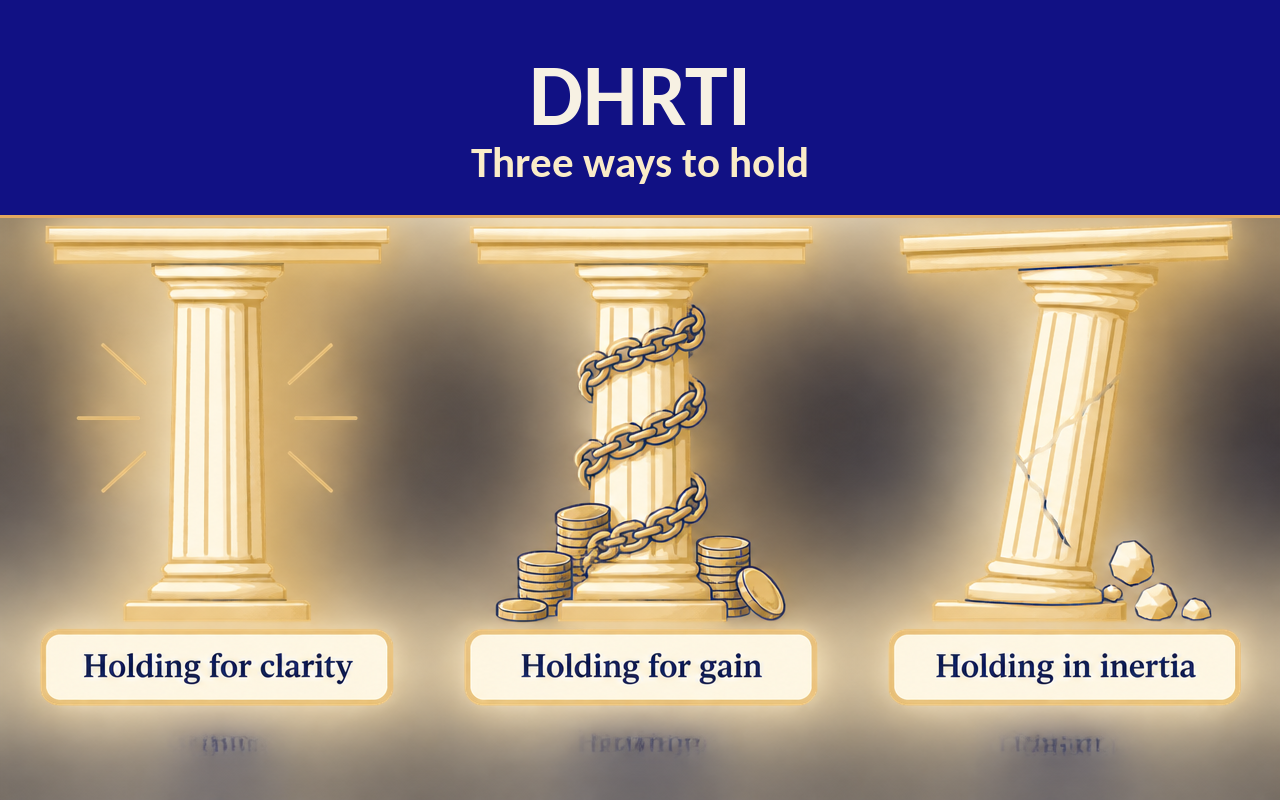
Gita 18.33 describes the steadfastness of clarity: it holds the mind, breath, and senses in yoga, without wavering. Verse 18.34 describes the steadfastness of passion, which holds on for the sake of gain, desire, and enjoyment. Verse 18.35 describes the steadfastness of inertia, which holds the mind in sleep, fear, grief, and depression. The three together form a diagnostic, not a hierarchy of personalities.
Yoga Sutra 1.14 supplies the practical criterion: practice becomes firmly grounded when continued for a long time, without interruption, and with sincere cultivation. That is dhrti in the vocabulary of practice. The two texts agree that duration and continuity matter more than intensity, and that the quality of what is being held determines whether the firmness is worth having.
Why it matters in practice
Most practice is lost not in dramatic failure but in the ordinary Thursday when the initial enthusiasm has faded and nothing visible has changed. Dhrti is the capacity that carries a person across that gap. Without it, every method is abandoned just before it would have become familiar, and the practitioner concludes that no method works.
The Gita’s analysis protects against the opposite error. Holding on for status, for a result, or out of fear is also dhrti, and it produces the exhaustion that makes people quit. The question is not only “how do I become more disciplined?” but “what exactly am I holding, and why?”
How to build dhrti
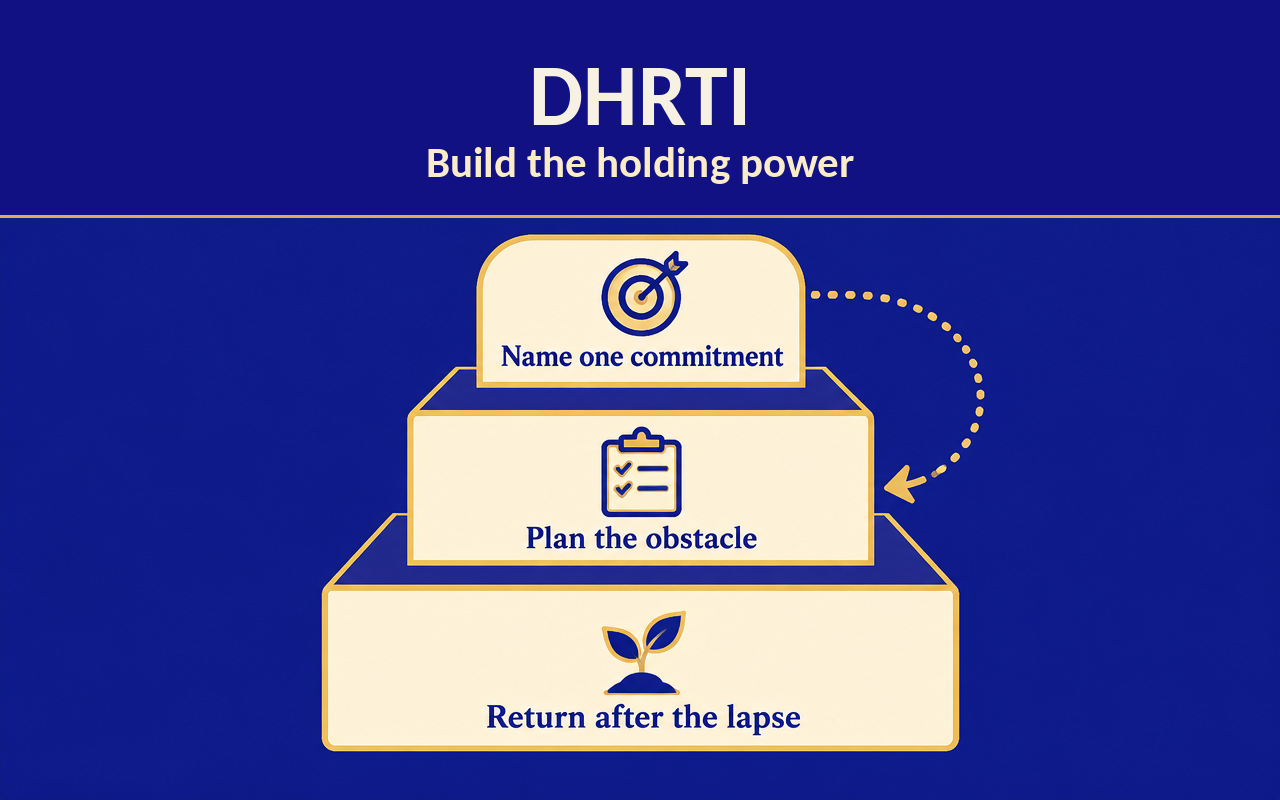
- Name one commitment. Not five. Write it in a sentence and put it where you will see it.
- Set the smallest viable form. A daily ten minutes is easier to hold than a weekly two hours.
- Plan the obstacle before it arrives. Decide now what you will do on a bad day: the shortened version, not the abandoned one.
- Use a visible record. A mark on a calendar keeps the measure on continuity rather than on mood.
- Return without a story. A lapse is a gap in the record, not a verdict; resume at the smallest form.
- Check the motive monthly. Ask whether you are holding for clarity or for gain (18.33–34). If it has shifted, adjust the aim, not just the effort.
When the commitment has genuinely become wrong: the Gita’s steadfastness of clarity holds the mind in yoga, not in a mistaken plan. Changing course after honest review is not a failure of dhrti; abandoning a course because it became boring is.
Common misunderstandings
Dhrti is steady holding that serves a living purpose. Stubbornness protects the ego’s earlier decision; dhrti protects a commitment that still serves its purpose.
It grows through short, repeated practice. Short, repeated, unbroken practice meets the sutra’s criterion better than occasional heroic effort.
It is a capacity present in everyone. The Gita describes three kinds of holding, which means the capacity is present in everyone and needs direction, not possession.
Signs of progress
The practice survives a bad week. You stop renegotiating the basics each morning. Practitioners often report that decisions become less dramatic because the default is already set. The clearest sign is that a lapse produces a return rather than a new plan.
Traditional benefits
The Gita’s claim is that steadfastness of clarity holds the mind, breath, and senses in yoga, and that the other two kinds produce exhaustion. Sutra 1.14 promises firm ground for practice that is long, unbroken, and sincere. The tradition treats this as a condition for every later attainment rather than as an attainment itself.
Modern research gives partial context. Hafenbrack and colleagues (Psychological Science, 2014) found that a brief mindfulness exercise reduced the sunk-cost bias, which is relevant to holding a course for the right reason. Goyal and colleagues (JAMA Internal Medicine, 2014) found moderate evidence that meditation programmes reduce anxiety and depression, with weaker evidence elsewhere. Hölzel and colleagues (2011) propose attention regulation and a changed self-perspective as mechanisms, in a framework rather than a trial. None of these studies tests dhrti, and none establishes a subtle-body claim.
For public context, the WHO treats mental health as part of overall health, and the UN marks 21 June as the International Day of Yoga. Neither addresses persistence in practice.
How dhrti connects to the 114-chakra framework
Sri Amit Ray’s model describes 114 centers — 108 internal plus 6 external — grouped into 7 basic, 21 power, and 86 master chakras, within a map that uses 11 dimensions and 15 nested layers. Dhrti is not a center; it is the quality that keeps a practice going. In Sri Amit Ray’s 114 chakra system, dhrti is deeply connected to the practice.
A student takes a named center that Ray’s teaching associates with stability or resolve, holds it during the practice that is being tested, and returns after a lapse. Basic chakras support the first steadying; the power chakras are described in the tradition as supporting decisions and leadership, and the master chakras as supporting sustained attention. What must not be claimed is that resolve “opens” a center, that a strong sensation proves progress, or that the practice replaces medical or psychological care. See Sri Amit Ray’s 114 Chakras and 72,000 Nadis framework, and his course on resilience and the 21 chakras.
Related concepts
- Abhyasa — sustained practice, the behavioural form of dhrti.
- Titiksha — forbearance, which carries the discomfort that steadfastness meets.
- Akrodha — freedom from anger, which keeps resolve from becoming harshness.
- Kaivalya — the freedom that sustained practice serves.
The series is indexed in the Master Yoga Concepts Guide; for a physical form that builds tolerance for steady effort, see IFYM’s Surya Namaskar and 114 Chakras guide.
Further reading and sources
Primary: Bhagavad Gita 18.33–35; Yoga Sutras 1.14. Context: Sri Amit Ray on resilience and the 114 centers. Supporting studies: Hafenbrack, Kinias and Barsade on persistence decisions (Psychological Science, 2014); Goyal and colleagues’ meta-analysis (JAMA Internal Medicine, 2014); Hölzel and colleagues on proposed mechanisms (Perspectives on Psychological Science, 2011).
Frequently asked questions
How is dhrti different from discipline?
Discipline is the structure; dhrti is the holding power that keeps you inside it when the structure is inconvenient.
Can steadfastness be harmful?
Yes. The Gita names holding for gain and holding in inertia as two distortions; the test is whether the firmness serves clarity.
What should I do after missing a week?
Resume at the smallest form the same day, without restarting the count or inventing a new plan.