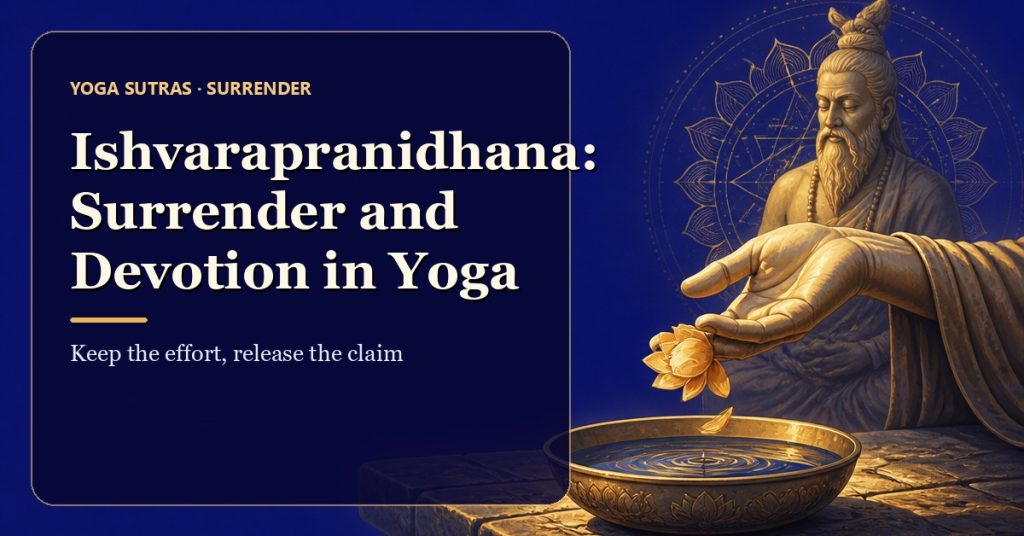
Ishvarapranidhana: Surrender and Devotion in Yoga
Ishvarapranidhana (ईश्वरप्रणिधान, īśvara-praṇidhāna) means dedication or surrender to the Lord. The compound joins īśvara, “lord” or “the divine”, with praṇidhāna, “application, placing oneself before”, and Patanjali offers it as an alternative route to the same steadiness: īśvara-praṇidhānād vā, “or by dedication to Ishvara” (1.23). He then defines Ishvara, gives the syllable Om as its designation, and names surrender as one of the niyamas (2.32) and as a cause of samadhi (2.45). This article explains the term, its textual setting, and what surrender does and does not mean in practice.
In Sri Amit Ray’s 114-chakra tradition, ishvarapranidhana is associated with the basic and power chakras that the teaching links to emotional balance and to compassion and relationships, and with the master chakras it connects to overcoming stress and restoring calm. Every one of those centres is a place where attention can rest, so the quality grows through the map rather than beside it. The practitioner offers the result of practice at a named centre and returns to the practice without bargaining; the tradition describes surrender as a release of grip rather than a passive resignation. The connection is interpretive and belongs to Ray’s contemplative teaching, not to medical evidence.
At a glance
| Sanskrit | ईश्वरप्रणिधान · īśvara-praṇidhāna · dedication to the Lord |
|---|---|
| Primary text | Yoga Sutras 1.23–1.29, 2.32, 2.45 |
| Tradition | Classical Yoga, with a close parallel in the Gita’s devotion |
| Practice form | Offering the result of effort while continuing the effort |
| Nearest contrast | Bargaining, which offers in order to receive; and resignation, which stops practising |
| 114-chakra association | Basic centres for balance; power centres for compassion; master centres for calm |
What the word names
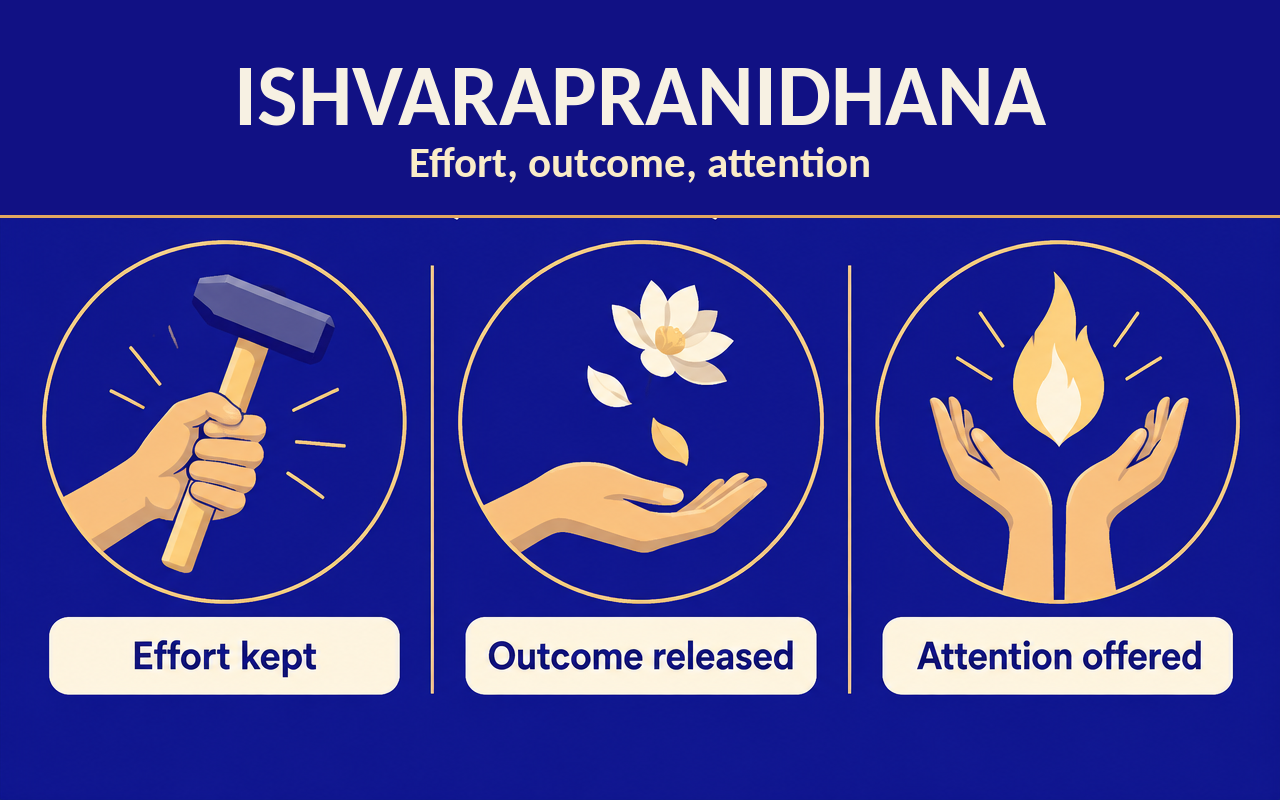
Praṇidhāna is not the ordinary word for giving up. It carries the sense of placing oneself toward something with sustained intent, which is why the same term serves for devotion, application, and vows. Surrender in this vocabulary is an act of orientation: the practitioner keeps practising and releases the claim on the outcome.
The Gita uses a parallel structure when it tells Arjuna to act without claiming the fruits (2.47). The two texts differ in vocabulary but agree on the mechanics: effort remains, ownership of the result is released. What is surrendered is not the work but the demand that the work produce a particular result.
Where it appears in the texts
Yoga Sutra 1.23 offers dedication to Ishvara as a means of stilling the mind. Sutra 1.24 defines Ishvara as a special purusha untouched by afflictions, karma, and their residues, and 1.25–1.26 describe its omniscience and status as teacher of the ancients. Sutra 1.27 names Om as its designation, 1.28 gives repetition and meaning, and 1.29 describes the result: inward awareness and the removal of obstacles.
In the second chapter, ishvarapranidhana is one of the five niyamas (2.32), and 2.45 states that from surrender comes the perfection of samadhi. The placement is important: surrender is both a moral observance and a meditative method, and the text does not separate the two.
Why it matters in practice
Practice is easily captured by ambition. The practitioner wants a calmer mind, a better session, a measurable result, and the wanting itself becomes the agitation. Surrender interrupts that loop by removing the demand, and the removal often produces the steadiness that the demand was blocking.
The concept also makes effort sustainable. A person who has released the outcome can keep practising after a bad session, because the session is no longer a verdict. The Gita’s phrase for this is equanimity in success and failure (2.48), and it is the practical face of the same surrender.
How to practise ishvarapranidhana
- Choose your form of the divine. A name, a form, or the sacred as such; the Yoga Sutras offer Om.
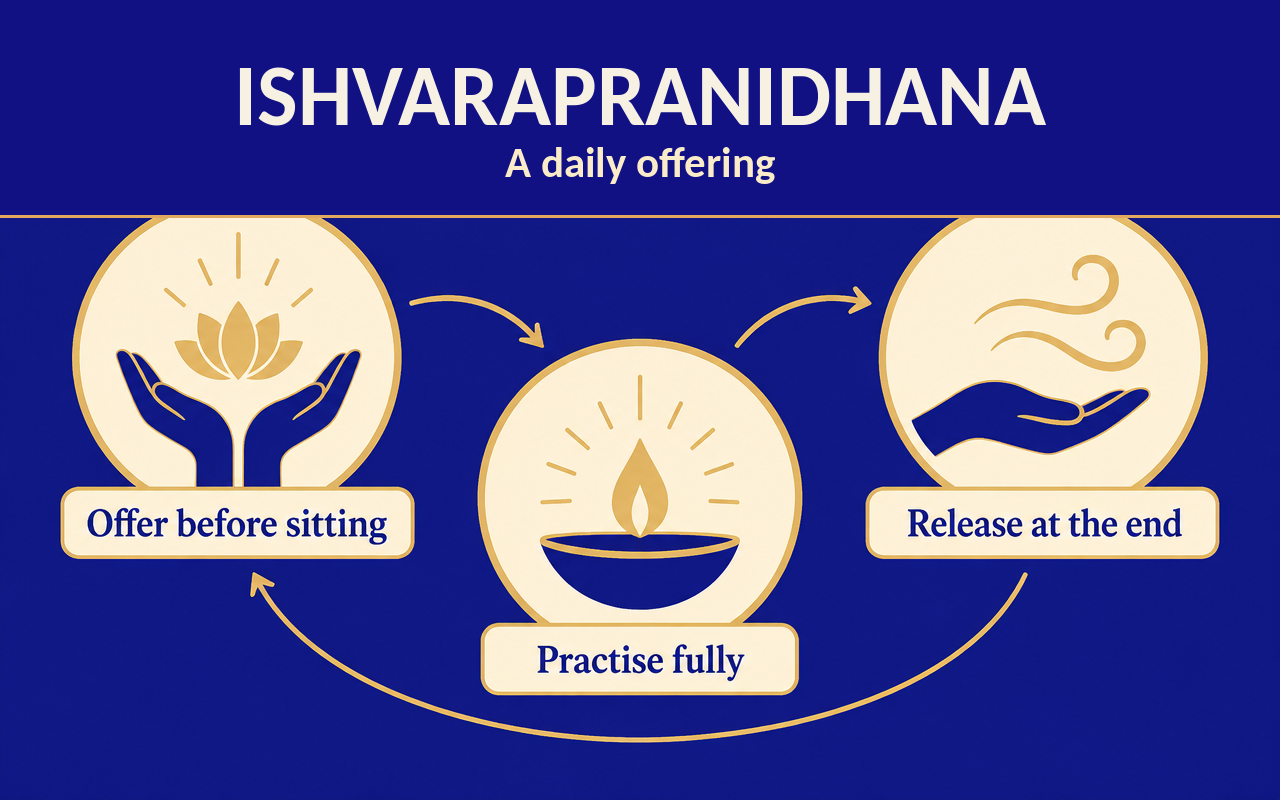
- Begin with a short offering. One sentence before practice: “This practice is offered.”
- Do the work fully. Surrender is not an excuse for vagueness; the effort stays precise.
- Release the result at the end. Name what you noticed, then let go of the verdict.
- Keep the same time tomorrow. The continuity is the evidence that the surrender was real.
- Watch for bargaining. If the offering has become a transaction, name it and return to the simple sentence.
When surrender feels like collapse: return to the smallest unit of effort. The tradition does not ask you to stop acting; it asks you to stop treating the result as your identity.
Common misunderstandings
Surrender is vigorous action with the claim on results released. The Gita’s instruction to act without claiming the fruits assumes vigorous action; only the claim is released.
It is an offering that releases the result. Offering in order to obtain a result is the opposite of the practice, which releases the result.
It is open to anyone willing to release outcomes. The Yoga Sutras describe Ishvara in their own terms, and the practice of releasing the outcome can be undertaken within other frameworks.
Signs of progress
Practice becomes less dramatic. A poor session no longer produces a crisis, and a good one no longer produces inflation. Practitioners often report a lighter relationship with results at work as well. The sign is steadiness in effort, not the absence of effort.
Traditional benefits
Patanjali states that surrender brings the perfection of samadhi (2.45) and lists it among the observances that support the whole path (2.32). Sutra 1.29 promises inward awareness and the removal of obstacles for the practitioner who repeats Om with meaning. These are the text’s claims, stated as the text states them.
Modern research gives partial context. Goyal and colleagues (JAMA Internal Medicine, 2014) found moderate evidence that meditation programmes reduce anxiety and depression, with weaker evidence elsewhere. Hölzel and colleagues (2011) propose attention regulation and a changed self-perspective as mechanisms, in a framework rather than a trial. Tang, Hölzel and Posner (Nature Reviews Neuroscience, 2015) review attention and stress findings across heterogeneous studies. None of these studies tests surrender, and none establishes a theological claim.
Two public frames are relevant: the WHO’s mental-health work treats psychological well-being as part of general health, while the UN resolution recognises yoga through a day of observance. Neither text discusses surrender.
How ishvarapranidhana connects to the 114-chakra framework
Sri Amit Ray’s model describes 114 centers — 108 internal plus 6 external — grouped into 7 basic, 21 power, and 86 master chakras, within a map that uses 11 dimensions and 15 nested layers. Ishvarapranidhana is not a center; it is an attitude brought to the map. In Sri Amit Ray’s 114 chakra system, ishvarapranidhana (surrender) is deeply connected to the practice.
A student takes a named center, offers the session at that center, and releases both the center and the result at the end. Basic chakras support the first steadiness; the power chakras are described in the tradition as supporting compassion and relationship, and the master chakras as supporting calm. What must not be claimed is that surrender “opens” a center, that a warm sensation proves a layer, or that dedication replaces medical care. See Sri Amit Ray’s 114 Chakras and 72,000 Nadis framework, and his teaching on releasing what is held.
Related concepts
- Bhakti — devotion, the emotional form of the same orientation.
- Soham — a mantra that can carry dedication through the day.
- Abhyasa — sustained practice, which surrender makes sustainable.
- Kaivalya — the freedom that released grasping serves.
The series is indexed in the Master Yoga Concepts Guide; for dedication embodied in movement, see IFYM’s Surya Namaskar and 114 Chakras guide.
Further reading and sources
Primary: Yoga Sutras 1.23–1.29, 2.32, and 2.45 with Vyasa’s commentary; Bhagavad Gita 2.47–48. Context: Sri Amit Ray on releasing held emotion and the 114 centers. The studies drawn on here are Goyal and colleagues’ meta-analysis (JAMA Internal Medicine, 2014), Hölzel and colleagues on mechanisms (Perspectives on Psychological Science, 2011), and the review by Tang, Hölzel and Posner (Nature Reviews Neuroscience, 2015).
Frequently asked questions
Do I have to believe in God to practise this?
The Yoga Sutras assume Ishvara, but the underlying action — offering the result while continuing the effort — can be practised within other frameworks.
Is surrender the same as acceptance?
Acceptance concerns what is present; surrender concerns the claim on the outcome. They often appear together.
How do I know I am not just avoiding responsibility?
Check the effort. Surrender keeps the work precise; avoidance reduces it.