Bhakti: Devotion as a Path of Yoga
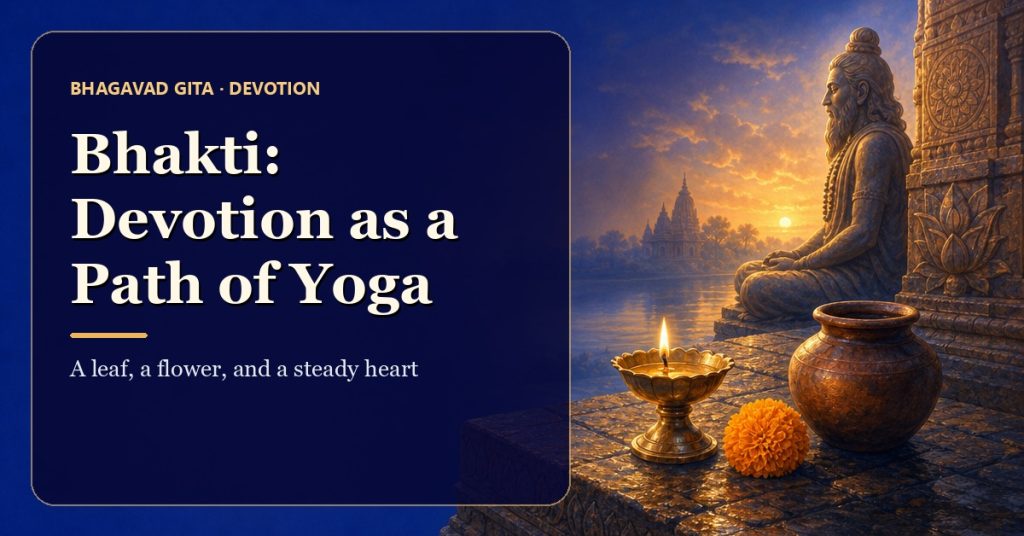
Bhakti (भक्ति, bhakti) means devotion: the turning of the whole person toward what is held as sacred. The word comes from the root bhaj, “to share, to belong to, to serve”, and its oldest sense is participation rather than sentiment. In the Bhagavad Gita, Krishna describes the path in chapters 9 and 12, and the offer is deliberately small: a leaf, a flower, a fruit, or water given with devotion (9.26). This article explains what the tradition means by devotion, how it differs from religious feeling, and how it is practised on an ordinary day.
In Sri Amit Ray’s 114-chakra tradition, bhakti is associated with the basic and power chakras that the teaching links to compassion and relationships and to emotional balance. Every one of those centres is a place where attention can rest, so the quality grows through the map rather than beside it. The practitioner offers attention at a named centre, lets the offering be simple, and returns to it when the mind begins to bargain; the tradition describes devotion as a warming of attention rather than a transaction. The relation is a contemplative connection inside Sri Amit Ray’s teaching.
At a glance
| Sanskrit | भक्ति · bhakti · devotion, participation, belonging |
|---|---|
| Primary text | Bhagavad Gita 9.26–34 and 12.1–20 |
| Tradition | Bhakti Yoga within the Gita; developed in later devotional schools |
| Practice form | A fixed time, a simple offering, and repeated remembrance |
| Nearest contrast | Bargaining, which treats devotion as a transaction; and mere sentiment, which does not change conduct |
| 114-chakra association | Basic centres for emotional warmth; power centres for relationships and compassion |
What the word names
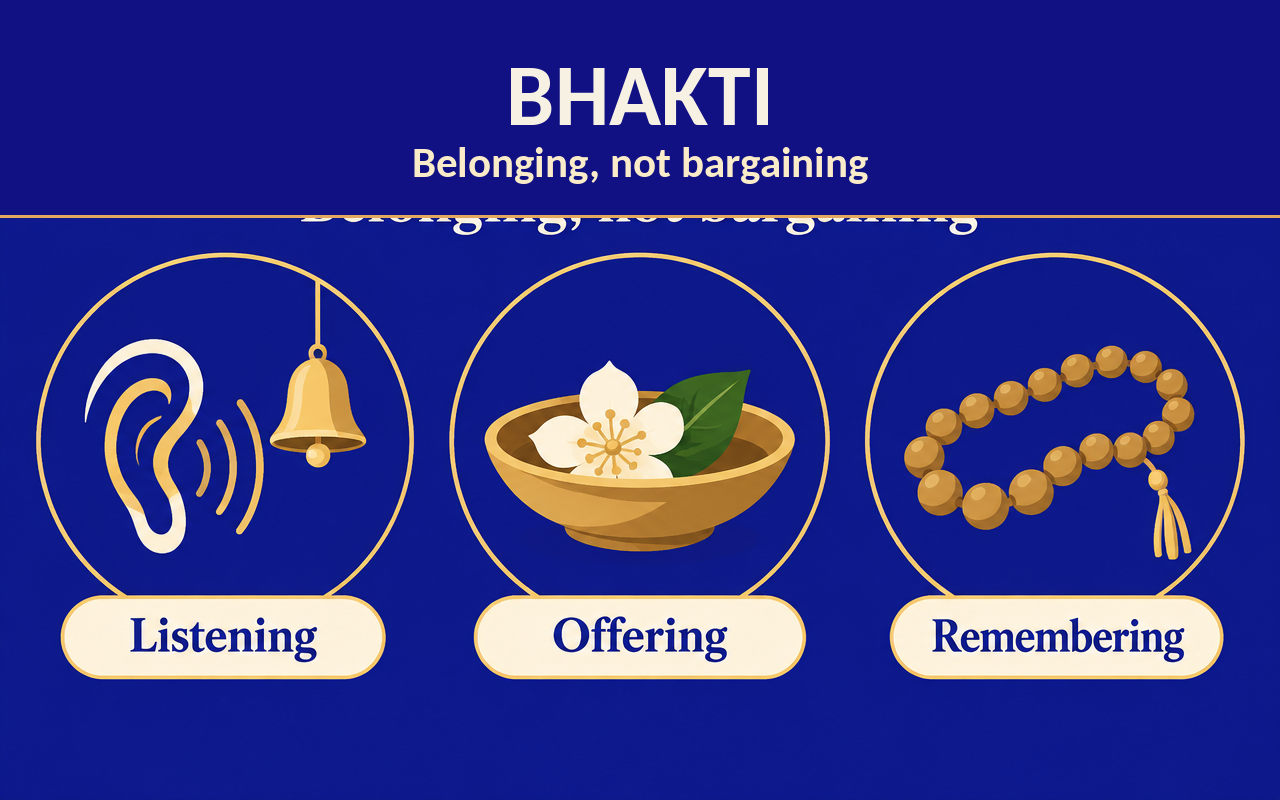
Because bhaj means to share or to belong, bhakti begins as a relationship rather than a belief. The devotee does not primarily hold an opinion about the divine; the devotee belongs to it, serves it, and is changed by the belonging. This is why the Gita can accept the smallest offering: the size of the gift is irrelevant because the relationship is the point.
The term also has a public life. In Indian usage bhakti names whole movements of song, pilgrimage, and poetry, and the Gita’s chapter 12 is a compact manual for that life: who the devotee is, how they behave, and what they may expect. The text is careful to make devotion visible in conduct rather than in intensity of feeling.
Where it appears in the texts
Gita 9.26–28 gives the practice in miniature: whatever is offered with devotion is accepted, and the instruction is to act, offer, and give as an offering. Gita 9.34 then states the direction of attention — think of me, be devoted, worship, bow — and promises that the devotee comes to the divine. Gita 12.1–20 answers Arjuna’s question about the relative merit of devotion to a personal form and devotion to the unmanifest, and then describes the devotee’s character.
The description in 12.13–20 is the practical test of the whole chapter: the devotee is not hostile, is friendly and compassionate, free from possessiveness and ego, even in pleasure and pain, and patient. Devotion that leaves these qualities untouched has not yet become bhakti in the Gita’s sense, however warm the feeling.
Why it matters in practice
Practice tends to become a project: improve attention, reduce reactivity, achieve calm. A project has a manager, and the manager keeps score. Bhakti interrupts the scoring by relocating the reason for practice outside the self. The practitioner still practises, but the practice is no longer a performance to be evaluated.
Devotion also gives attention a direction when concentration is weak. A mind that cannot hold an abstract object can often hold a name, a form, or a song, and the Gita’s own recommendation is to use whatever is available. The path is designed for ordinary capacities, not for specialists.
How to practise bhakti
- Choose one form or name. A deity, a line of a song, a teacher, or the sacred as such. One, for a season.
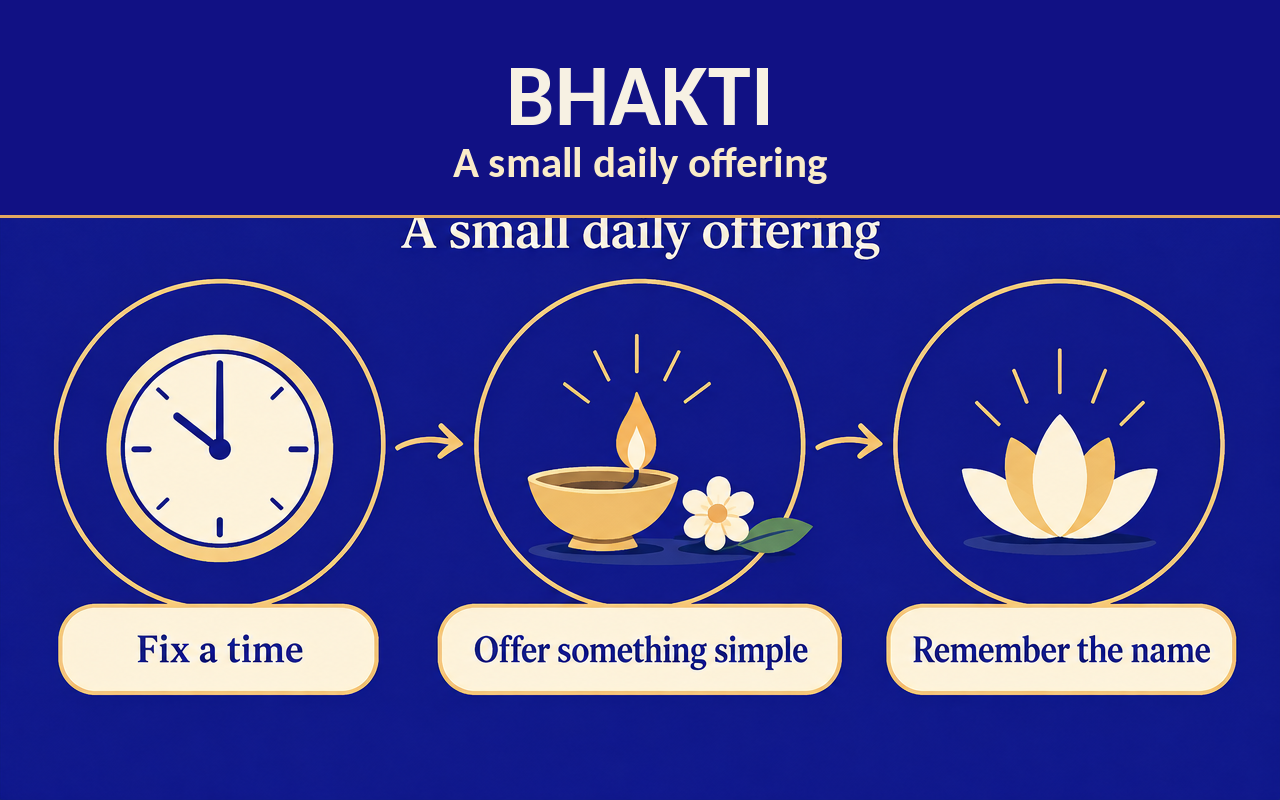
- Fix a small daily time. Five minutes at the same hour beats an hour when you feel inspired.
- Make a simple offering. Water, a flower, a lamp, or a few words. The Gita’s list is deliberately ordinary (9.26).
- Sing or listen. The voice steadies attention faster than silent intention, which is why kirtan and bhajan remain central.
- Remember during the day. A single repeated phrase at transitions keeps devotion from becoming a compartment.
- Check the conduct. Once a week, ask whether friendliness, patience, and freedom from possessiveness have moved at all (12.13–20).
When nothing is felt: continue the form without demanding an experience. The Gita treats devotion as a practice of offering, and dryness is part of the practice rather than evidence that it has failed.
Common misunderstandings
Bhakti is steady belonging expressed through conduct. Tears and excitement are not the measure; the measure is the conduct described in chapter 12.
It is an offering that releases the result. Offering a lamp in exchange for a result turns devotion into bargaining, and the Gita’s language of offering is precisely not that.
It is open to anyone who turns the heart toward the divine. The Gita speaks of devotion to the divine in a personal form, but the practice of belonging, offering, and remembrance can be undertaken within any tradition that values it.
Signs of progress
The practice becomes easier to begin and harder to skip. Ordinary moments — a meal, a journey, a threshold — acquire a short inward phrase. Practitioners often report a softening in how they speak about people they dislike. The reliable sign is not a special state but a change in manners.
Traditional benefits
The Gita’s promise is companionship and freedom from fear: the devotee is never lost, and the divine carries what is lacking (9.22, 9.31). Chapter 12 adds the psychological fruit — steadiness in pleasure and pain, and a mind that is not agitated by the world. These are the tradition’s claims, stated as the text states them.
Modern research offers partial context. Goyal and colleagues (JAMA Internal Medicine, 2014) found moderate evidence that meditation programmes reduce anxiety and depression, with weaker evidence for other outcomes. Hölzel and colleagues (2011) propose emotion regulation and a changed self-perspective among the mechanisms of mindfulness, as a model rather than a measured result. Tang, Hölzel and Posner (Nature Reviews Neuroscience, 2015) review evidence linking regular practice with attention and stress measures across heterogeneous studies. None of these studies tests bhakti, and none establishes a theological claim.
For public context, the UN marks 21 June as the International Day of Yoga, and the WHO describes traditional medicine as part of health systems in many countries. These are cultural and policy recognitions, not doctrinal endorsements.
How bhakti connects to the 114-chakra framework
Sri Amit Ray’s model describes 114 centers — 108 internal plus 6 external — grouped into 7 basic, 21 power, and 86 master chakras, within a map that uses 11 dimensions and 15 nested layers. Bhakti is not a center in that map; it is the orientation a practitioner brings. In Sri Amit Ray’s 114 chakra system, bhakti is deeply connected to the practice.
In practice, a student takes a named center associated in Ray’s teaching with warmth, compassion, or relationship, and treats it as the place of offering during a short daily practice. The basic chakras support the first, simplest offering; the power chakras are described in the tradition as supporting relationship, which is where devotion becomes visible. The practitioner should not conclude that a sensation proves a center has opened, that devotion “activates” a chakra, or that the practice replaces medical care. See Sri Amit Ray’s 114 Chakras and 72,000 Nadis framework, and his discussion of devotional singing and movement.
Related concepts
- Ishvarapranidhana — dedication, the Yoga Sutra’s form of the same surrender.
- Soham — a mantra of belonging that can carry devotion through the day.
- Mauna — silence, which makes room for listening.
- Jnana — knowledge, which the Gita treats as the fruit rather than the rival of devotion.
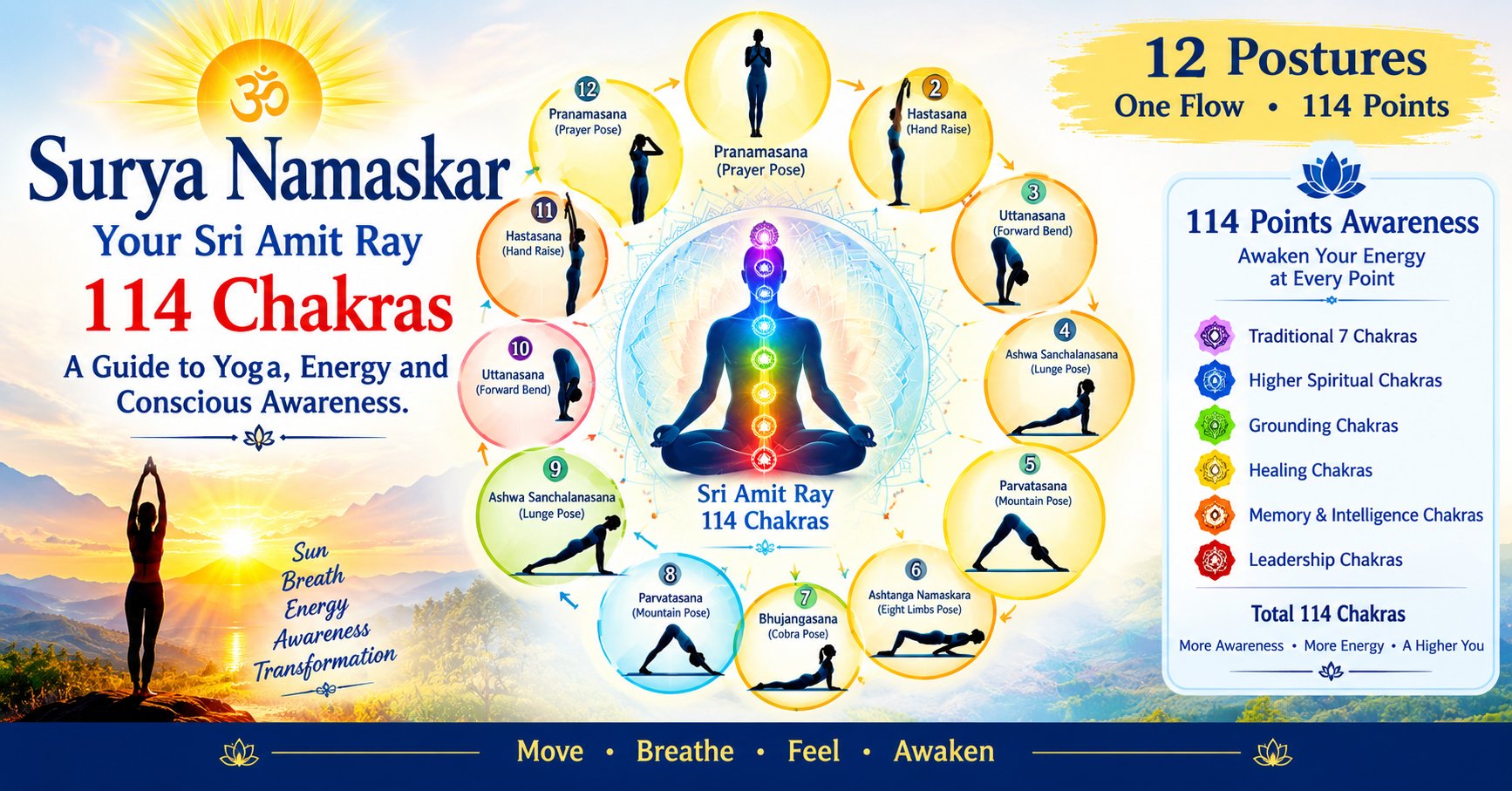
The series is indexed in the Master Yoga Concepts Guide; for devotion embodied in movement, see IFYM’s Surya Namaskar and 114 Chakras guide.
Further reading and sources
Primary: Bhagavad Gita 9.26–34 and 12.1–20. Context: Sri Amit Ray on devotional practice and the 114 centers. Research: Goyal et al., JAMA Internal Medicine 174 (2014); Hölzel et al., Perspectives on Psychological Science 6 (2011); Tang, Hölzel and Posner, Nature Reviews Neuroscience 16 (2015).
Frequently asked questions
Do I need to belong to a tradition to practise bhakti?
The Gita assumes a relationship with the divine, but the practices of offering, remembrance, and service can be undertaken within any tradition that values them.
Is devotion compatible with inquiry?
Yes. The Gita presents knowledge and devotion as mutually supporting rather than as alternatives.
What if I feel nothing during practice?
Continue the form without demanding a feeling. The text defines devotion by offering and conduct, not by emotional intensity.