Kundalini: The Serpent Power in Yoga Traditions
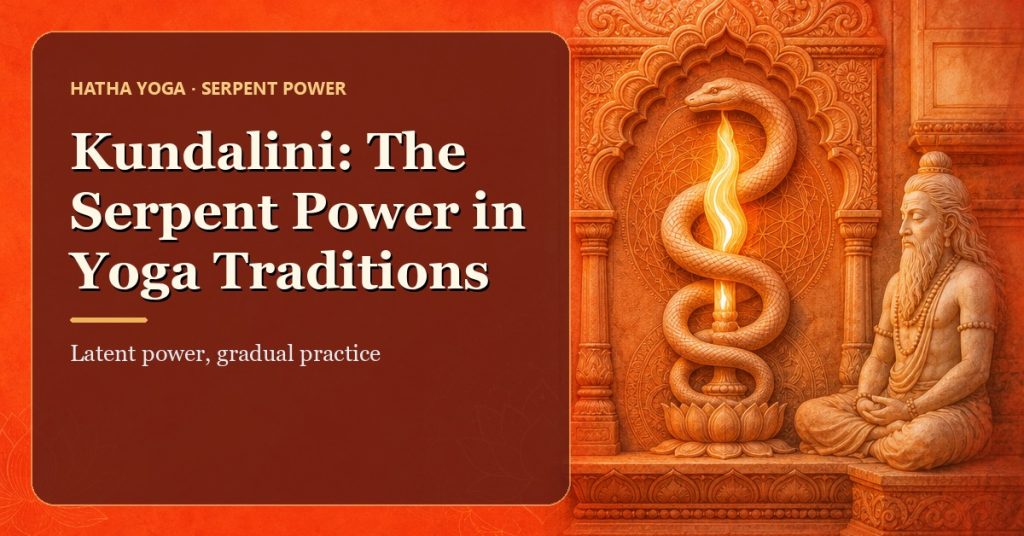
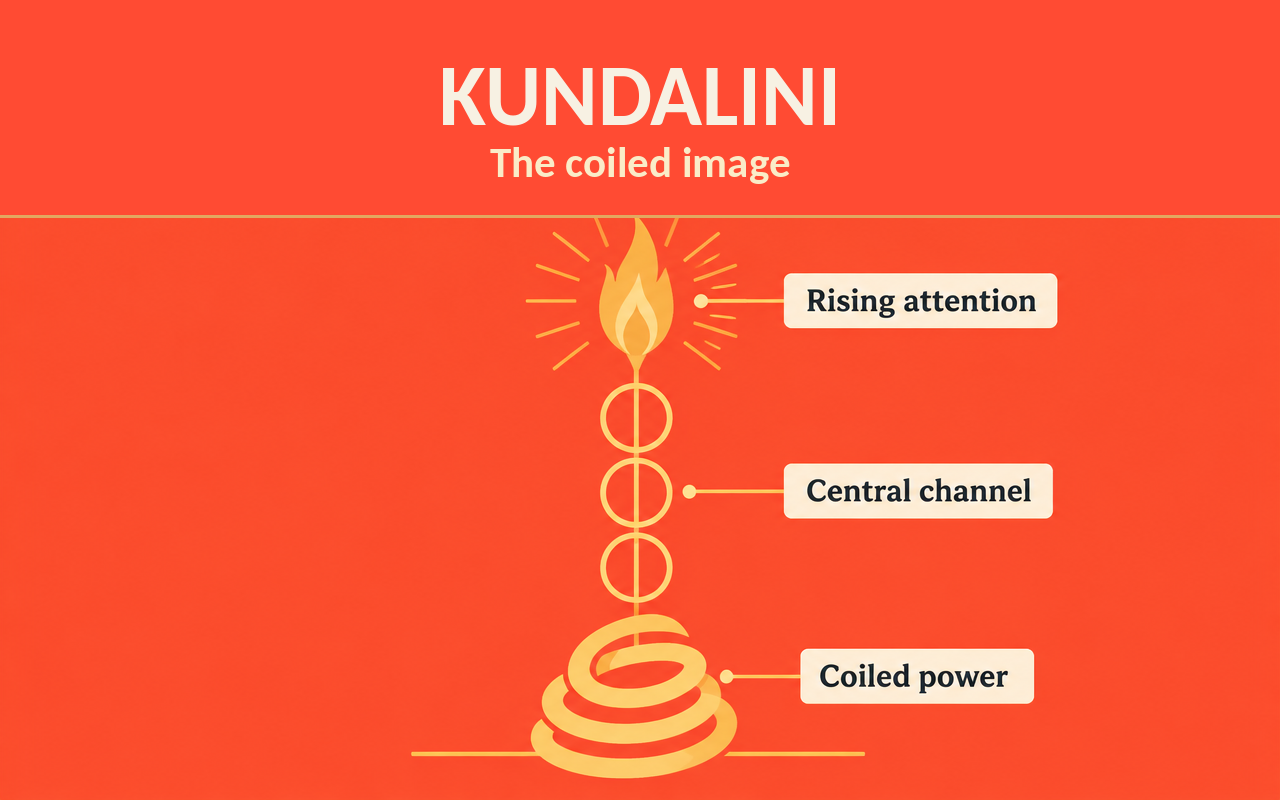
Kundalini (कुण्डलिनी, kuṇḍalinī) means “the coiled one”: the feminine image of a latent power said to lie at the base of the subtle body and to rise through its central channel when awakened. The word comes from kuṇḍala, a coil or ring, and the image is developed in the Hatha manuals and in later texts on the chakras. It is one of the most claimed and least verifiable terms in yoga, which is why this article separates the traditional account from the medical language that often surrounds it. It explains the image, the texts, the practices associated with it, and the cautions the tradition itself gives.
In Sri Amit Ray’s 114-chakra tradition, kundalini is associated with the basic and power chakras that the teaching links to concentration and attention and to emotional balance, and with the master chakras it connects to creativity and insight and to vitality and immunity. Every one of those centres is a place where attention can rest, so the quality grows through the map rather than beside it. The practitioner works gradually through named centres rather than chasing a dramatic rise; the tradition describes the process as the maturing of attention, not as a physical event to be forced. The connection is symbolic and contemplative within Sri Amit Ray’s teaching.
At a glance
| Sanskrit | कुण्डलिनी · kuṇḍalinī · the coiled one |
|---|---|
| Primary text | Hatha Yoga Pradipika chapters 3–4; later chakra texts such as the Ṣaṭ-cakra-nirūpaṇa |
| Tradition | Hatha and Tantric yoga, with strong lineage variation |
| Practice form | Posture, breath, locks, and attention, built slowly under guidance |
| Nearest contrast | Force and ambition, which the texts warn against; and medical claims about a “kundalini awakening” |
| 114-chakra association | Basic and power centres for attention and balance; master centres for insight |
What the word names
The image is of a serpent coiled at the base, asleep, whose rising is said to open the centres along the central channel. The language is deliberately symbolic: a coil suggests potential, a channel suggests direction, and sleep suggests latency. Read literally, the image invites fantasy; read as a map of inner maturation, it is closer to the tradition’s intent.
The term is feminine, and the texts often pair it with śakti, power, and with śiva, consciousness. The union of the two is the aim, and the ascent is not an end in itself; without the corresponding steadiness of awareness, the tradition says, the power is dangerous or useless. That pairing is the most important thing to understand about the word.
Where it appears in the texts
The Hatha Yoga Pradipika discusses kundalini in connection with mudras, bandhas, and samadhi, and the Gheranda Samhita develops similar material. Later chakra texts describe the ascent through six or seven centres with far more detail. The traditions do not agree on every point, and the reader should expect variation rather than a single system.
The Yoga Sutras do not use the word kundalini. Patanjali describes concentration, meditation, and absorption, and the powers that follow (3.1–3.55), but the coiled-serpent imagery belongs to the Hatha and Tantric streams. Presenting it as Patanjali’s teaching is a common error and blurs the traditions.
Why it matters in practice
The image gives practitioners a way to talk about intensity. Strong sensations, involuntary movements, and emotional surges can be interpreted as a rising process, and that interpretation can be helpful when it encourages patience. It becomes harmful when it is used to explain away distress, to claim special status, or to justify ignoring medical symptoms.
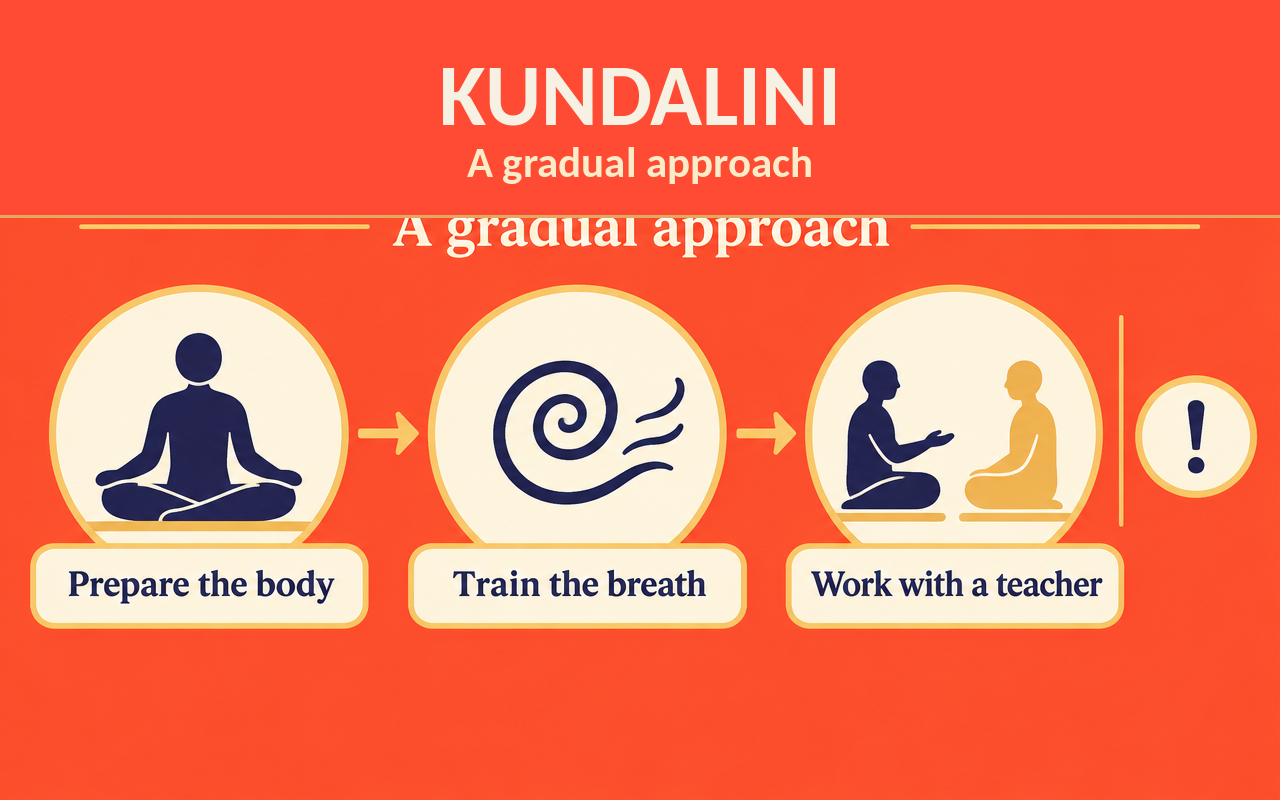
The concept also explains why the tradition insists on preparation. A body that cannot sit still, a breath that is not trained, and a life without ethical ground are poor containers for intensity. The Hatha texts put posture, breath, and restraint before the practices associated with kundalini for exactly this reason.
How the tradition approaches kundalini
- Establish posture and breath. A steady seat and smooth breathing are the base for everything that follows.
- Build ethical ground. The yamas and niyamas reduce the inner conflict that intensity amplifies.
- Work with attention, not ambition. Choose one center or channel that a qualified teacher names and stay with it.
- Use locks and retention only when taught. These are advanced practices with real cautions.
- Keep the sessions short. Intensity is not a measure of progress; regularity is.
- Have a teacher and a peer. The tradition assumes supervision for these practices, and the caution is not bureaucratic.
If sensations become overwhelming: stop the practice, ground the body, and speak to a qualified teacher and a clinician if needed. The tradition does not ask anyone to endure distress in the name of awakening.
Common misunderstandings
Kundalini is a contemplative image of ascent. The texts describe a contemplative process in symbolic language; they do not describe a verified physiological mechanism.
Progress shows in steadiness and conduct. Strong sensations can arise from breath work, fatigue, or anxiety, and the tradition warns against reading them as status.
Its imagery belongs to the Hatha and Tantric literature. The Yoga Sutras do not use the word; the imagery belongs to Hatha and Tantric literature.
Signs of progress
The tradition is cautious about signs, and this article follows that caution. Observable markers are modest: steadier posture, smoother breath, less fear of intensity, and a capacity to stop when a practice becomes too much. A practitioner who becomes more grandiose has not progressed, whatever the sensations.
Traditional benefits
The Hatha texts present kundalini practice as a route to samadhi and to the union of power and consciousness. Those claims belong to the tradition and should be quoted as such. The practical benefits commonly described — greater steadiness, a wider tolerance for strong experience, and a sense of inner direction — are modest and do not require metaphysical commitments.
Research gives limited context. Goyal and colleagues (JAMA Internal Medicine, 2014) found moderate evidence that meditation programmes reduce anxiety and depression, with weaker evidence elsewhere. Hölzel and colleagues (2011) propose attention regulation and body awareness as mechanisms, in a framework rather than a trial. Tang, Hölzel and Posner (Nature Reviews Neuroscience, 2015) review attention and stress findings across heterogeneous studies. None of these studies tests kundalini, and none establishes the subtle-body model.
For public context, the Ayush yoga portal publishes official protocols, and the WHO treats mental health as part of overall health. Neither endorses kundalini claims.
How kundalini connects to the 114-chakra framework
Sri Amit Ray’s model describes 114 centers — 108 internal plus 6 external — grouped into 7 basic, 21 power, and 86 master chakras, within a map that uses 11 dimensions and 15 nested layers. Kundalini is not one of those centers; it is a traditional image of ascent. In Sri Amit Ray’s 114 chakra system, kundalini is deeply connected to the practice.
Used carefully, the connection replaces the dramatic image with a gradual one: a student moves attention through the basic centres, then the power centres, and only much later the master centres, with each stage held long enough to become familiar. The tradition’s own caution applies: no center is “forced open”, no sensation proves a layer, and no experience justifies ignoring medical care. See Sri Amit Ray’s 114 Chakras and 72,000 Nadis framework, and his teaching on awakening.
Related concepts
- Nadi — the channels through which the ascent is described.
- Bandha — the locks used, with caution, in Hatha kundalini practice.
- Prana — the breath-energy that the practices work with.
- Kaivalya — the classical goal against which kundalini claims should be read.
The series is indexed in the Master Yoga Concepts Guide; for a gradual, embodied practice, see IFYM’s Surya Namaskar and 114 Chakras guide.
Further reading and sources
Primary: Hatha Yoga Pradipika chapters 3–4; Gheranda Samhita; later chakra texts, read with a teacher. Context: Sri Amit Ray on awakening and the 114 centers. Reference studies: Goyal and colleagues’ meta-analysis of meditation outcomes (JAMA Internal Medicine, 2014); Hölzel and colleagues on proposed mechanisms (Perspectives on Psychological Science, 2011); and Tang, Hölzel and Posner’s review of attention research (Nature Reviews Neuroscience, 2015).
Frequently asked questions
Is kundalini dangerous?
Intense practices can produce distress, which is why the tradition requires preparation and supervision. Gentle, gradual practice is not the same as forcing an experience.
Does everyone experience a rising?
The texts describe an idealised process; individual experience varies widely, and the absence of dramatic sensations is not failure.
Is kundalini the same as chakra energy?
Related but not identical. Kundalini is an image of ascent; chakras are centres along the path. The traditions differ in how they describe both.