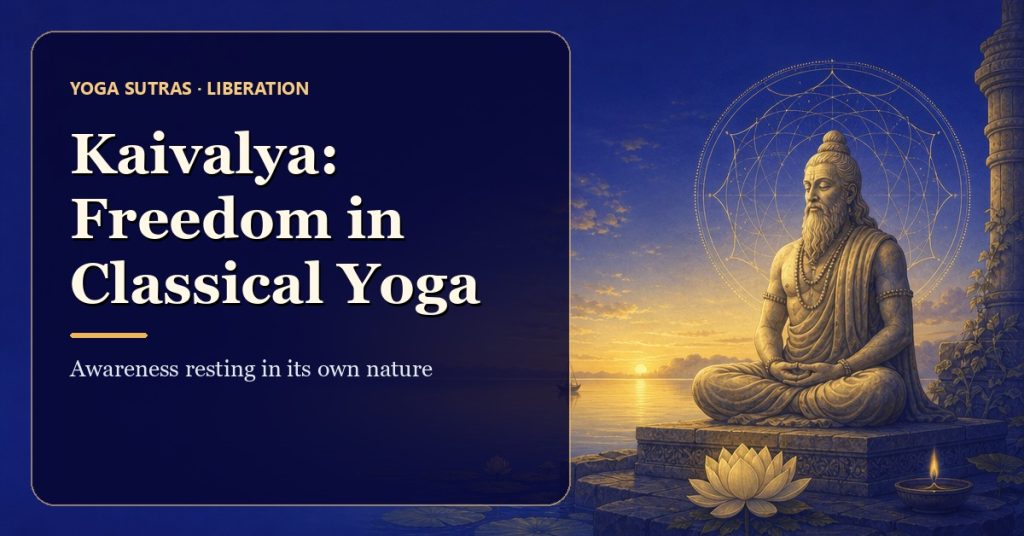
Kaivalya: Freedom in Classical Yoga
Kaivalya (कैवल्य, kaivalya) means aloneness in the precise sense of being free of everything mixed in: the final aim of classical Yoga. The word comes from kevala, “alone, only, unmixed”, and Patanjali defines it twice — as the purity of the relation between awareness and nature (3.55), and as the settling of the seer in its own nature at the close of the Yoga Sutras (4.34). It is not solitude, and it is not a mood. This article explains the term, its place at the end of the text, and why the tradition insists that freedom is not something a person acquires.
In Sri Amit Ray’s 114-chakra tradition, kaivalya is associated with the master chakras that the teaching links to creativity and insight and to emotional balance, and with the power chakras it connects to concentration and attention. Every one of those centres is a place where attention can rest, so the quality grows through the map rather than beside it. The practitioner works through named centres towards a settled awareness, not towards a new possession; the tradition describes freedom as the recognition of what was already present rather than as an experience to be produced. The link is interpretive and belongs to Ray’s teaching, not to medical evidence.
At a glance
| Sanskrit | कैवल्य · kaivalya · aloneness, unmixed freedom |
|---|---|
| Primary text | Yoga Sutras 3.55 and 4.34; related at 2.25 |
| Tradition | Classical (Patanjali) Yoga, with a parallel vocabulary in Samkhya |
| Practice form | The long sequence of ethics, attention, and discernment that ends in release |
| Nearest contrast | Isolation as withdrawal from others; and absorption (samadhi), which is a state rather than the final freedom |
| 114-chakra association | Master centres for insight; power centres for attention and balance |
What the word names
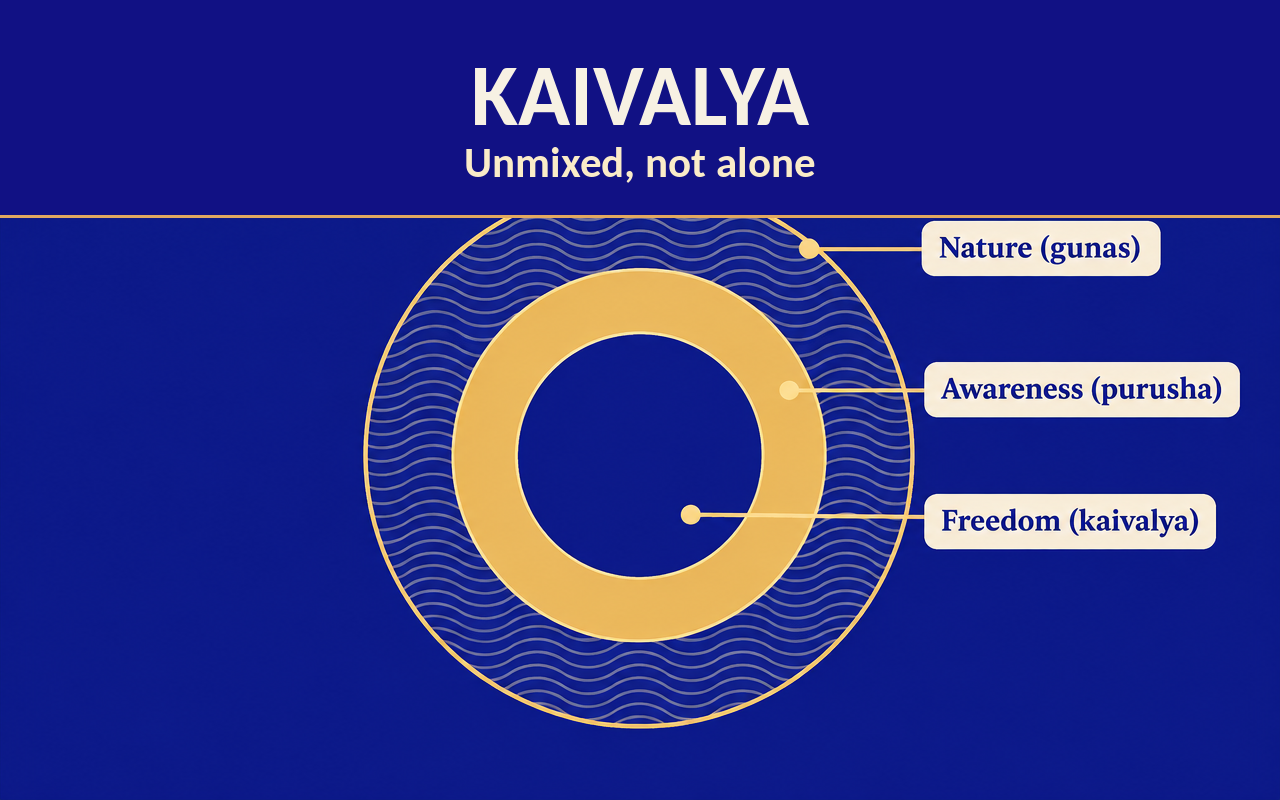
Kaivalya is not the loneliness of being apart from people. The root sense is “unmixed”: a thing that is only itself, with nothing added. In Samkhya and Yoga the mixture is between puruṣa, pure awareness, and prakṛti, the processes of nature, and the bondage consists in awareness appearing to be those processes. Kaivalya is the end of that confusion, not the end of relationship.
This is why the English word “isolation” misleads. A liberated person is not sealed off; the person is simply no longer determined by the flux of mind and matter. The Gita’s language of a stable self in the midst of action is closer to the practical flavour than the image of a hermit.
Where it appears in the texts
Yoga Sutra 3.55 describes kaivalya as the equality of purity between awareness and the mind’s sattva, a state in which discernment has nothing left to remove. Sutra 4.34 closes the text: the gunas, their purpose fulfilled, return to their source, and awareness is established in its own nature — that is kaivalya. The phrasing is deliberately quiet. There is no celebration, no attainment language, only the end of a process.
Sutra 2.25 supplies the mechanism: the conjunction between seer and seen ceases when its cause, ignorance, is removed. The rest of the text is the long preparation for that cessation, which is why kaivalya is described as the last sutra rather than the first experience.
Why it matters in practice
Most practitioners come to yoga with a goal, and the goal quietly becomes another possession: a calmer mind, a better body, a spiritual identity. Kaivalya names the end of that logic. Freedom is not an object to hold; it is what remains when the holding stops. Keeping the term in view protects practice from turning into self-improvement without end.
The concept also gives perspective on the path. If freedom is the settling of awareness in its own nature, then ethics, posture, breath, and attention are not hoops to jump through but the gradual removal of what obscures that nature. The sequence matters because each limb reduces a kind of agitation.
How the tradition approaches kaivalya
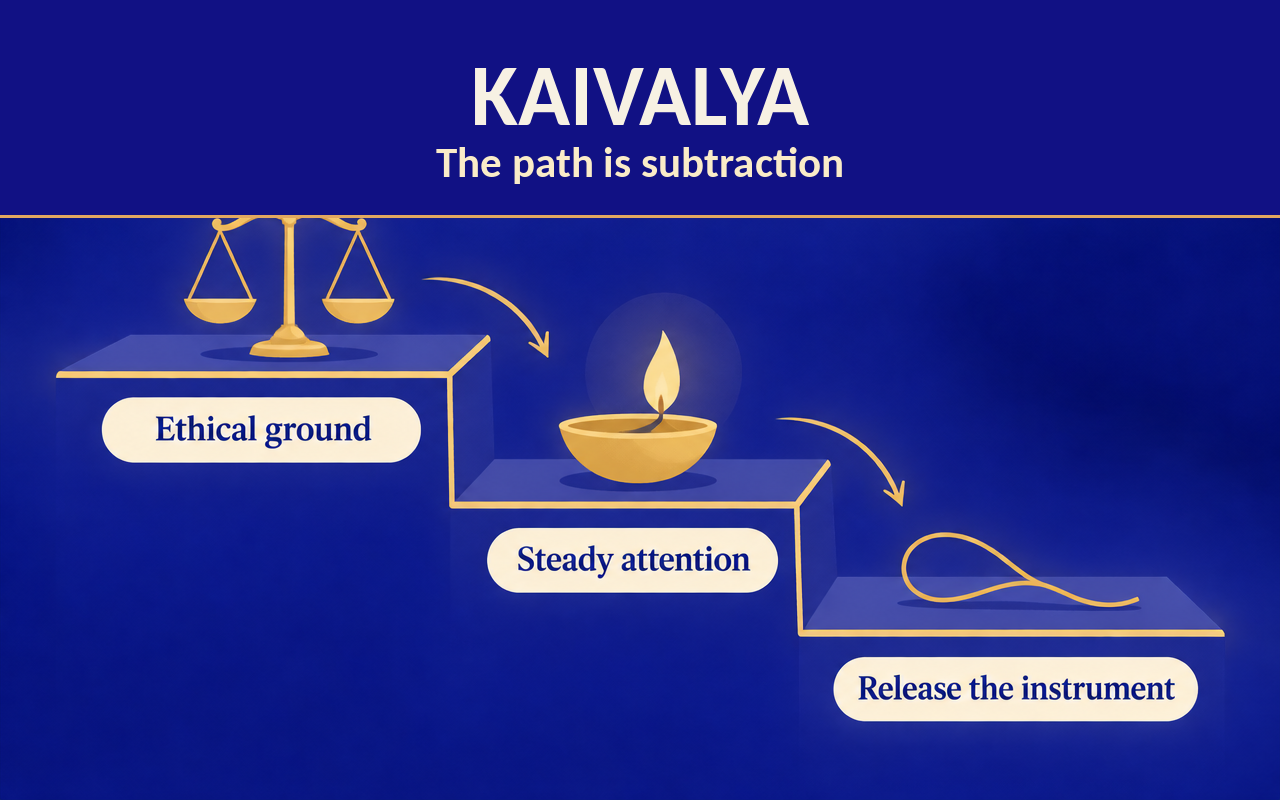
- Establish conduct. The yamas and niyamas reduce the friction that constant self-justification creates.
- Steady the body and breath. Posture and breath work make attention less reactive.
- Train attention. Dharana, dhyana, and samyama make the mind capable of staying.
- Discern. Repeatedly distinguish awareness from the contents of awareness.
- Release the instrument. Even the finest state of mind is seen as belonging to nature, not to the seer.
- Stop adding. At a certain point the work is subtraction; the text’s final image is return, not achievement.
When the goal becomes a possession: notice the ambition and return to the next ordinary step. The tradition is suspicious of anyone in a hurry to be free.
Common misunderstandings
Kaivalya is freedom unmixed with confusion, lived in the world. The word’s sense is “unmixed”, and the liberated person can act in the world without being determined by it.
It is distinct from samadhi: the final settling. Samadhi is an absorption that can be entered and left; kaivalya is the final settling described at the end of the text.
It is a recognition of what awareness is. Feelings belong to the mind; the text describes a recognition of what awareness is, not an emotional high.
Signs of approach
The tradition is cautious about signs, but the practical markers are a decreasing need to defend an identity, a lighter relationship with states of mind, and a willingness to let practice be ordinary. A person may still have preferences and work; what changes is the sense that these define the self.
Traditional benefits
The Yoga Sutras present kaivalya as the resolution of suffering: ignorance removed, the conjunction ended, awareness established in itself (2.25, 3.55, 4.34). The benefit is not described as a new power but as the end of a misidentification. The text’s confidence is that this is the natural state, not an exotic attainment.
Research offers only distant context. Goyal and colleagues’ 2014 meta-analysis in JAMA Internal Medicine reported moderate support for anxiety and depression, and less for other outcomes. Hölzel and colleagues (2011) propose a changed self-perspective among mechanisms of mindfulness, as a model rather than a measured result. Brewer and colleagues (PNAS, 2011) reported differences in default-mode network activity in experienced meditators, in a small cross-sectional sample. None of these studies tests kaivalya, and none establishes the metaphysics of Samkhya-Yoga.
For public context, the UN Sustainable Development Goal 3 commits member states to health and well-being, and the WHO treats mental health as part of overall health. Neither addresses liberation.
How kaivalya connects to the 114-chakra framework
Sri Amit Ray’s model describes 114 centers — 108 internal plus 6 external — grouped into 7 basic, 21 power, and 86 master chakras, within a map that uses 11 dimensions and 15 nested layers. Kaivalya is not a center in that map; it is the freedom the map is used to approach. In Sri Amit Ray’s 114 chakra system, kaivalya is deeply connected to the practice.
A practitioner works from the basic centres, through the power centres, towards the master centres that the tradition links with insight; the movement is one of increasingly subtle attention rather than increasing intensity. The map is a support for that movement, and the final claim of the Yoga Sutras remains the Yoga Sutras’ claim, not the map’s. What must not be claimed is that a center “grants” freedom, that an experience proves a dimension, or that the practice replaces medical care. See Sri Amit Ray’s 114 Chakras and 72,000 Nadis framework, and his course on the 72,000 nadis.
Related concepts
- Jnana — the clear seeing that removes ignorance, the cause of bondage.
- Nirbija — absorption without seed, the last state before the final settling.
- Samyama — the integrated practice that trains the discernment kaivalya requires.
- Vidya — knowledge as a path, the counterpart of the ignorance removed here.
The series is indexed in the Master Yoga Concepts Guide; for freedom approached through the body, see IFYM’s Surya Namaskar and 114 Chakras guide.
Further reading and sources
Primary: Yoga Sutras 2.25, 3.55, and 4.34 with Vyasa’s commentary. Context: Sri Amit Ray on the 114 centers and the nadis. Research: Goyal et al., JAMA Internal Medicine 174 (2014); Hölzel et al., Perspectives on Psychological Science 6 (2011); Brewer et al., PNAS 108 (2011).
Frequently asked questions
Is kaivalya the same as enlightenment?
It is the classical Yoga term for final freedom. “Enlightenment” is a broader English word used across traditions with different meanings.
Can kaivalya be experienced?
The text describes it as the settling of awareness in its own nature rather than as an experience among others.
Do I need to renounce the world to reach it?
The Yoga Sutras do not require physical renunciation, though they do require the gradual release of identification with mind and body.