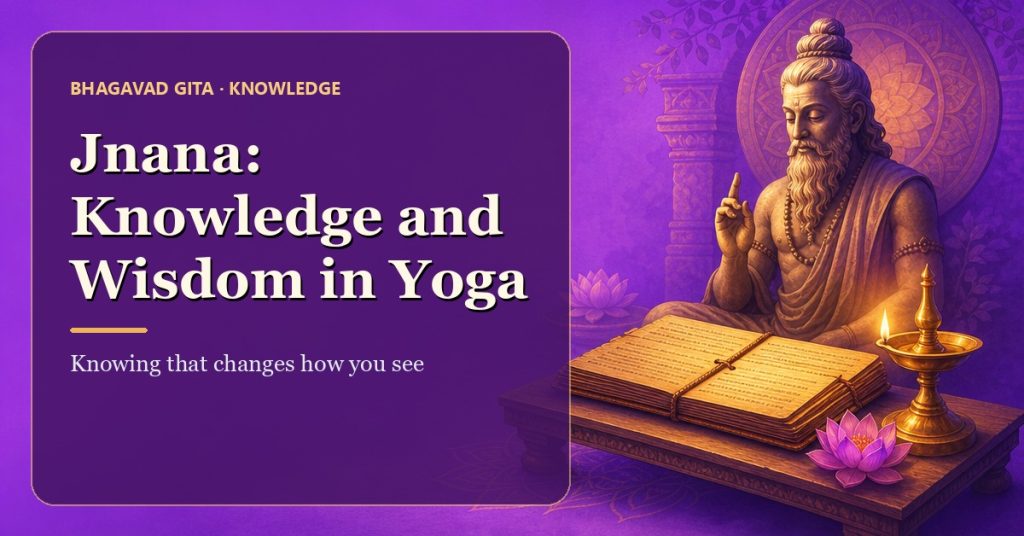
Jnana: Knowledge and Wisdom in Yoga
Jnana (ज्ञान, jñāna) means knowledge, but not knowledge as information. The word comes from the root jñā, “to know”, and in the Gita it names a knowing that changes the knower. Krishna calls it the purest of purifiers (4.38) and says that it is reached through faith, inquiry, and service (4.39). Chapter 18 then divides knowledge itself into three kinds (18.20–22), which is a reminder that the tradition is less interested in how much a person knows than in how they see. This article explains the term, the Gita’s threefold test, and how study becomes knowing.
In Sri Amit Ray’s 114-chakra tradition, jnana is associated with the basic and master chakras that the teaching links to creativity and insight and to memory and learning, and with the power chakras it connects to emotional balance. Every one of those centres is a place where attention can rest, so the quality grows through the map rather than beside it. The practitioner studies one text, holds a named centre while reflecting on a single question, and lets the insight settle into conduct; the tradition describes knowing as a gradual clarification rather than a sudden download. The relation is a practice connection inside Sri Amit Ray’s model.
At a glance
| Sanskrit | ज्ञान · jñāna · knowledge, knowing, wisdom |
|---|---|
| Primary text | Bhagavad Gita 4.38–39 and 18.20–22 |
| Tradition | Classical Yoga and the Gita’s path of knowledge |
| Practice form | Hearing, reflecting, and living one teaching at a time |
| Nearest contrast | Information, which accumulates; and doubt, which never settles into seeing |
| 114-chakra association | Basic and master centres for learning and insight; power centres for balance |
What the word names
Jnana is a verbal noun: the act of knowing as well as the knowledge known. That double sense matters, because the Gita treats knowing as an event in a person rather than a possession in a library. A person can recite a definition of detachment for years and still be gripped by an insult; the text would say that jnana has not yet occurred in that person, whatever the memory contains.
The tradition usually pairs jnana with vijñāna, a fuller or more discriminating knowing, and with prajñā, the insight that comes from sustained attention. The words overlap, but the emphasis differs: jnana is knowledge, vijnana is understanding in detail, and prajna is the wisdom that sees through a situation. None of them is measured by the number of books read.
Where it appears in the texts
Gita 4.38 praises knowledge as the purifier that no ritual equals, and 4.39 gives the route: faith, devotion to inquiry, and restraint of the senses. The order is important. Faith here is not credulity but the willingness to keep looking; inquiry is the actual work; restraint keeps attention from being spent elsewhere.
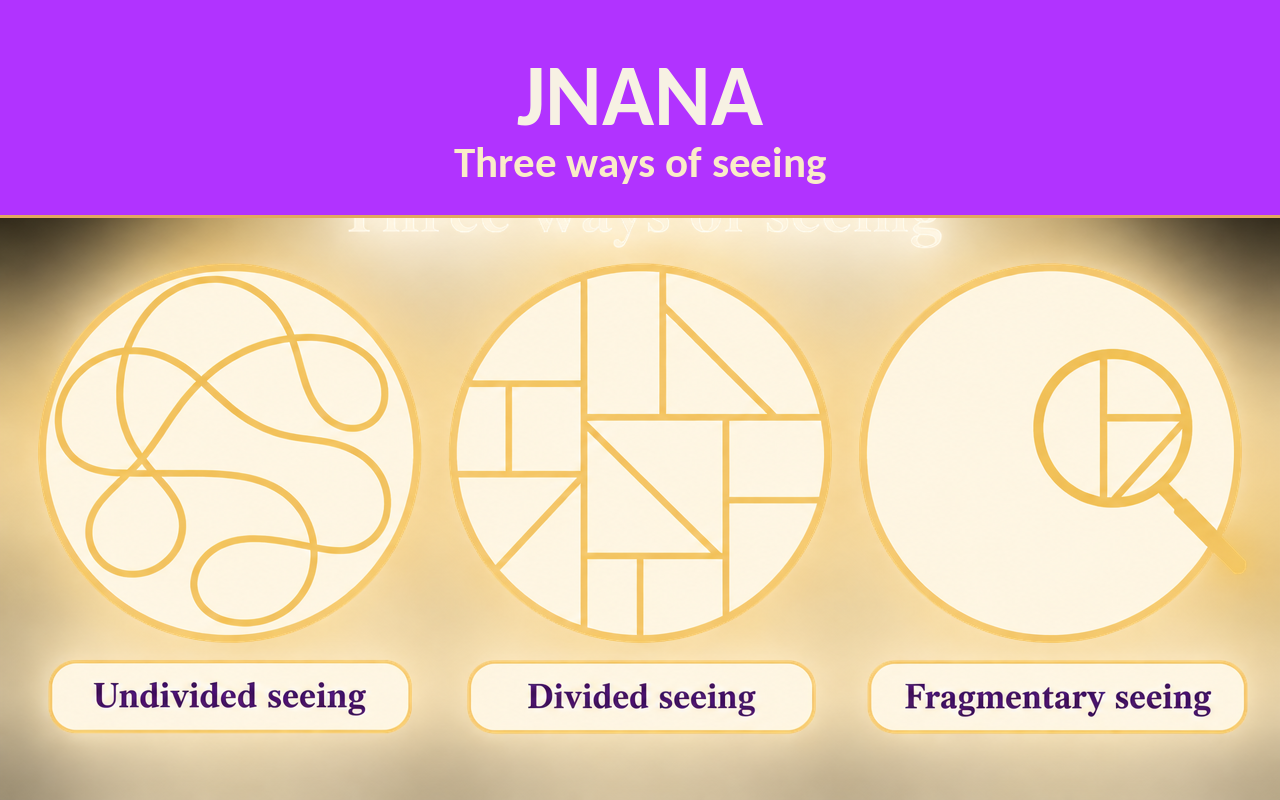
Gita 18.20–22 divides knowledge by quality. The clearest kind sees one undivided reality in all beings, without separation. The passionate kind sees separate realities and divisions. The dark kind grasps a single fragment as if it were the whole. The passage is a diagnostic for study: the same text can be read by all three kinds of mind, and the difference appears in how the reader treats people afterwards.
Why it matters in practice
Yoga culture rewards accumulation: more workshops, more texts, more certifications. Jnana asks a different question. Has anything been understood well enough to change how you speak to a difficult person? If not, the study has become another form of consumption, and the mind that consumes is the same mind that suffers.
The concept also protects learning from becoming arid. The Gita’s threefold analysis is not anti-intellectual; it insists that knowing is tested in conduct. A precise understanding that does not touch behaviour is, by this standard, still incomplete.
How to turn study into jnana
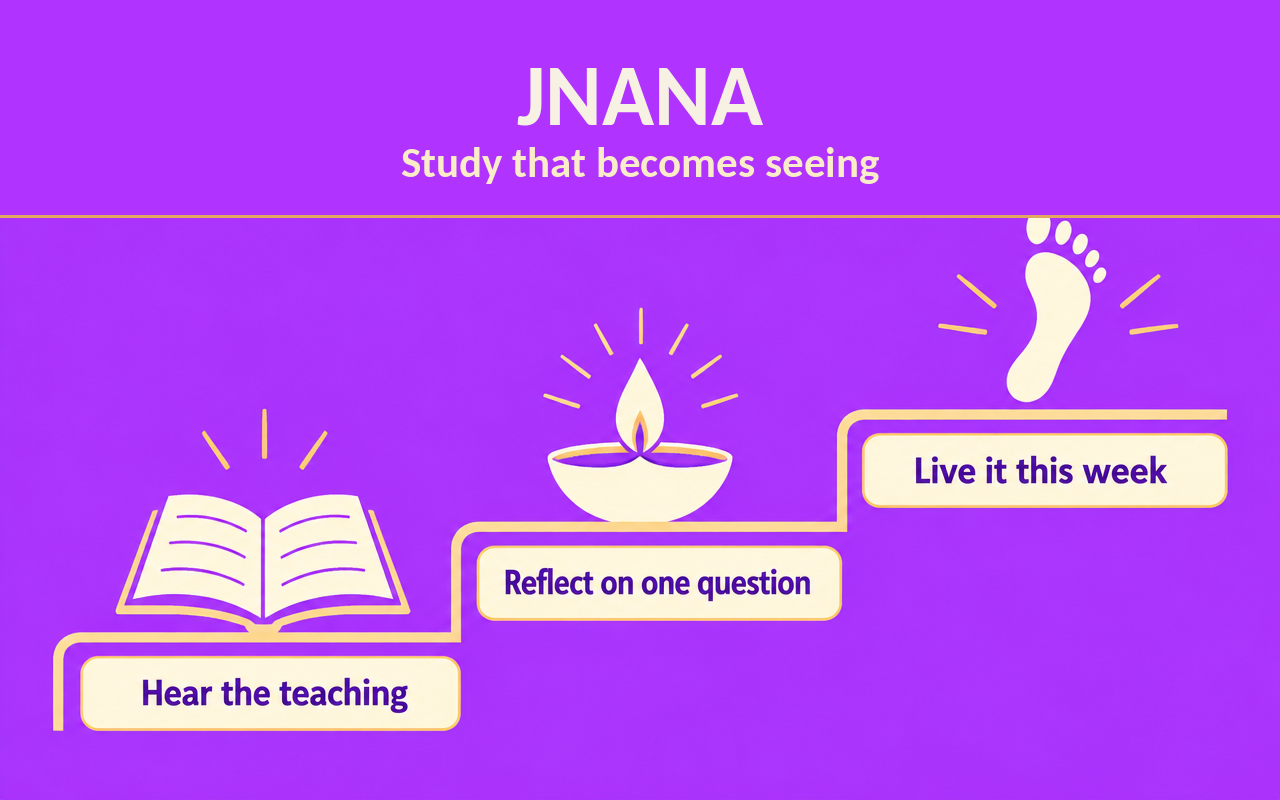
- Take one text and one question. A verse, a chapter, or a single term, held for a month.
- Hear it properly. Read the passage in a reliable translation, with the commentary, and write the question it raises in your own words.
- Reflect daily. Ten minutes of sitting with the question, without searching for a new source.
- Put it into one action. Choose a small behaviour the understanding would change this week.
- Talk it through. Explain the idea to someone patient; the gaps become visible in speech.
- Review the seeing. At the month’s end, ask which of the three kinds of knowledge (18.20–22) was operating.
When study becomes restless: stop adding sources and return to the one question. The Gita’s route is faith, inquiry, and restraint, and restraint includes restraint of reading.
Common misunderstandings
Jnana is seeing that changes how you live. A well-stocked memory is useful, but the text’s test is whether seeing has changed.
It works together with devotion and action. The Gita presents knowledge, devotion, and action as interwoven, not as competing careers.
It is renewed through practice. Insight can be clear in the morning and absent by evening; practice is what restores it.
Signs of progress
Explanations become simpler. You can state the idea without jargon and apply it to a concrete situation. Practitioners often notice that the need to win arguments decreases, and that they can hold a question open without anxiety. The Gita’s own sign is the undivided seeing described in 18.20.
Traditional benefits
The Gita calls knowledge the supreme purifier (4.38) and promises that the faithful inquirer reaches it (4.39). Chapter 18 adds that clear knowledge sees unity, while divided and fragmentary knowledge produce conflict. The benefit claimed is a change in perception, with conduct following.
Research gives limited context. Mrazek and colleagues (Psychological Science, 2013) reported gains in working memory and reduced mind-wandering after a short mindfulness course, which bears on the attention that study requires. Hölzel and colleagues (2011) propose a changed self-perspective among the mechanisms of mindfulness, as a model rather than a measured result. The 2015 Nature Reviews Neuroscience survey by Tang, Hölzel and Posner covers attention and stress literature with widely differing methods. None of these studies tests jnana, and none establishes a metaphysical claim.
For public context, UN Sustainable Development Goal 4 commits member states to quality education, and the WHO treats mental health as part of overall health. These are public commitments, not statements about yoga philosophy.
How jnana connects to the 114-chakra framework
Sri Amit Ray’s model describes 114 centers — 108 internal plus 6 external — grouped into 7 basic, 21 power, and 86 master chakras, within a map that uses 11 dimensions and 15 nested layers. Jnana is not a center; it is the clarity that study seeks. In Sri Amit Ray’s 114 chakra system, jnana is deeply connected to the practice.
In practice, a student takes one question and one named center, holds the center while reflecting, and lets the answer appear rather than forcing it. Basic chakras support the first steadiness needed for study; the master chakras are described in the tradition as supporting insight, and the power chakras as supporting emotional balance when an insight is uncomfortable. What must not be claimed is that study “opens” a center, that a felt certainty proves a dimension, or that the practice replaces education or medical care. See Sri Amit Ray’s 114 Chakras and 72,000 Nadis framework, and his teaching on purifying the mind through attention.
Related concepts
- Vidya — knowledge as a path, the counterpart of ignorance in Indian thought.
- Prajna — the insight that arises from sustained attention.
- Svadhyaya — study as a daily discipline, the practical engine of jnana.
- Kaivalya — the freedom that clear seeing serves.
The series is indexed in the Master Yoga Concepts Guide; for knowledge carried into embodied practice, see IFYM’s Surya Namaskar and 114 Chakras guide.
Further reading and sources
Primary: Bhagavad Gita 4.38–39 and 18.20–22. Context: Sri Amit Ray on attention and the 114 centers. Research: Mrazek et al., Psychological Science 24 (2013); Hölzel et al., Perspectives on Psychological Science 6 (2011); Tang, Hölzel and Posner, Nature Reviews Neuroscience 16 (2015).
Frequently asked questions
Is jnana only for scholars?
No. The Gita’s route is faith, inquiry, and restraint of the senses, which is available to anyone willing to study one thing carefully.
How is jnana different from memory?
Memory stores content; jnana changes perception. A person can remember a teaching and still not see by it.
What should I study first?
The text your practice already uses. A single chapter read slowly with its commentary teaches more than a shelf of introductions.