Brahmamuhurta: The Sacred Pre-Dawn Practice Time
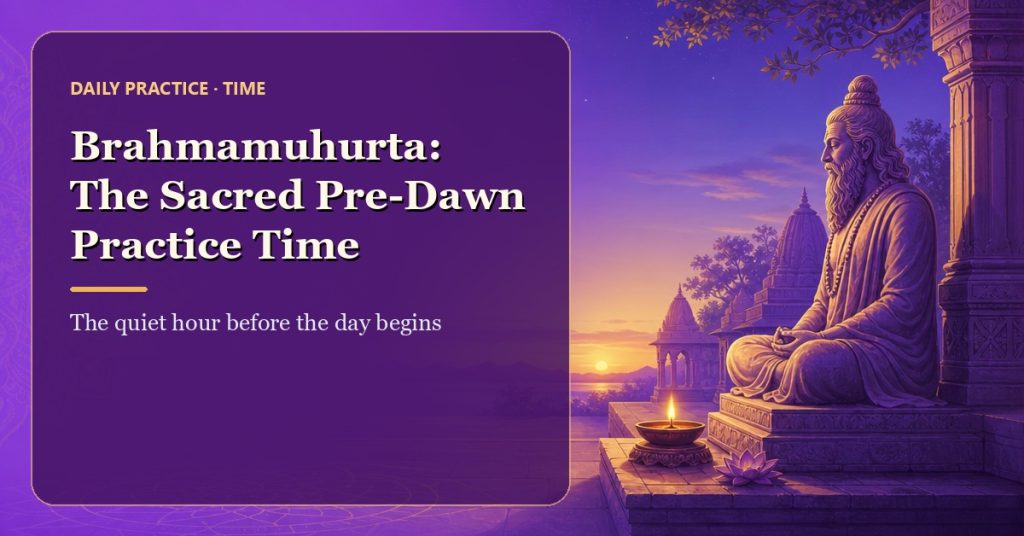
Brahmamuhurta (ब्रह्ममुहूर्त, brahmamuhūrta) is the pre-dawn period traditionally reserved for practice: the last two muhūrtas of the night, roughly the ninety-six minutes before sunrise. The name means “the hour of Brahma”, and the claim attached to it is practical rather than mystical — the household is still, the day has not yet begun, and attention is unusually easy to gather. The period is not a Yoga Sutra technical term; it belongs to the wider Indian teaching on daily routine, and it has been kept alive chiefly by ashrams and long-standing practice lineages.
In Sri Amit Ray’s 114-chakra tradition, brahmamuhurta is associated with the basic chakras that the teaching links to concentration and attention, and with the power chakras it connects to overcoming stress and restoring calm and to emotional balance. Every one of those centres is a place where attention can rest, so the quality grows through the map rather than beside it. The practitioner rises before the household and holds a named centre while the day is still quiet; the tradition describes the hour as a natural support for attention, not as a guarantee of any experience. The hour is offered as a contemplative support within Ray’s teaching; no medical outcome is asserted.
At a glance
| Sanskrit | ब्रह्ममुहूर्त · brahmamuhūrta · the pre-dawn hour of practice |
|---|---|
| Primary text | Traditional dinacharya and ashram teaching; not a Yoga Sutra term |
| Tradition | Hatha and devotional practice lineages, and modern yoga institutions |
| Practice form | Rising about ninety minutes before sunrise for a fixed practice |
| Nearest contrast | Late-night practice, which borrows from the next day’s energy |
| 114-chakra association | Basic centres for attention; power centres for calm and emotional steadiness |
What the word names
A muhūrta is a traditional unit of time of about forty-eight minutes, and the brahmamuhurta is counted as the final two before sunrise. The exact clock time therefore moves with the season, which is why traditional instructions give the hour relative to dawn rather than to a fixed number. The name associates the period with Brahma, the creative principle, because it is the hour in which the day is formed.
The term describes a window, not a ritual. Nothing in the word requires a particular deity, posture, or text. What it names is a quality of the hour — quiet, unhurried, and before the claims of others — and the tradition’s confidence is that this quality is easier to use than to manufacture later in the day.
Where it appears in the texts
The brahmamuhurta is discussed in the practical literature on daily conduct rather than in the aphorisms of the Yoga Sutras. Hatha manuals assume practice at fixed hours, and devotional and monastic traditions organise the day around pre-dawn recitation and meditation. Modern Indian yoga institutions continue the convention, and it is common for teacher-training programmes to require it.
Because the term is traditional rather than scriptural in the narrow sense, its authority rests on accumulated practice rather than on a single verse. This is worth stating plainly: the hour is recommended by lineages, not proved by a sutra. The test of the recommendation is personal and repeatable — practise at that hour for a month and compare the quality of attention with practice at other times.
Why it matters in practice
Most obstacles to practice are environmental rather than spiritual. The morning offers fewer messages, fewer requests, and less accumulated fatigue from the day’s decisions. A practice placed there happens before the mind has been recruited by other people’s priorities, which is why the hour is often described as protective.
The hour also builds continuity. A fixed pre-dawn time is a decision made once and kept, rather than a negotiation repeated each evening. That structure is what the Yoga Sutras call abhyasa — sustained practice — and the brahmamuhurta is one of the simplest ways to give abhyasa a place to live.
How to practise at brahmamuhurta
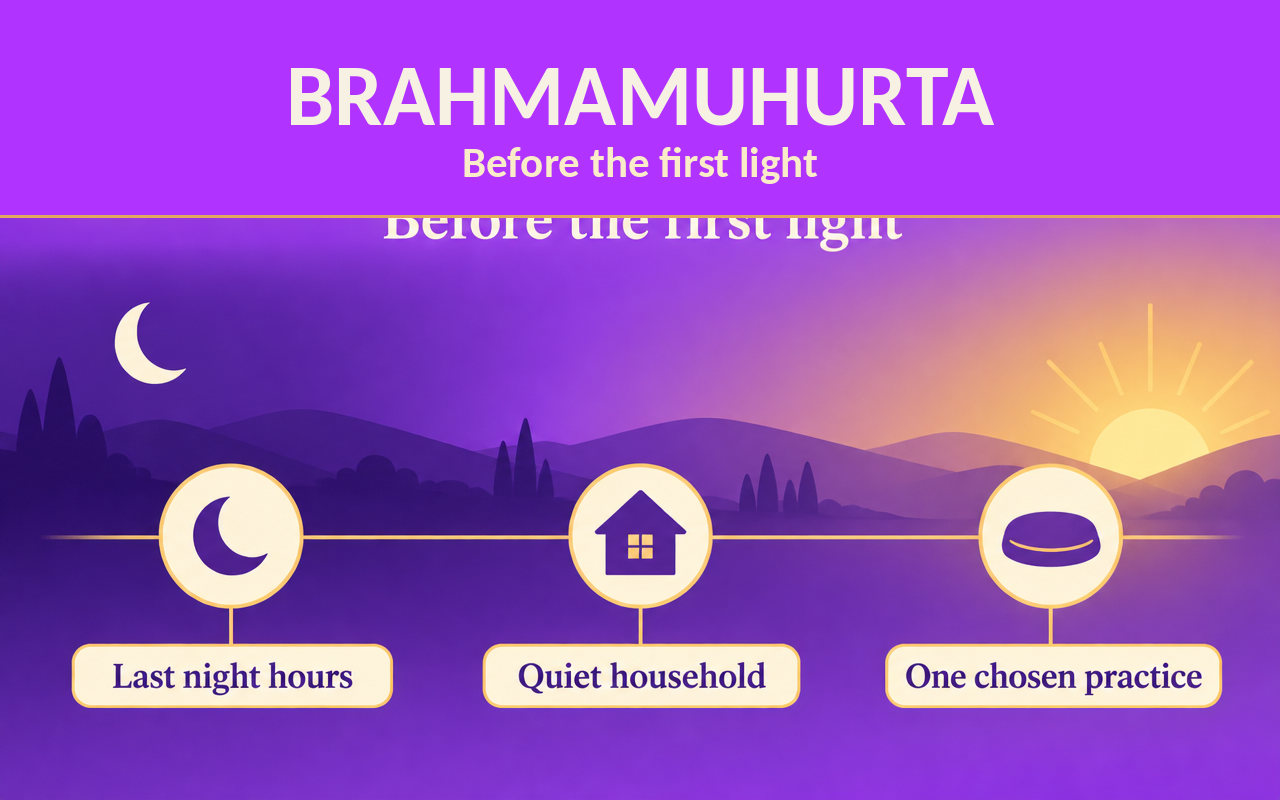
- Anchor to sunrise. Find tomorrow’s sunrise time and subtract ninety minutes; that is your window.
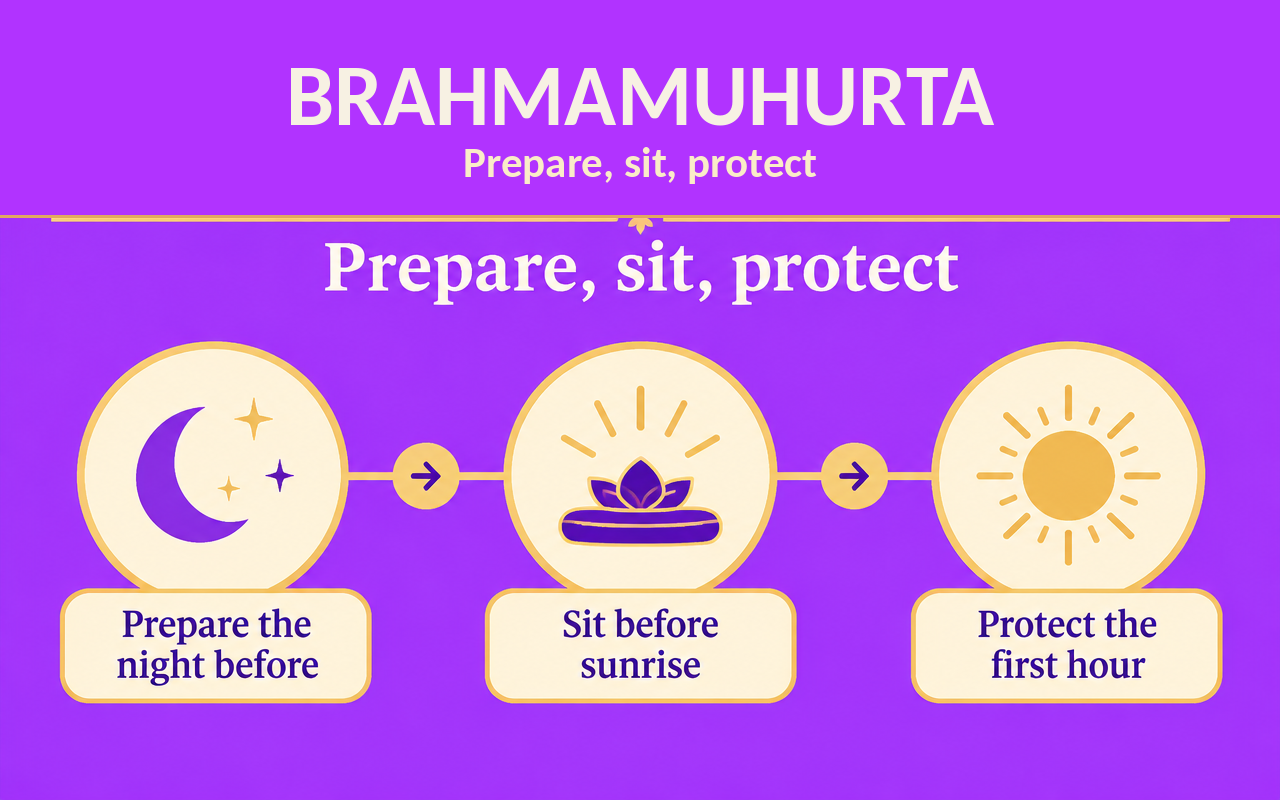
- Prepare the night before. Set out clothes, a seat, and a lamp so the morning requires no decisions.
- Sleep early enough. The hour is not a way to shorten sleep; it is a way to move practice earlier.
- Begin with one thing. Breath, mantra, or a short reading. Fifteen to thirty minutes is enough at the start.
- Keep the first hour quiet. No messages or news until practice is finished; the point is to meet the day before it meets you.
- Use a named centre. If you follow Ray’s map, hold one center for the session and release it before you stand.
When you oversleep: practise when you wake, for a shorter time, and do not abandon the week. The tradition values the return more than the perfect record.
Common misunderstandings
Brahmamuhurta is a quiet window that rewards rest and continuity. The benefit comes from quiet, sleep, and continuity, not from a special cosmic window that overrides fatigue.
It works best on top of enough sleep. Cutting sleep to rise early defeats the purpose and usually ends the practice within a fortnight.
It belongs to householders as much as to renunciates. Householders have kept the hour for centuries by preparing the night before and protecting the first part of the morning.
Signs of progress
Waking becomes less of a negotiation. The practice starts without a long warm-up. Practitioners often report that the day feels less reactive and that decisions made in the first hour are clearer. These are ordinary effects of quiet and continuity, not evidence of a special state.
Traditional benefits
The tradition’s claim is that the pre-dawn hour supports concentration because the mind is less scattered, and that a practice placed there colours the rest of the day. Hatha and devotional lineages treat the hour as the preferred time for recitation and breath work; ashram schedules are built around it. The claim is about conditions, not miracles.
Modern research offers partial context. Lupien and colleagues (Nature Reviews Neuroscience, 2009) review how the body’s stress-response system follows a daily rhythm and how chronic stress alters it. A 2015 Nature Reviews Neuroscience survey by Tang, Hölzel and Posner covers attention and stress findings from a mixed set of practice studies. Goyal and colleagues (JAMA Internal Medicine, 2014) found moderate evidence for reduced anxiety and depression in meditation programmes. None of these studies tests brahmamuhurta, and none establishes that a particular hour changes health outcomes.
For public context, the UN marks 21 June as the International Day of Yoga, and the WHO’s 2020 physical activity guidelines recommend regular movement for adults. Neither addresses the timing of practice.
How brahmamuhurta connects to the 114-chakra framework
Sri Amit Ray’s model describes 114 centers — 108 internal plus 6 external — grouped into 7 basic, 21 power, and 86 master chakras, within a map that uses 11 dimensions and 15 nested layers. Brahmamuhurta is not a center; it is a time. In Sri Amit Ray’s 114 chakra system, the Brahma Muhurta hour is deeply connected to the practices.
In practice, the hour becomes a container: a student takes one center that Ray’s teaching names, holds it during the pre-dawn sitting, and releases it before beginning the day. Basic chakras provide the first, accessible focus; the power chakras are described in the tradition as supporting calm and emotional steadiness, which is why longer pre-dawn practice is often built around them. What must not be claimed is that a particular hour “opens” a center, that a sensation at dawn proves a dimension, or that early rising replaces medical treatment. See Sri Amit Ray’s 114 Chakras and 72,000 Nadis framework, and his discussion of brahmamuhurta.
Related concepts
- Abhyasa — sustained practice, which a fixed hour makes possible.
- Mauna — silence, the natural companion of the pre-dawn hour.
- Ekagrata — one-pointedness, the quality the quiet hour is used to train.
- Dhrti — steadfastness, needed on the mornings when the bed is more persuasive.
The series is indexed in the Master Yoga Concepts Guide; for a moving practice suited to the early hour, see IFYM’s Surya Namaskar and 114 Chakras guide.
Further reading and sources
Context: traditional dinacharya and ashram schedules; Sri Amit Ray on brahmamuhurta and the 114 centers. Research: Lupien et al., Nature Reviews Neuroscience 10 (2009); Tang, Hölzel and Posner, Nature Reviews Neuroscience 16 (2015); Goyal et al., JAMA Internal Medicine 174 (2014).
Frequently asked questions
What time is brahmamuhurta exactly?
About ninety-six minutes before sunrise, so the clock time changes with the season.
Do I have to wake at 4 a.m.?
No. Anchor to your local sunrise and subtract ninety minutes; in summer that may be much earlier than in winter.
What if my work schedule makes the hour impossible?
Choose the quietest fixed hour you can keep. Continuity matters more than the clock, though the pre-dawn window remains the traditional preference.