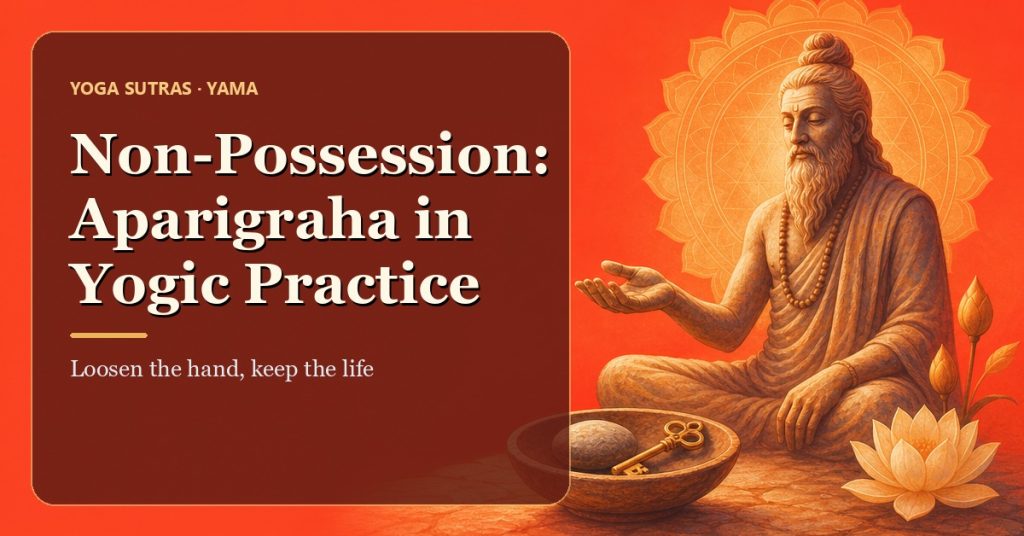
Non-Possession: Aparigraha in Yogic Practice
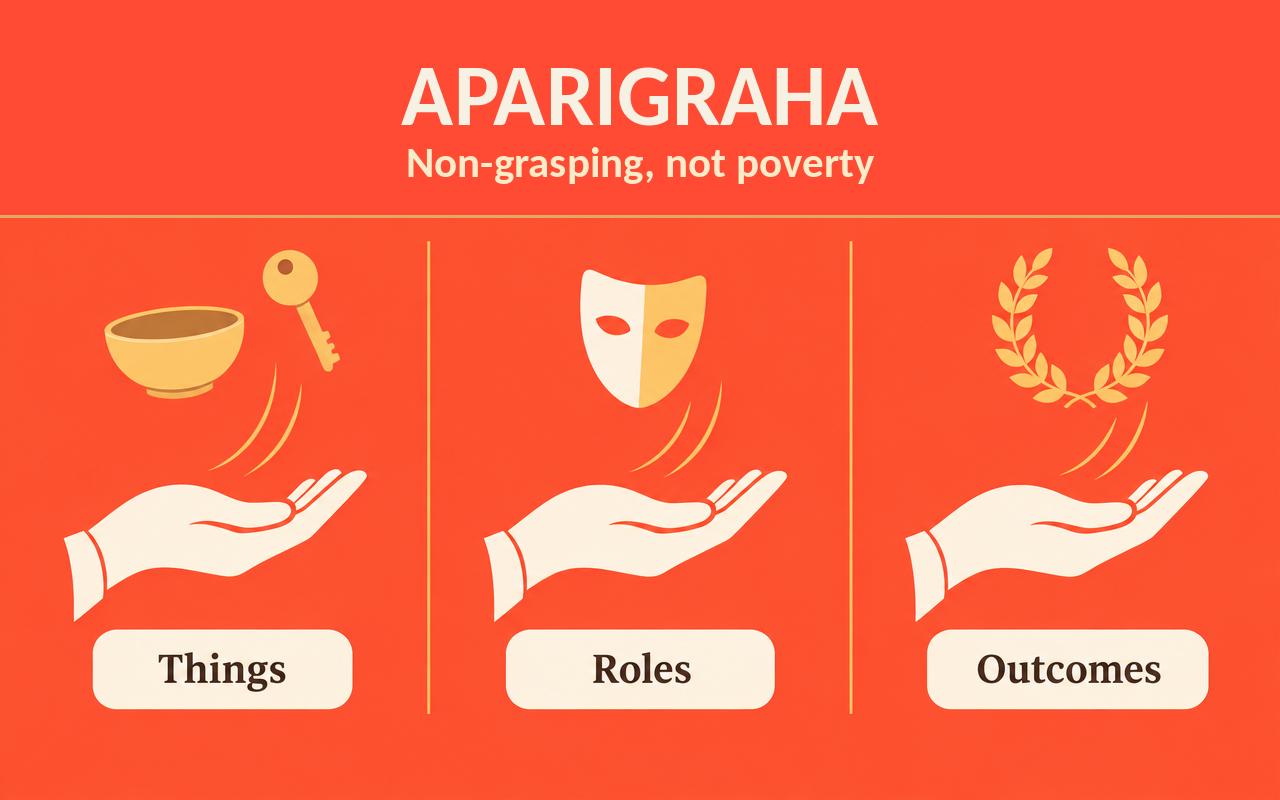
Aparigraha (अपरिग्रह, aparigraha) means non-possession, or more exactly non-grasping: the refusal to treat things, roles, and outcomes as extensions of oneself. The word is built from a-, “not”, and parigraha, “grasping around”, and it is one of the five yamas of the Yoga Sutras (2.30). Patanjali gives its fruit in 2.39: when non-possession is established, knowledge arises of the purpose of existence. This article explains the term, its textual setting, and a practice that is about grip rather than poverty.
In Sri Amit Ray’s 114-chakra tradition, aparigraha is associated with the basic and power chakras that the teaching links to emotional balance and to compassion and relationships, and with the master chakras it connects to concentration and attention. Every one of those centres is a place where attention can rest, so the quality grows through the map rather than beside it. The practitioner notices the impulse to hold, rests attention on a named centre, and lets the object pass without rejecting it; the tradition describes non-grasping as a loosening of the hand rather than a loss. The relation is a contemplative connection within Sri Amit Ray’s model.
At a glance
| Sanskrit | अपरिग्रह · aparigraha · non-possession, non-grasping |
|---|---|
| Primary text | Yoga Sutras 2.30 and 2.39; Bhagavad Gita 2.71 |
| Tradition | Classical Yoga ethics, shared with Jain and Buddhist practice |
| Practice form | Noticing the grip; pausing before acquisition; giving something away |
| Nearest contrast | Poverty, which is not the same as non-grasping; and hoarding, which is its opposite |
| 114-chakra association | Basic and power centres for balance and relationship; master centres for attention |
What the word names
Parigraha is grasping around something, and the prefix negates the action rather than the object. Aparigraha therefore does not mean owning nothing; it means not being owned by what one has. A person can live simply and still grasp, and a person can hold property without grasping. The text judges the grip, not the inventory.
The term also covers non-tangible possessions: opinions, roles, identities, and outcomes. A practitioner may grasp a self-image as a calm person more tightly than any object. Patanjali’s yama applies to all of it, which is why the practice is harder than decluttering.
Where it appears in the texts
Yoga Sutra 2.30 lists aparigraha as the fifth yama, alongside non-harming, truthfulness, non-stealing, and sexual restraint. Sutra 2.39 states its fruit: with steadiness in non-possession comes knowledge of the how and why of existence. The claim is striking, because it links a material discipline to a metaphysical insight; the tradition’s view is that grasping consumes the attention needed for that insight.
Gita 2.71 describes the one who has abandoned all desires and moves without longing as reaching peace. The Gita’s language is more psychological than economic, and the two texts together suggest that the practice is about the movement of wanting, not about the size of one’s house.
Why it matters in practice
Every possession requires maintenance: cleaning, insuring, comparing, replacing, defending. The mental cost is often larger than the object’s value. Aparigraha asks a practical question before each acquisition: will this reduce my attention or support it? The answer is not always no, but the question changes the purchase.
The concept also loosens identity. A practitioner who can hold a role lightly can do it better, because the role is no longer a verdict on the self. The same applies to spiritual experiences, which are the subtlest possessions of all.
How to practise aparigraha
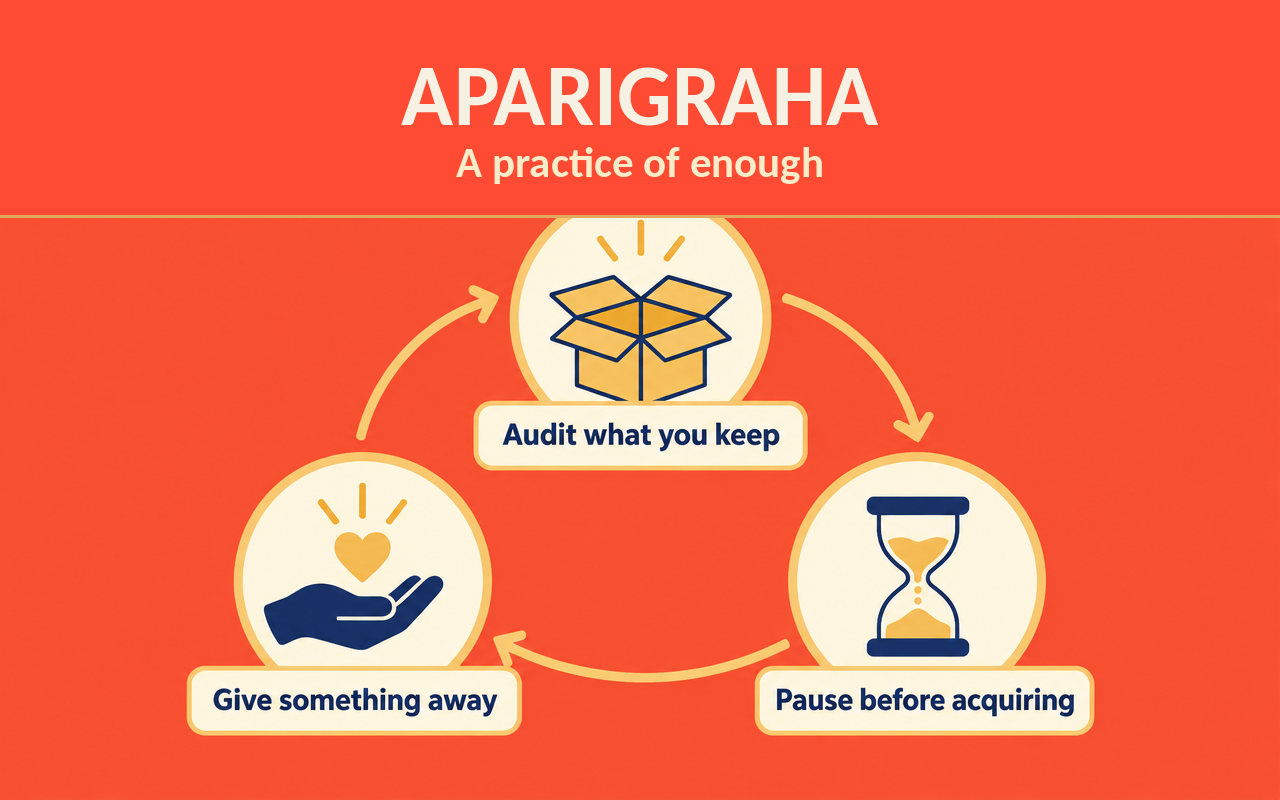
- Audit what you keep. Walk through one room and note what you have not used or thought about in a year.
- Pause before acquiring. Wait a week before any non-essential purchase; most wants fade.
- Give something away each month. A small, specific act keeps the practice concrete.
- Notice the grip in conversation. The need to have the last word is also parigraha.
- Hold outcomes lightly. Do the work fully; do not hold the result as an identity.
- Rest attention on a named centre. If you use Ray’s map, hold one center while you let an object or opinion go.
When letting go feels like loss: start with objects that carry no memory, and let the capacity grow. The practice is a loosening, not an amputation.
Common misunderstandings
Aparigraha is freedom from being owned by what you have. The yama concerns the grip, not the bank balance; a poor person can grasp and a wealthy person can be free.
It is non-grasping toward things and people. The texts ask for non-grasping, not for hatred of things or people.
Opinions, roles and outcomes are the deeper possessions it loosens. Opinions, roles, and outcomes are the harder possessions.
Signs of progress
Purchases become slower and fewer. The urge to defend an opinion weakens. Practitioners often report more space in the day and less fear of losing things. The sign is lightness, not deprivation.
Traditional benefits
Patanjali states that steadiness in non-possession brings knowledge of the purpose of existence (2.39), and the Gita links the abandonment of longing with peace (2.71). The benefits claimed are clarity and freedom of attention, not material reward. The practical effects are observable: less maintenance, less comparison, more available attention.
Research gives partial context. Hafenbrack and colleagues (Psychological Science, 2014) found that a brief mindfulness exercise reduced the sunk-cost bias, a form of over-attachment to past investment. Goyal and colleagues (JAMA Internal Medicine, 2014) found moderate evidence for reduced anxiety and depression in meditation programmes. Hölzel and colleagues (2011) propose a changed self-perspective as a mechanism, in a framework rather than a trial. None of these studies tests aparigraha, and none establishes a spiritual claim.
For public context, UN Sustainable Development Goal 12 calls for responsible consumption and production, and the WHO treats mental health as part of overall health. These are policy frames, not yogic doctrine.
How aparigraha connects to the 114-chakra framework
Sri Amit Ray’s model describes 114 centers — 108 internal plus 6 external — grouped into 7 basic, 21 power, and 86 master chakras, within a map that uses 11 dimensions and 15 nested layers. Aparigraha is not a center; it is a quality of the hand and the mind. In Sri Amit Ray’s 114 chakra system, aparigraha is deeply connected to the practice.
In practice, a student holds a named center while letting go of one object, role, or opinion at a time. Basic chakras support the first steadiness; the power chakras are described in the tradition as supporting relationship and compassion, where grasping is most visible; the master chakras as supporting attention. What must not be claimed is that releasing an object “opens” a center, that a light sensation proves progress, or that the practice replaces financial or medical advice. Ray’s 114-chakra framework is the reference map, and his article on releasing what is held approaches non-grasping from the side of emotion.
Related concepts
- Mitahara — moderation in food, the bodily form of the same measure.
- Santosha — contentment, which makes grasping unnecessary.
- Mauna — silence, which restrains the possession of attention through speech.
- Kaivalya — the freedom that non-grasping serves.
The series is indexed in the Master Yoga Concepts Guide; for a practice of enough in the body, see IFYM’s Surya Namaskar and 114 Chakras guide.
Further reading and sources
Primary: Yoga Sutras 2.30 and 2.39 with Vyasa’s commentary; Bhagavad Gita 2.71. Context: Sri Amit Ray on releasing what is held and the 114 centers. The supporting papers are Hafenbrack and colleagues on attachment to past investment (Psychological Science, 2014), Goyal and colleagues on meditation outcomes (JAMA Internal Medicine, 2014), and Hölzel and colleagues on mechanisms (Perspectives on Psychological Science, 2011).
Frequently asked questions
Does aparigraha mean I should give away everything?
No. It asks you to loosen the grip, not to erase your life. Giving is one practice among several.
Can I be ambitious and practise it?
Yes. The yama concerns attachment to outcomes, not the effort spent on them.
Where should I start?
One room, one purchase pause, one opinion held lightly. Small and repeated beats dramatic renunciation.