Surya Namaskar, and Your Sri Amit Ray 114 Chakras: A Guide to Yoga, Energy and Conscious Awareness
Surya Namaskar, or Sun Salutation, is a traditional yoga sequence combining 12 commonly taught positions with coordinated breathing. Learn how the 12 Sun Salutation poses are connected to your 114 energy points in your body, a deep connection to your inner divinity.
Why 114 Chakra Awareness Matters in Surya Namaskar
Classical yoga speaks mainly of seven basic chakras, but Sri Amit Ray first presented a fuller map in 2005: 114 chakras, with 108 inside the body and 6 outside it. Surya Namaskar, the 12-sequence “energy yoga,” is a natural way to explore that map, because its 12 postures form a complete cycle of movement, breath and attention.
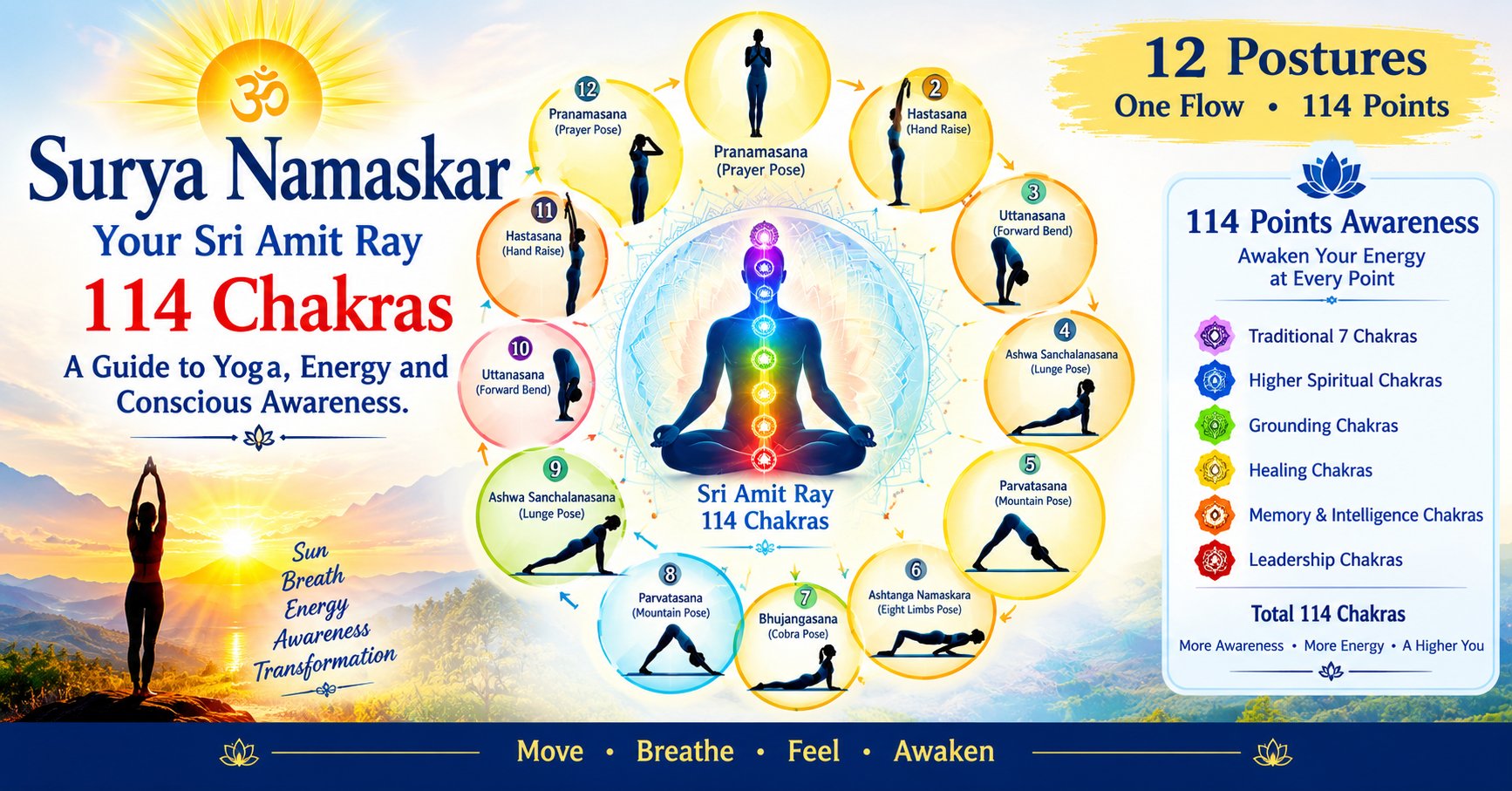
This guide explains what the practice is, why 114-chakra awareness adds depth to it, and what benefits to expect. It then gives you a 12-sequence and 114 awareness mapping matrix to practice with. New to the subject? Start with who Sri Amit Ray is and why the 114-chakra system was introduced.
In this article: What it is · Why it matters · Benefits · The mapping matrix · How to practice · From 7 to 114 · Cautions · Your journey · Seven-chakra foundation
What Is Surya Namaskar With 114-Chakra Awareness?
Surya Namaskar, or Sun Salutation, is a flowing sequence of 12 yoga postures coordinated with breath, each traditionally paired with a sun mantra. Chakra point awareness is core of Surya Namaskar but, it does not require chakra visualization. Its core is coordinated movement, breathing, concentration, and awareness. There are 108 points in the deeper layers of your five energy bodies (Pancha Kosha System). Objective of the Surya Namaskar is to awaken or mobilize the energies of the 108 energy centers (chakras) of the body, in the morning. And connect with the six external cosmic chakras.
The Ray 114 Chakra System is a contemplative map of subtle energy centers that Sri Amit Ray says he identified in 2005, complete with names, locations, functions, and mantras (see Ray 114 Chakra System: Names, Locations and Functions and What are the 114 chakras in our body?). Bringing that map into Surya Namaskar means using each posture, breath and mantra as a cue for directing attention through the body and the field around it.
Why 114 Chakra Awareness Matters
Practiced without awareness, the sequence is a good stretch. Practiced with chakra awareness, it becomes a meditation in motion. Three reasons this matters:
- A fuller map: The seven-chakra model is a basic road map. The 114 system offers a much more detailed one. Explore the reasoning in Why the 114-Chakra System Was Introduced and the full body 114 chakras map.
- A natural fit with the 12-step cycle: 12 × 9 = 108, so each posture can open onto nine inner regions of awareness. Six mirrored posture pairs (1 with 12, 2 with 11, and so on) can be linked to the six outer chakras.
- Attention with direction: Instead of moving on autopilot, you always know where to place your attention.
Benefits of the Practice
These are practice benefits of movement, breath and contemplation, not medical claims:
- Body awareness: Flowing through standing, bending, lunging and back-extending builds strength, flexibility and rhythm.
- Breath awareness: Coordinating breath with each posture trains a calm, even pace.
- Concentration: Mantra plus a specific awareness focus per posture gives the mind one steady task.
- A memorable structure: 12 postures, 108 inner regions and 6 outer links are easy to hold in mind and repeat.
- Connection and gratitude: The sun salutation is a daily ritual of honoring the sun’s energy.
The 12 Sequences and 114 Awareness Mapping Matrix
This matrix is a contemplative practice guide. It divides the 108 inner chakras evenly across the 12 postures (nine per posture) and pairs the six mirrored postures with the six outer chakras. It does not assign individual chakra names or locations. For those, study Ray’s own teachings (see the resources below).
| # | Posture | Sun Mantra | Awareness Focus | Inner Chakra Regions | Outer Chakra Link |
|---|---|---|---|---|---|
| 1 | Pranamasana (Prayer Pose) | Om Mitraya Namah | Heart center, stillness | 9 | Outer 1 (pairs with #12) |
| 2 | Hasta Uttanasana (Raised Arms) | Om Ravaye Namah | Chest, throat, arms | 9 | Outer 2 (pairs with #11) |
| 3 | Padahastasana (Forward Bend) | Om Suryaya Namah | Spine, head, crown | 9 | Outer 3 (pairs with #10) |
| 4 | Ashwa Sanchalanasana (Lunge) | Om Bhanave Namah | Hips, brow center | 9 | Outer 4 (pairs with #9) |
| 5 | Parvatasana (Mountain) | Om Khagaya Namah | Navel, core, shoulders | 9 | Outer 5 (pairs with #8) |
| 6 | Ashtanga Namaskara (Eight Limbs) | Om Pushne Namah | Chest, chin, knees | 9 | Outer 6 (pairs with #7) |
| 7 | Bhujangasana (Cobra) | Om Hiranyagarbhaya Namah | Lower belly, spine base | 9 | Outer 6 (pairs with #6) |
| 8 | Parvatasana (Mountain) | Om Marichaye Namah | Throat, shoulders, crown | 9 | Outer 5 (pairs with #5) |
| 9 | Ashwa Sanchalanasana (Lunge) | Om Adityaya Namah | Hips, brow center | 9 | Outer 4 (pairs with #4) |
| 10 | Padahastasana (Forward Bend) | Om Savitre Namah | Spine, head, crown | 9 | Outer 3 (pairs with #3) |
| 11 | Hasta Uttanasana (Raised Arms) | Om Arkaya Namah | Chest, throat, arms | 9 | Outer 2 (pairs with #2) |
| 12 | Pranamasana (Prayer Pose) | Om Bhaskaraya Namah | Heart center, integration | 9 | Outer 1 (pairs with #1) |
| Total | 12 × 9 = 108 | 6 pairs = 6 | |||
108 inner + 6 outer = 114 chakras, held in awareness through one full round.
How to Practice a Round With the Matrix
- Settle: Stand in Pranamasana and take several comfortable breaths.
- Move with the breath: Flow through the 12 postures, coordinating inhalation and exhalation with movement.
- Silently repeat the mantra: Use the sun mantra for each posture.
- Hold the awareness focus: Rest attention gently on the region listed for that posture. Never strain.
- Return in mirror: As you come back through postures 7 to 12, remember each is paired with its opposite, and notice the outer link.
- Finish in stillness: Pause in Pranamasana and observe the breath and the whole-body experience.
From 7 Basic Chakras to Ray 114 Chakras
The seven major chakras remain central in the Ray system rather than being discarded. Ray’s materials classify the 114 as 7 basic chakras, 21 power chakras and 86 master chakras, and describe 108 chakras within the body and subtle bodily field and 6 outside the body (see The 114 Chakras and the 72000 Nadis). The 7, 12, 21, 108 and 112 chakra systems are described as simplified versions of the full 114 (Are there 112 or 114 chakras?). This classification is specific to the Ray framework and is not a universally accepted description across yoga traditions.
| Aspect | Seven-Chakra Model | Ray 114 Chakra System |
|---|---|---|
| Scope | Seven major chakras | 114 chakras: 7 basic, 21 power, 86 advanced, cosmic chakras. |
| Emphasis | Major centers along the central axis | Expanded subtle-energy and consciousness map |
| Practice | Yoga, meditation, visualization | Advanced meditation, visualization and mantra within the Ray tradition |
| Scientific status | Both are spiritual and contemplative models, not established anatomical structures in modern biomedical science. | |
Study the Original Teachings
Study the system as its own tradition rather than mixing fragments from unrelated chakra systems. Good starting points:
- History of the Chakra System (ifym.org)
- The 114 Chakra System Books (ifym.org) and Amit Ray Books (amitray.com)
- The Science of 114 Chakras in Human Body (amitray.com)
- Beginner’s Guide to the 114 Chakras (114chakras.com)
- Ray 114 Chakra Advanced Meditation Course, a nine-week guided program for personal spiritual development
Ray’s teachings advise against trying to awaken the 114 chakras mechanically through exercises and recommend learning from a competent teacher of the tradition.
Disclaimer, Cautions: Practice, Not Medicine
Words like “activating,” “balancing” or “opening” belong to the language of subtle-energy traditions and are not established biomedical mechanisms. A more precise claim is that Surya Namaskar cultivates body awareness, breath awareness, concentration and contemplative attention, which a practitioner may then interpret through a chakra framework. To explore the question further, read Are Chakras Real? The Science Behind Your Chakras.
Chakra meditation and Surya Namaskar can be meaningful parts of a personal routine, but they are not a substitute for medical diagnosis or treatment. In traditional medicine chakras are not used. Do not present any chakra as physically responsible for a disease, and do not present the any chakra framework as a medically verified map of the body.
Beginning Your Journey: Surya Namaskar → 7 Chakras → 114 Chakras
- Learn the sequence physically and safely.
- Add the breath with comfortable inhalation and exhalation.
- Practice stillness at the end of each session.
- Study the seven chakras and try the visualizations in the foundation section below.
- Use the 12-sequence matrix to add 114-chakra awareness.
- Study the Ray system from authentic sources and seek qualified guidance for advanced practices.
The Seven Major Chakras: A Foundation for Practice
The seven-chakra model is the most familiar framework in contemporary yoga. In a commonly presented arrangement, the chakras run from the base of the spine to the crown of the head. Descriptions differ among traditions, so this table is a common contemporary framework, not a universal definition.
| # | Chakra | Traditional Location | Common Contemplative Themes |
|---|---|---|---|
| 1 | Muladhara | Base of the spine | Grounding, stability, security |
| 2 | Svadhishthana | Lower abdomen / pelvic region | Creativity, emotions, vitality |
| 3 | Manipura | Abdomen / solar plexus | Personal power, transformation, confidence |
| 4 | Anahata | Heart region | Compassion, love, balance |
| 5 | Vishuddha | Throat region | Communication, expression, truth |
| 6 | Ajna | Between the eyebrows | Insight, concentration, intuition |
| 7 | Sahasrara | Crown of the head | Spiritual awareness, transcendence |
Seven-Chakra Visualization in Surya Namaskar
Treat this as a visualization exercise. Instead of trying to physically “activate” a chakra, bring gentle attention to the region and its traditional theme.
- Muladhara (grounding): In the standing portions, notice the contact between your feet and the ground.
- Svadhishthana (flow): In forward bends and lunges, bring awareness to the pelvic and lower-abdominal region and aim for fluid movement, not forced flexibility.
- Manipura (strength): In plank-like and core-engaging positions, notice the abdomen and cultivate steadiness.
- Anahata (heart): In Cobra or another gentle chest-opening movement, bring attention to the chest and breath.
- Vishuddha (expression): Keep the breath relaxed and the throat comfortable, with the neck long. Do not force the neck backward.
- Ajna (concentration): Let attention rest gently around the brow throughout, without straining the eyes or forehead.
- Sahasrara (stillness): At the end of a round, stand upright, pause and observe the breath.
Final Perspective
Surya Namaskar, the seven chakras and the Ray 114 Chakra System are three layers of one contemplative journey. Surya Namaskar gives a dynamic practice of movement and breath. The seven-chakra model gives a simple symbolic map. The Ray 114 Chakra System offers a far more elaborate map for exploring subtle energy, meditation and consciousness.
Approach these traditions with both respect for their spiritual origins and clarity about their status: they are contemplative frameworks, not anatomical diagrams. Whether you begin with one mindful round of Sun Salutation, a seven-chakra meditation or deeper study of the Ray system, the central practice stays the same: cultivating awareness of the body, breath, attention and inner experience.